


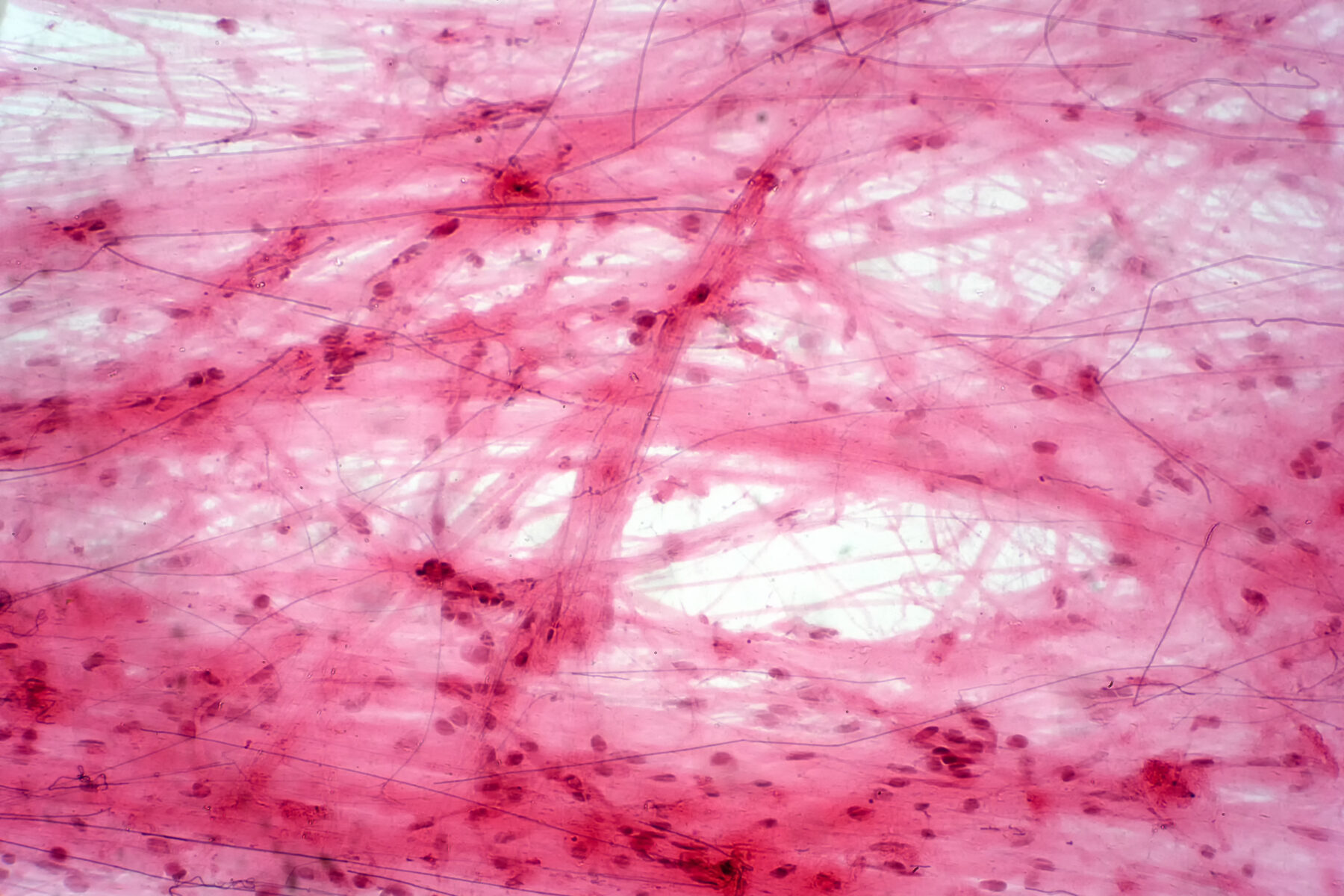
Our lab was interested in understanding whether breast cancer cells could use ECM components in a similar way to support their growth. We found that, while the presence of the ECM did not affect the proliferation of breast cancer cells when nutrients were not limited, it strongly promoted their growth under amino acid starvation. The cancerous cells internalise ECM components, degrade them in the lysosome, which results in increased intracellular amino acid levels.
We hypothesised that, to be able to feed on an unconventional nutrient source, cancer cells might adapt their metabolic pathways. Using metabolomics, we discovered that the most upregulated pathway in the presence of ECM was phenylalanine and tyrosine catabolism, leading to the production of fumarate, a Krebs cycle intermediate.
As with so many discovery science findings around cancer, the question then became: could this represent a cancer vulnerability? Importantly, the presence of ECM did not affect the proliferation of non-cancerous mammary epithelial cells, whereas ECM uptake was strongly upregulated in invasive and metastatic breast cancer cells. Excitingly then, this does suggest that ECM-dependent cell growth could indeed be a cancer vulnerability.
Journey to exploitation
To exploit this, we need to fully understand how ECM uptake is regulated. To this end, we performed an RNAi screen targeting ~1000 kinases and phosphatases in the genome and we identified the p38/mitogen activated protein kinase (MAPK) pathway as one of the top hits.
Interestingly, this pathway has been shown to be activated by the ECM receptor α2β1 integrin and we demonstrated that both α2β1 and MAPK signalling were required for ECM internalisation not only in breast cancer cells, but also in ovarian and pancreatic cancer cells.
In addition to cell proliferation, ECM uptake was also required for invasive cancer cell migration, both in 2D and 3D systems, raising the intriguing possibility that ECM internalisation and degradation might lead to the generation of energy required to sustain cell migration.
In addition to amino acids, the tumour microenvironment is also depleted of glucose, a key nutrient to sustain cell metabolism. We wanted to determine whether the ECM also supported cell growth under glucose starvation. Interestingly, while we found that this was indeed the case in both breast and pancreatic cancer cell lines, ECM uptake was not required for this. In this context, integrin-dependent mammalian target of rapamycin complex 1 (mTORC1) activation and amino acid uptake were required for ECM-dependent cell survival, in 2D and 3D culture systems.
So, while there is more work to do to fully understand the complexities here, these observations do suggest that the ECM plays multiple roles in supporting cancer cells within fibrotic tumours. It’s likely that tumours experience regional differences in nutrient availability, so I envisage that a combination approach will be needed to block the different nutrient scavenging pathways utilising the ECM to prevent the growth and migration of cancer cells within fibrotic tumours.
