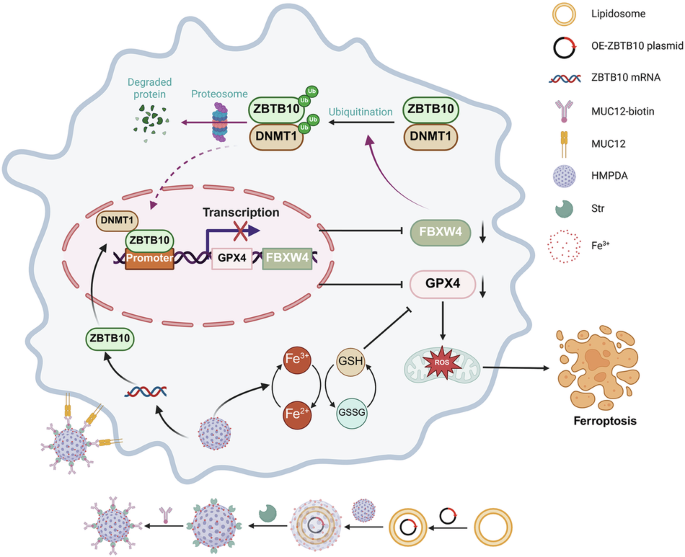
Clear cell renal cell carcinoma (ccRCC) is a common urological malignancy with limited therapeutic options for advanced disease. Aberrant DNA methylation and dysregulated ferroptosis have both been implicated in ccRCC progression, yet the mechanisms connecting these processes remain incompletely defined. Here, we identify ZBTB10 as a suppressor of ccRCC progression that transcriptionally represses GPX4, a central inhibitor of ferroptosis. Mechanistically, ZBTB10 recruits DNMT1 to the GPX4 promoter, thereby increasing promoter methylation and silencing GPX4 expression. We further define a self-regulatory ZBTB10/DNMT1/FBXW4 loop that maintains this epigenetic state. FBXW4 acts as an E3 ubiquitin ligase that promotes DNMT1 degradation and directly ubiquitinates ZBTB10 to reduce its stability. In turn, ZBTB10 recruits DNMT1 to the FBXW4 promoter, increases promoter methylation, and suppresses FBXW4 transcription. This self-regulatory circuit stabilizes both ZBTB10 and DNMT1, sustains low GPX4 expression, and promotes ferroptosis in ccRCC cells, as evidenced by increased lipid peroxidation and reactive oxygen species accumulation. Together, these findings reveal an epigenetic mechanism linking ZBTB10 to ferroptosis in ccRCC and suggest that targeting the ZBTB10/DNMT1/FBXW4/GPX4 axis may provide a therapeutic strategy for limiting ccRCC progression.
Trending
- Cancer treatment alters the selection of pre-existing somatic mutations in normal esophagus
- Patient-derived 3D organotypic co-cultures as a long-term ex vivo model for pleomorphic adenoma of the parotid gland
- Teclistamab versus lenalidomide-dexamethasone in high-risk smoldering multiple myeloma: a randomized phase 2 trial
- MMSDH facilitates ACSL4 propionylation to counteract ferroptosis upon hypoxia and impairs PDAC chemotherapy efficacy
- Development and preclinical evaluation of a decoy DLL4-encoding oncolytic HSV-1 for high-grade glioma
- ATR inhibition induces NF-κB-dependent immunogenicity in Merkel cell carcinoma independent of cGAS-STING
- Debating CAR T-Cell Therapy Vs Bispecifics at First Relapse in Myeloma
- A pro-inflammatory metastasis-associated macrophage subset induces tumor-promoting mesothelial cell conversion in ovarian cancer via IL-1α secretion


Sunday, September 13
ZBTB10 inhibits ccRCC progression by epigenetically silencing GPX4 through a self-regulatory ZBTB10/DNMT1/FBXW4 loop
 By NewsCancer