


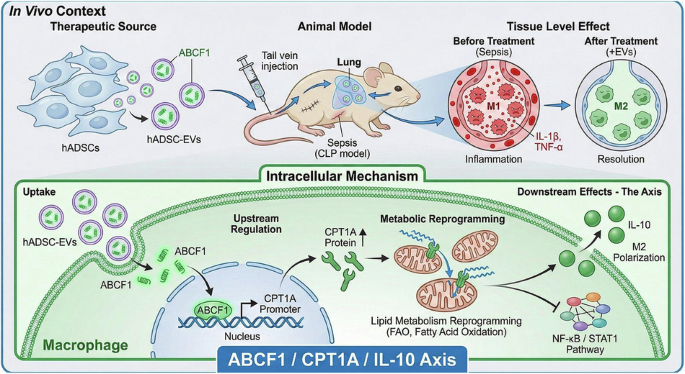
Sepsis-induced acute lung injury (ALI) is a life-threatening syndrome characterized by overwhelming inflammation, immune dysregulation, and tissue damage. Metabolic reprogramming of macrophages has emerged as a central regulator of inflammatory responses. Extracellular vesicles (EVs) derived from mesenchymal stem cells (MSCs) offer therapeutic potential, but their molecular mechanisms in regulating immunometabolism during ALI remain unclear. Single-cell RNA sequencing (GSE207651) revealed enrichment of pro-inflammatory macrophages and activation of IL-1/TNF signaling in septic ALI. Human adipose-derived MSC-EVs (hADSC-EVs) were isolated and characterized by transmission electron microscopy, nanoparticle tracking analysis, and Western blotting. Their effects on macrophage metabolism and polarization were assessed using bulk RNA-seq, Real-Time Quantitative Polymerase Chain Reaction (RT-qPCR), Western blotting, flow cytometry, enzyme-linked immunosorbent assay (ELISA), and lipid staining. In vivo efficacy was validated in a cecal ligation and puncture (CLP)-induced murine ALI model, and the macrophage-dependency of this therapy was confirmed using a genetic LysM-Cre; iDTR macrophage-ablation model. hADSC-EVs delivered ABCF1 into macrophages, upregulating CPT1A and IL-10, which is associated with fatty acid oxidation pathways, and promoting M2 polarization while suppressing NF-κB/STAT1-mediated inflammatory signaling. Silencing CPT1A disrupted lipid metabolism-associated profiles, reduced M2 polarization, and amplified pro-inflammatory responses. In vivo, hADSC-EVs alleviated pulmonary injury, decreased IL-1β and TNF-α release, and reduced apoptosis and inflammatory infiltration in lung tissue. ABCF1-deficient EVs lost these protective effects, highlighting the central role of the ABCF1/CPT1A/IL-10 axis. Collectively, our findings identify the ABCF1/CPT1A/IL-10 axis as a key immunometabolic pathway through which hADSC-EVs modulate macrophage lipid profiles to suppress inflammation, reduce apoptosis, and protect against sepsis-induced ALI. These results provide novel mechanistic insights into the interplay between metabolism, immune regulation, and cell death, highlighting EV-based strategies as promising therapeutic interventions for septic lung injury.
Graphical Abstract. hADSC-EVs Reprogram Lipid Metabolism via the ABCF1/CPT1A/IL-10 Axis, Promoting Macrophage M2 Polarization and Ameliorating Sepsis-Induced ALI.
