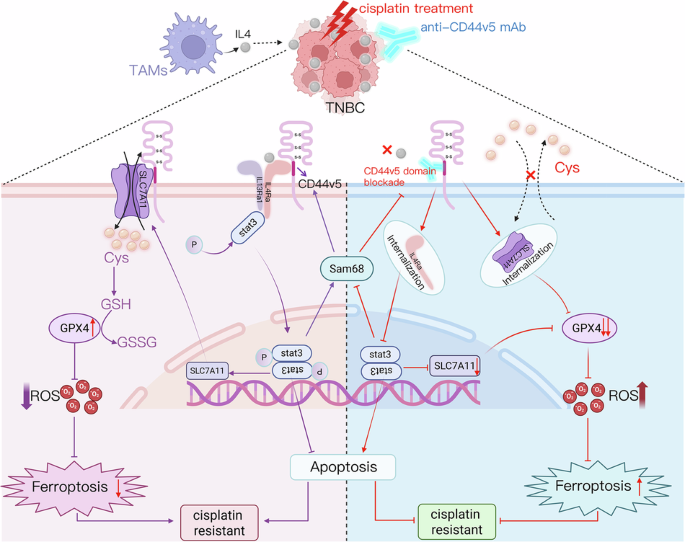
Triple-negative breast cancer (TNBC) is an aggressive subtype of breast cancer with limited therapeutic options, and the development of chemoresistance remains a major challenge for effective treatment. Our findings reveal that the CD44 variant isoform CD44v5 plays a crucial role in TNBC cisplatin resistance. Analyses of clinical samples, bioinformatic data, and cellular experiments demonstrated that CD44v5 was highly expressed in TNBC and correlated with tumor-associated macrophage (TAM) infiltration and poor therapeutic response. Mechanistically, TAMs enhanced cisplatin resistance through CD44v5-dependent mechanisms by releasing interleukin-4 (IL-4). CD44v5 amplified the IL-4/IL-4Rα/STAT3 signaling pathway, which upregulated SLC7A11 expression and inhibited ferroptosis. In addition, CD44v5 stabilized SLC7A11 on the cell membrane by preventing its internalization, which reduced reactive oxygen species (ROS) accumulation and promoted TNBC ferroptosis resistance. Furthermore, in vivo studies demonstrated that CD44v5 knockdown significantly enhanced the antitumor efficacy of cisplatin through suppression of SLC7A11 expression and induction of ferroptosis, accompanied by decreased IL-4Rα expression and reduced TAM infiltration. These findings indicate that CD44v5 contributes to cisplatin resistance by both reinforcing IL-4/IL-4Rα/STAT3 signaling and maintaining SLC7A11 membrane stability, highlighting CD44v5 as a potential therapeutic target for overcoming chemoresistance in TNBC.
Trending
- County-Level Medical Debt Tied to Later-Stage Cancer Diagnosis, Worse Survival
- Managing Diarrhea and Optimizing Dose Reductions With NALIRIFOX
- Discussing Advances in the Stereotactic Management of Brain Metastases
- CD44v5 promotes triple-negative breast cancer cisplatin resistance by enhancing IL-4/IL-4Rα/STAT3 pathway and stabilizing membranous SLC7A11
- Lymphoma’s Revolution: Evens & Rhodes on CLL, CAR-T, and NJ Care
- Debating Frontline Treatment for Child-Pugh B7 Disease With Compromised Liver Function
- What Role Will Artificial Intelligence Play in Genitourinary Oncology?
- Debating Locoregional Versus Earlier Systemic Therapy in BCLC-B HCC


Friday, August 21
CD44v5 promotes triple-negative breast cancer cisplatin resistance by enhancing IL-4/IL-4Rα/STAT3 pathway and stabilizing membranous SLC7A11
 By NewsCancer