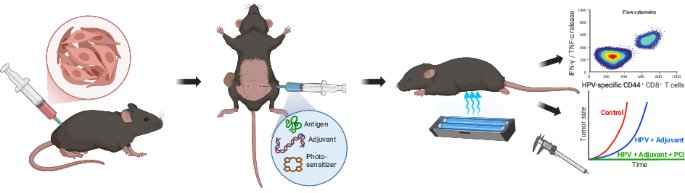
Efficient priming of antigen‑specific CD8⁺ T cells remains a major challenge for peptide‑ and protein‑based therapeutic vaccines targeting cancer and intracellular pathogens, despite the use of potent innate immune adjuvants such as synthetic double‑stranded RNA (dsRNA). In this study, we evaluated photochemical internalization (PCI), an endosomal escape technology, as a strategy to enhance vaccine‑induced immunity in combination with the dsRNA adjuvants poly(I:C) and poly‑ICLC. In mouse models, PCI combined with the SIINFEKL peptide and poly(I:C) increased circulating antigen‑specific CD8⁺ T cells by approximately 100‑fold compared with vaccination without PCI. Using a synthetic long HPV16 E7 peptide, PCI with poly(I:C) induced robust effector- and memory-phenotype CD8⁺ T‑cell responses and strong anti‑tumour activity in the TC‑1 HPV cancer model. PCI also enhanced CD8⁺ T‑cell priming induced by the clinically relevant telomerase vaccine UV1 when combined with poly‑ICLC. For larger protein antigens, including PPD, HBsAg, and KLH, PCI augmented CD4⁺ T‑cell responses and IgG production. Together, these findings establish PCI as a broadly applicable platform for enhancing peptide‑ and protein‑based vaccine immunity in combination with synthetic dsRNA adjuvants.
Trending
- Does Patient Selection Inflate CAR T Outcomes in Multiple Myeloma?
- Synthesis and molecular docking of novel pyrazole, pyrimidine, and pyridine derivatives as potent antimicrobial, antibiofilm, and anticancer agents
- Calreticulin-targeting L-asparaginase-flagellin conjugate enhances Salmonella-mediated antitumor efficacy
- Family bid to prevent cancer return for Stourbridge girl, 2
- Exploring PDLIM2 as a prognostic biomarker and therapeutic target in lung adenocarcinoma
- Photochemical internalization enhances in vivo immunity to peptide‑ and protein‑based vaccines with synthetic dsRNA adjuvants
- Durable clinical and immunologic response to an off-the-shelf EWSR1–FLI1 peptide vaccine in metastatic Ewing sarcoma
- Characterization of putative germline pathogenic variants in 27 candidate cancer-predisposing genes in 813 cats using a feline-specific multiplex targeted sequencing


Sunday, August 9
Photochemical internalization enhances in vivo immunity to peptide‑ and protein‑based vaccines with synthetic dsRNA adjuvants
 By NewsCancer