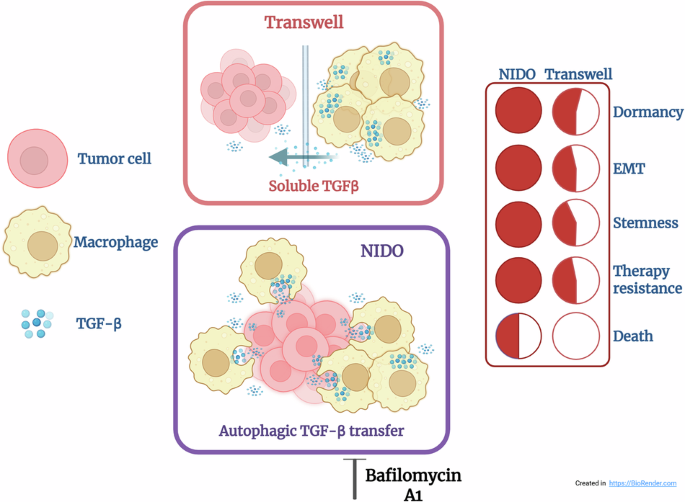
Macrophages are the major immune cell type in the microenvironment of non-small cell lung cancer (NSCLC), playing a key role in tumor development, progression, and response to therapies. Elucidating the interplay between macrophages and NSCLC is crucial to fulfill the potential of macrophage-targeting strategies. We used NSCLC surgical specimens to generate multicellular spheroids enriched in cancer stem cells (CSCs) and highly responsive to microenvironmental cues. NSCLC spheroids were used to characterize state transitions induced by macrophage-tumor cell interactions in terms of proliferation, epithelial-to-mesenchymal transition (EMT), expression of stemness-related factors, self-renewal, and drug resistance. To define whether state transitions were induced by cell–cell contact or soluble factors, we compared direct co-cultures of spheroids and macrophages with transwell cultures, where cells are separated by a porous membrane. Cellular interactions were recorded by time-lapse microscopy and immunofluorescence (IF), whereas EMT, dormancy, stemness and chemoresistance were evaluated by real-time PCR, immunoblotting and functional assays. We found that co-cultures allowing cell–cell contact, but not transwell cultures, induced robust state transitions in NSCLC CSCs, promoting a state of dormancy associated with increased stemness, EMT and chemoresistance. In direct co-cultures (named NIDO, for Niche-Induced DOrmancy), macrophages and tumor cells formed nest-shaped aggregates and underwent a specular modulation of TGF-β levels, suggesting a physical transfer of this cytokine from macrophages to NSCLC cells within cellular nests. Treatment with Bafilomycin A1, an inhibitor of autophagosome-lysosome fusion and autolysosome acidification, inhibited TGF-β relocation and prevented the full spectrum of TGF-β-induced state transitions, including chemoresistance, EMT, and nest formation. By contrast, antibody-mediated TGF-β neutralization had only a partial effect, indicating secretory autophagy as a key mechanism underlying macrophage-tumor cell interplay. Altogether, these results show that lung macrophages crucially influence CSC phenotype, proliferation, and therapy resistance, pointing to a key role of local cell circuits in regulating tumor cell plasticity.
Trending
- Tumor plasticity in macrophage niches promotes dormancy, EMT and chemoresistance of non-small cell lung cancer stem cells
- Ex-Deputy Who Shot Sonya Massey Is Denied a Request for Medical Release From Prison
- Subcutaneous Amivantamab Receives FDA Priority Review in R/M HNSCC
- Cancer Screenings by Age: When to Get Screened for Cancer
- <![CDATA[Antibody-Drug Conjugates in Advanced/Metastatic Non–Small Cell Lung Cancer]]>
- Sneak Peek: Practical CAR T Cell Use in Multiple Myeloma Care
- Disease Biology, Aromatase Inhibitor-Driven Resistance, and ESR1 Emergence
- Targeting ACSF2 overcomes Ara-C resistance in acute myeloid leukemia via the cholesterol metabolism-ERK signaling axis


Friday, July 31
Tumor plasticity in macrophage niches promotes dormancy, EMT and chemoresistance of non-small cell lung cancer stem cells
 By NewsCancer