


Adult B-ALL exhibits significant heterogeneity and poor prognosis compared with the pediatric population. While the complete remission (CR) rate of traditional induction chemotherapy is 70%–90% for newly diagnosed patients [1], only 30–50% of patients attain long-term disease-free survival (DFS) exceeding 5-years [2]. For the Philadelphia chromosome-positive (ph+) patients, the addition of tyrosine kinase inhibitors (TKIs) significantly improved the CR rates [3]. In addition, achieving measurable residual disease (MRD) negativity (<10−4 leukemic blasts), particularly early MRD negativity, is a critical determinant for long-term survival and reduces relapse [4]. Despite improvements in CR rates with traditional therapy, approximately half of them are still detected MRD positive [4]. Persistent MRD positivity is considered an independent adverse prognosis factor [5], whereas early achievement of MRD negativity in CR was associated with sustained remission [6].
INO, as an anti-CD22 antibody-drug conjugate, was originally explored in aggressive B-cell lymphoma. Given its superior efficacy in relapsed and refractory B-ALL, favorable safety profile, and ability to enhance CR rates and MRD negativity, INO was verified and approved by the FDA in 2017 [7]. Current published studies on INO as front-line therapy primarily focused on Philadelphia chromosome-negative (ph-) patients (≥50 years) [8,9,10,11,12]. Data regarding younger patients or ph+ patients remain scarce and deserve equal attention.
We designed a multi-center, single-arm, prospective study; adult B-ALL patients aged ≥17 years were eligible since May 2023, regardless of ph status. The study was registered in the Chinese Clinical Trial Register (ChiCTR): ChiCTR2500104832 (ph+) / ChiCTR2500105595 (ph-).
All patients (Ph- or Ph+) received INO combined with VP as induction therapy; CD22 positivity was confirmed via multi-parameter flow cytometry (MFC). INO was administered at a fixed dose of 1 mg on days 1, 8, and 15, capped at a maximum cumulative dose of 2.7 mg/m2. Vincristine was given at 1.4 mg/m² (up to a maximum of 4 mg) on days 1, 8, 15, and 22. Prednisone was administered orally in two patterns: 1 mg/kg daily from days 1 to 14, then 0.5 mg/kg daily from days 15 to 28, or 1 mg/kg on the first 4 days of each week for four consecutive weeks. For ph+ patients, TKIs were added orally. Patients with peripheral white blood leukocyte counts (WBC) ≥ 25 × 10⁹/L were eligible for the pre-phase regimen. Patients proceeded to consolidation and maintenance depending on MRD status and physician discretion.
The primary endpoint is the overall response rate (ORR) after one cycle of induction therapy, which includes CR, complete remission with incomplete hematologic recovery (CRi), morphologic leukemia-free state (MLFS), and partial remission (PR).
As of November 2025, a total of 39 newly diagnosed adult B-ALL patients were recruited, including twenty-two ph- B-ALL and seventeen ph+ B-ALL. 38 patients achieved CR, with the ORR rate up to 97.44% (38/39, 95% CI 92–100%) and an overall MRD negativity rate of 89.74% (35/39, 95% CI 80–99%). Among patients who acquired CR, 92.11% (35/38, 95% CI 84–100%) showed MRD negativity by the MFC. Only one patient with an IKZF1 mutation failed to achieve remission, corresponding to a no response (NR) rate of 2.56% (1/39, 95% CI 0–7.52%).
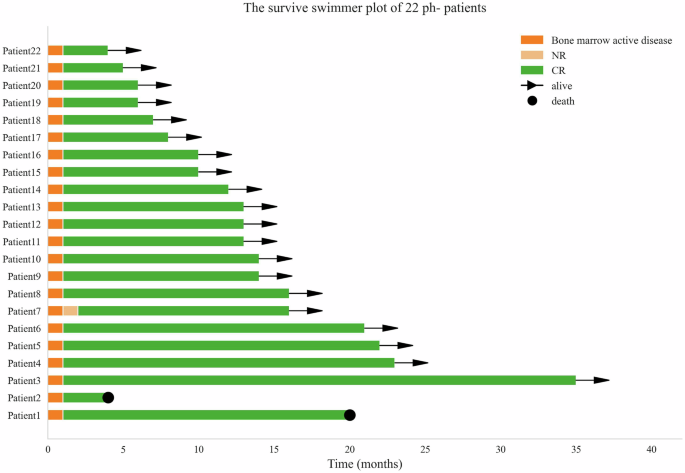
22 patients were enrolled with a median age of 54.5 (range 17–75) years in the ph- B-ALL cohort (Table 1). Average WBC count was 12.64 (range 1.67–68.2) × 10⁹/L, and the median bone marrow blast percentage was 85.25% (range 49–97%). High-risk features included: complex karyotype (n = 3), TP53 mutation (n = 2), FLT3 mutation (n = 1), IKZF1 ateration (n = 1), FLT3 with PAX5:: ETV6 (n = 1), PAX5:: ETV6 (n = 1); MEF2D::BCL9 fusion variant (n = 1). Followed one cycle of INO plus VP, 21 patients achieved CR, with a CR rate of 95.45% (21/22, 95% CI 87–100%). Notably, all patients who attained CR also achieved MRD-negative status. The single NR (4.55%, 1/22, 95% CI 0–13%) harbored an IKZF1 mutation. The remaining high-risk patients all achieved CR. One patient died of graft failure following allogeneic hematopoietic stem cell transplantation (allo-HSCT), another from cardiac disease; all remaining patients survived (Fig. 1).
Fig. 1: The survival swimmer plot of 22 ph- B-ALL patients.
Bar length corresponds to time from diagnosis established to last follow-up. Patient outcomes are indicated as alive (→) or death(●). Response categories included: CR complete remission, NR no response.
Table 1 Baseline characteristics of 22 ph- B-ALL patients.
17 patients with a median age of 42 (range 17–74) years were enrolled in the ph+ B-ALL cohort (Table 2). The Average peripheral WBC count was 39.38 (1.90–313.39) × 10⁹/L, and the median bone marrow blast percentage was 87.5% (49.5–91.0%). High-risk features included (Fig. 3): complex karyotype (n = 2, one with IgH rearrangement), IKZF1 alteration (n = 3, one with PAX5 mutation), CRLF2 (n = 1). 12 patients expressed positive for BCR-ABL1 (p190) transcript, 5 patients with the BCR-ABL1 (p210) transcript positive. All patients received INO plus VP in combination with TKIs. The selection of TKIs was based on individual patient factors: first-generation TKIs (imatinib, n = 5), second-generation TKIs (dasatinib, n = 1), second-generation TKIs (flumatinib, n = 8), and third-generation TKI (olverembatinib, n = 3). All 17 ph+ B-ALL patients achieved CR, with a CR rate of 100% (17/17). 82.35% (14/17, 95% CI 64–100%) of the CR patients attained MRD negativity. All patients survived except for one who died of complications related to allo-HSCT (Fig. 2).
Fig. 2: The survival swimmer plot of 17 ph+ B-ALL patients.
Bar length corresponds to time from diagnosis established to last follow-up. Patient outcomes are indicated as alive (→) or death(●). Response categories included: CR complete remission.
Table 2 Base line characteristics of 17 ph+ B-ALL patients.
Grade 3–4 hematologic toxicities were infrequent. The median duration of granulocytopenia was 0 (0–16) days and 9 (0–13) days, respectively, for ph- and ph+ cohorts. 54.55% (12/22) of ph- patients and 35.29% (6/17) of ph+ patients did not experience granulocytopenia. Furthermore, 72.72% (16/22) of ph- patients and 47.06% (8/17) of ph+ patients did not require platelet transfusion. Only one case of sinusoidal obstruction syndrome (SOS)/veno-occlusive disease (VOD) occurred due to self-discontinuation of ursodeoxycholic acid, which recovered completely after methylprednisolone treatment. No elevation in liver enzymes or bilirubin was observed in the remaining patients.No deaths due to pulmonary infections.
To our knowledge, multiple prospective studies have established the efficacy of INO ranging from 80% to 100% for newly diagnosed adult B-ALL [8,9,10,11]. The current standard regimen typically employs a de-escalation strategy (0.8 mg/m2 day 1, 0.5 mg/m2 day 8 and 15) for INO. Unlike previous prospective trials, we pioneered the use of a fixed-dose regimen of INO for newly diagnosed B-ALL in this prospective study. We evaluated the efficacy and safety of this innovative approach in achieving a response during the first induction. Among the 39 newly diagnosed B-ALL patients, only one experienced treatment failure. A single cycle of induction therapy yielded a remarkable 97.44% CR rate, and deep-level molecular responses were observed, with an overall MRD negativity rate of 89.74%, rising to 92.11% specifically in the CR cohort, significantly higher than traditional chemotherapy, further enhancing MRD negativity than previous prospective clinical studies on INO.
The EWALL-INO study for CD22+ and ph- B-ALL with age ≥55 years shared a similar protocol design with our clinical trial. The key difference lay in the administration schedule of INO dose, which was given 0.8 mg/m2 on days 1, 0.5 mg/m2 on days 8 and 15, combined with VP in cycle 1, with vincristine/cyclophosphamide/prednisone (VCP) in cycle 2 [11]. Their two-cycle induction achieved a CR/CRi rate of 90%, and an MRD2 rate of 80%, lower than what we received in one cycle. Although the protocol designs are similar, our fixed-dose modification for INO likely contributed to significant improvement in both the CR/CRi (97.44% vs. 90%) and MRD negativity rate (92.11% vs. 80%). Similarly, the MD Anderson Cancer Center (MDACC) prospective study of ≥60 years of age ph- B -ALL patients used INO with low-intensity therapy (mini-hyper-CVD) and achieved a 98% CR rate and 78% MRD negativity after one cycle [8]. Compared to mini-hyper-CVD, our regimen avoided the cytotoxicity of cyclophosphamide, but achieved a comparable CR rate(98% vs. 97.44%) and higher molecular response (78% vs. 89.74%). Comparisons of our clinical trial with the MDACC and EWALL-INO studies clearly indicated that a modified dose of INO may be associated with an CR rate improvement, markedly elevating MRD negativity.
High-risk molecular or cytogenetic alterations were presented in 16 of 39 cases (Fig. 3). Notably, 93.75% (15/16) patients achieved CR and 93.33% (14/15) patients concurrently obtained a deep molecular response; the CR rate for high-risk patients in the ph+ cohort was 100%. These outcomes challenged the traditional notion that patients with these genetic profiles and cytogenetic features have a dismal prognosis and demonstrated that INO retains potent activity in high-risk populations.
Fig. 3: OncoPrint plot of the landscape of gene alterations.
Each row represents a recurrent gene alteration, and each column represents an individual patient. Colors indicate distinct gene alteration types. Patients are grouped by age, karyotype, bone marrow remission status, and measurable residual disease status. CR complete remission, MRD measurable residual disease, DEL deletion, meaning gene copy number loss, AMP amplification, meaning high-level gene copy number.
Although the dose of INO was fixed during the induction remission phase, no increase in grade 3–4 hematological adverse events was observed. Conversely, this innovative treatment regimen enabled more than half of the patients to avoid agranulocytosis and platelet transfusions, thereby reducing the incidence of infection and bleeding events. In addition, a notable decrease in the length of hospital stay was observed with the reduction in treatment-related toxicity.
In conclusion, the fixed-dose INO combined with VP regimen achieved high CR rates, rapid and deep early molecular response, and potent efficacy in high-risk populations, and may serve as a novel induction therapy strategy for all adult B-ALL.
