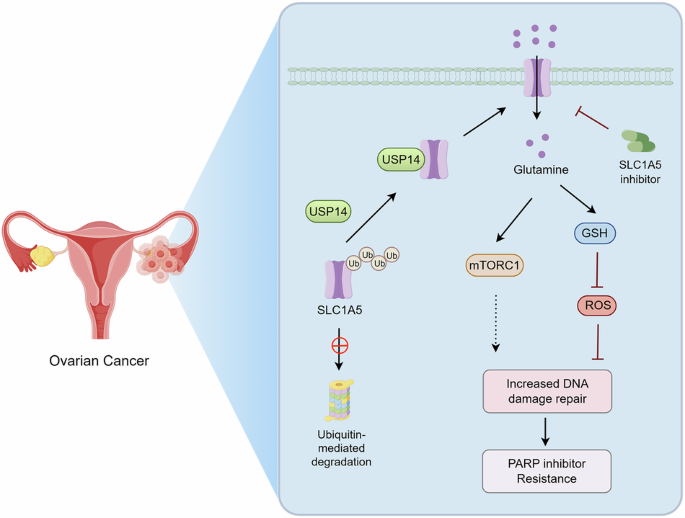
Poly(ADP-ribose) polymerase inhibitors (PARPi), such as olaparib, have significantly improved outcomes in ovarian cancer (OC); however, therapy resistance remains a major clinical challenge. Here, we showed that glutamine metabolism was upregulated in PARPi-resistant OC cells and identified the glutamine transporter SLC1A5 as a key mediator of this metabolic adaptation. Inhibition of SLC1A5 increased the sensitivity of OC cells to olaparib both in vitro and in vivo. Mechanistically, we demonstrated that the deubiquitinating enzyme USP14 directly interacted with and stabilized SLC1A5 by removing K48-linked polyubiquitin chains, thereby enhancing glutamine uptake, promoting glutathione synthesis, alleviating oxidative stress, and activating the mTORC1 pathway. This metabolic rewiring improved DNA damage repair capacity and ultimately contributed to PARPi resistance. Notably, combined treatment with the SLC1A5 inhibitor V-9302 and olaparib synergistically suppressed tumor growth in a patient-derived xenograft (PDX) model. Collectively, our findings identify the USP14–SLC1A5 axis as a novel regulator of PARPi resistance and suggest that targeting glutamine metabolism represents a promising therapeutic strategy to overcome PARPi resistance in ovarian cancer.
Trending
- Characterisation of TP53 mutational features and outcomes of acute myeloid leukaemia after allogeneic haematopoietic cell transplantation
- Neoadjuvant triplet chemotherapy enables radiotherapy avoidance in human papillomavirus–associated oropharyngeal cancer: a multicentre Phase II trial
- Translational modelling challenges receptor‑occupancy‑based dosing of PD‑1 inhibitors like pembrolizumab
- A pancreatic cancer organoid-macrophage co-culture using starPEG-heparin hydrogel deciphers tumor-immune cell interactions
- How Might WCLC 2026 Clarify the Evolving Role of APPs in Lung Cancer?
- How Is AI Advancing Tumor Boards, Care Coordination, and Treatment Planning?
- ITGA5 promotes homologous recombination mediated radioresistance in esophageal squamous cell carcinoma by upregulating RAD51AP1 expression
- Helping stoma bag users to swim with confidence


Sunday, September 6
Targeting SLC1A5-mediated glutamine metabolism overcomes PARP inhibitor resistance in ovarian cancer
 By NewsCancer