


AREG-mediated EGFR phosphorylation results in intrinsic resistance (IR) to KRAS G12C inhibitors in KRAS G12C–mutant NSCLC cell lines
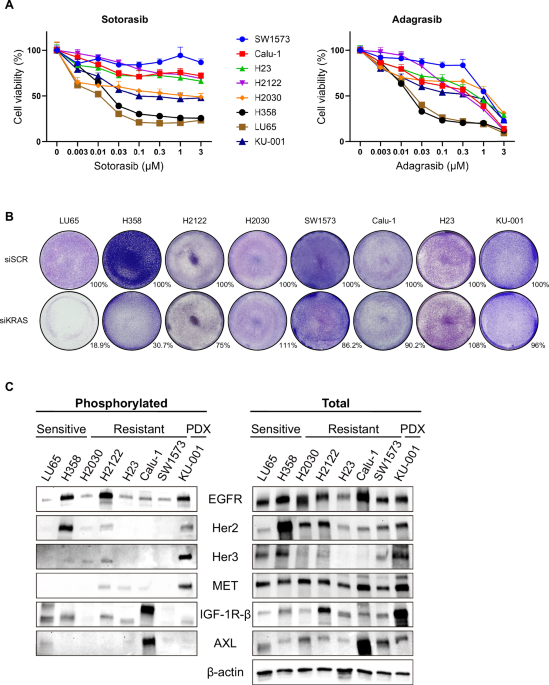
To elucidate the mechanisms underlying resistance to KRAS G12C inhibitors and to define the molecular features associated with IR, we evaluated the responses of eight KRAS G12C–mutant NSCLC cell lines to sotorasib and adagrasib (Fig. 1A). NCI-H358 and LU65 cells demonstrated marked sensitivity, with IC50 values below 100 nM. In contrast, H2030, H2122, H23, Calu-1, SW1573, and KU-001 cells exhibited varying degrees of reduced sensitivity, indicating IR. KU-001, a PDX cell line from a patient with KRAS G12C–mutant NSCLC who experienced rapid disease progression on sotorasib, represents a clinically relevant IR model [22]. To investigate KRAS G12C dependency, we conducted siRNA-mediated KRAS knockdown and assessed cell proliferation. The growth of H358 and LU65 cells was markedly reduced, consistent with KRAS addiction, although a fraction of H358 cells retained limited proliferative capacity. In contrast, in the IR cell lines, KRAS silencing had only a minimal impact on proliferation, suggesting the presence of alternative signaling pathways in addition to mutated KRAS (Fig. 1B). Therefore, we examined the phosphorylation status and total protein expression of multiple receptor tyrosine kinases, including EGFR, HER2, HER3, MET, IGF-1Rβ, and AXL, in KRAS G12C–mutant cell lines. Western blot analysis revealed that EGFR phosphorylation was elevated in H358, H2122, and KU-001 cells compared with that in other cell lines (Fig. 1C). Given that EGFR phosphorylation represented the most consistent and dominant alteration among resistant models, we focused on the EGFR pathway, one of the most potent bypass pathways reported to date.
Fig. 1: Sensitivity of Kirsten rat sarcoma viral oncogene (KRAS) G12C–mutant non-small cell lung cancer (NSCLC) cell lines to KRAS G12C inhibitors is associated with KRAS dependency and receptor tyrosine kinase activation.
A Cell viability of KRAS G12C–mutant NSCLC cell lines treated with the KRAS G12C inhibitors sotorasib and adagrasib, assessed by IC50 values. B Effect of small interfering RNA (siRNA)-mediated KRAS knockdown on cell proliferation, measured using crystal violet staining. C Western blot analysis of lysates from KRAS G12C–mutant NSCLC cell lines.
To further investigate the driver of EGFR activation, and as no EGFR mutation or amplification was detected, we examined the secretion of EGFR ligands using ELISA. AREG was upregulated in the culture supernatants of three cell lines (H358, H2122, and KU-001) with high p-EGFR expression (Figs. 1C and 2A), whereas TGF-α and EGF were minimally detected in the resistant cell lines (Fig. S1A, B and Table S1). Moreover, to systematically evaluate the relative expression of EGFR ligands in KRAS G12C–mutant NSCLC, we analyzed publicly available CCLE RNA-seq data defined by DepMap ACH identifiers (Table S2). Among EGFR ligands, AREG exhibited expression patterns similar to those observed in the ELISA supernatant analysis and showed the highest mean expression level in cells displaying high p-EGFR levels (Figs. 1C and S1C, D). Furthermore, RNAscope ISH was performed to detect AREG mRNA expression in FFPE tissue sections. The analysis revealed high AREG mRNA expression in H358 and H2122 xenograft tumors as well as KU-001 PDX tumor cells (Fig. 2B, C), consistent with the high AREG protein secretion observed in these tumor cells in vitro. These findings suggest that RNAscope may serve as a potential clinical diagnostic tool for detecting AREG expression in solid tumors.
Fig. 2: Amphiregulin (AREG)-mediated epidermal growth factor receptor (EGFR) activation contributes to intrinsic resistance (IR) to KRAS G12C inhibitors in H2122 and KU-001 cells.
A KRAS G12C–mutant NSCLC cells (1 × 10⁶ cells per well) were incubated for 48 h, and culture supernatants were collected. AREG levels were measured using an enzyme-linked immunosorbent assay (ELISA). B, C Representative images of RNAscope in situ hybridization (ISH) detection of AREG mRNA expression in xenograft tumor samples and the KU-001 patient-derived xenograft (PDX) tumor sample. Scale bar = 50 µm. D AREG levels in culture supernatants of H2122 cells treated with control (siSCR) or AREG-specific (siAREG) siRNA for 48 h, measured using an ELISA. E Western blot analysis of H2122 cell lysates using antibodies targeting the indicated proteins. F Cells were cultured in the presence or absence of sotorasib (0.03 and 0.3 μM) for 3 d. Cell viability was determined using an MTT assay with five replicate wells for each condition. G AREG levels in culture supernatants of KU-001 cells treated with siSCR or siAREG for 48 h, measured using an ELISA. H Western blot analysis of KU-001 cell lysates using antibodies targeting the indicated proteins. I Cell viability assay showing that knockdown of either AREG or EGFR reduced the viability of KU-001 cells in the presence of sotorasib. Statistical significance was determined using Student’s t test (D, G) and two-way ANOVA (F, I). **p < 0.01; ***p < 0.001; ****p < 0.0001.
To functionally test the role of AREG–EGFR signaling in mediating resistance, we performed siRNA knockdown of AREG or EGFR in H2122 and KU-001 cells. AREG (Fig. 2D, G) and EGFR (Fig. 2E, H) protein expression in these cell lines was effectively decreased following treatment with siRNAs targeting AREG and EGFR, respectively. Notably, AREG knockdown inhibited EGFR phosphorylation. Knockdown of either AREG or EGFR markedly reduced the viability of these resistant cell lines in the presence of sotorasib (Fig. 2F, I).
These findings suggest that AREG-mediated EGFR activation is a key mechanism of IR to KRAS G12C inhibitors in a subset of KRAS G12C–mutant NSCLC. Targeting EGFR signaling may provide a rational therapeutic strategy to overcome resistance in this context.
AREG–EGFR pathway activation correlates with resistance to sotorasib in patients with KRAS G12C–mutant NSCLC
To assess the clinical relevance of AREG–EGFR pathway activation in KRAS G12C inhibitor resistance, we analyzed tumor tissues from eight additional patients with KRAS G12C–mutant NSCLC who were treated with sotorasib monotherapy, along with a malignant ascites cell block specimen from the KU-001 patient (Fig. 3). IHC revealed p-EGFR positivity in eight of nine tissues. Notably, the only p-EGFR–negative patient achieved a complete response to sotorasib with prolonged PFS of 468 d, whereas p-EGFR–positive cases exhibited poorer outcomes, ranging from partial response to progressive disease.
Fig. 3: AREG–EGFR pathway activation correlates with poor response to sotorasib in patients with KRAS G12C–mutant NSCLC.
Representative H&E, p-EGFR immunohistochemistry (IHC), and AREG mRNA RNAscope ISH images from tumor tissue sections of eight patients with NSCLC and an ascitic cell block from the KU-001 patient, all treated with sotorasib. Clinical outcomes are indicated below each case. Scale bar = 50 µm. CR Complete response, PR Partial response, SD Stable disease, PD Progressive disease, N.E. Not evaluable, PFS progression-free survival.
RNAscope analysis revealed elevated AREG mRNA expression in three p-EGFR–positive tumors: patient no. 4, patient no. 7, and the KU-001 ascites cell block. Particularly, Patient no. 7 exhibited only stable disease with minimal tumor shrinkage and a short PFS of 62 d, suggesting a poor response. In the KU-001 patient, to localize AREG expression within cancer cells in the cell block, claudin-1 immunofluorescence combined with RNAscope confirmed increased AREG mRNA levels specifically in tumor cells (Fig. S2). Patient no. 4 exhibited elevated baseline expression of AREG and p-EGFR prior to treatment but still achieved a partial response (PR) to sotorasib, with a 37% reduction in tumor size. This observation is consistent with our findings in H358 cells and highlights the potential importance of earlier therapeutic intervention targeting the AREG–EGFR axis to enhance the response to treatment. These findings indicate that baseline activation of the AREG–EGFR axis may contribute to IR to sotorasib and support the use of AREG and p-EGFR as negative predictive biomarkers to guide individualized therapy in KRAS G12C–mutant NSCLC.
Combined use of EGFR TKIs sensitizes NSCLC to KRAS G12C inhibitors
Next, we examined the effects of the EGFR TKIs, osimertinib and erlotinib, on AREG-driven sotorasib-resistant cells in vitro. First, in two sotorasib-sensitive cell lines, combination treatment with EGFR TKIs did not improve the response of LU65 cells (Fig. 4A), whereas AREG–EGFR–positive H358 cells showed enhanced sensitivity to sotorasib, with a significantly reduced IC₅₀ (Fig. 4B). In resistant cells, both osimertinib and erlotinib sensitized H2122 (Fig. 4C) and KU-001 (Fig. 4D) cells to sotorasib. Western blot analysis revealed that EGFR TKI treatment alone partially reduced p-EGFR and showed limited inhibition of downstream p-ERK and p-AKT in H358 (Fig. 4E, F), H2122 (Fig. 4G, H), and KU-001 (Fig. 4I, J) cells. In contrast, combination treatment with osimertinib or erlotinib effectively inhibited EGFR phosphorylation and downstream ERK and AKT signaling in all three cell lines. This was accompanied by increased cleaved caspase-3 expression, indicating enhanced induction of apoptosis by the combination treatment (Fig. S3A).
Fig. 4: Combined use of EGFR tyrosine kinase inhibitors (TKIs) overcomes IR and enhances sotorasib efficacy in vitro and in vivo.
LU65 (A), H358 (B), H2122 (C), and KU-001 (D) cells (4 × 10³ cells per well) were treated with sotorasib, with or without EGFR TKIs, for 72 h. Cell viability was assessed using an MTT assay. Bars represent the standard deviation (SD) of quadruplicate cultures. Western blot analysis of H358 (E, F), H2122 (G, H), and KU-001 (I, J) cells treated with sotorasib, with or without EGFR TKIs, for 48 h using antibodies targeting the indicated proteins. K Percentage change in tumor volume in H358 xenograft–bearing mice treated with vehicle control (n = 6), sotorasib (30 mg/kg; n = 6), osimertinib (25 mg/kg; n = 6), or a combination of sotorasib (30 mg/kg) and osimertinib (25 mg/kg) (n = 6). The gray box indicates the period after treatment discontinuation. L Percentage change in tumor volume in H358 xenograft–bearing mice at three time points (days 21, 25, and 28) after treatment with sotorasib or sotorasib plus osimertinib. M Western blot analysis of H358 xenografts treated with vehicle, sotorasib, and/or osimertinib using antibodies targeting the indicated proteins. N Percentage change in tumor volume in H2122 xenograft–bearing mice treated with vehicle control (n = 6), sotorasib (30 mg/kg; n = 6), osimertinib (25 mg/kg; n = 6), or a combination of sotorasib (30 mg/kg) and osimertinib (25 mg/kg) (n = 6). O Percentage change in tumor volume in H2122 xenograft–bearing mice at three time points (days 11, 14, and 18) after treatment with sotorasib or sotorasib plus osimertinib. P Western blot analysis of tumor tissues from H2122 xenografts treated with vehicle, sotorasib, and/or osimertinib using antibodies targeting the indicated proteins. Q Percentage change in tumor volume in the KU-001 PDX model treated with vehicle control (n = 6), sotorasib (30 mg/kg; n = 6), osimertinib (25 mg/kg; n = 6), or a combination of sotorasib (30 mg/kg) and osimertinib (25 mg/kg) (n = 6). R Percentage change in tumor volume in the KU-001 PDX model at three time points (days 11, 14, and 18) after treatment with sotorasib or sotorasib plus osimertinib. S Western blot analysis of tumor tissues from the KU-001 PDX model treated with vehicle, sotorasib, and/or osimertinib using antibodies targeting the indicated proteins. Statistical significance was determined using Student’s t test. ***p < 0.001; ****p < 0.0001.
To evaluate the in vivo efficacy of this combination treatment, we utilized a mouse xenograft model. Mice bearing H358 xenografts were treated with sotorasib, osimertinib or erlotinib, or a combination of osimertinib or erlotinib with sotorasib for 28 days. Both sotorasib alone and the combination treatment effectively suppressed tumor growth without causing significant toxicity or weight loss (Figs. 4K and S4A). The combination treatment significantly suppressed tumor growth compared with sotorasib alone at the evaluated time points (Figs. 4L and S4B). We then investigated whether there was any differential tumor regrowth after treatment discontinuation. Notably, the combination treatment prevented tumor regrowth for up to 45 days after treatment discontinuation, whereas tumors treated with sotorasib alone regrew gradually (Figs. 4K and S4A). Moreover, compared with sotorasib alone, the combination treatment more effectively inhibited EGFR phosphorylation and downstream MAPK and PI3K–AKT signaling and markedly increased cleaved caspase-3 expression, indicating enhanced apoptosis (Figs. 4M and S4C).
Furthermore, the efficacy of the combination treatment was evaluated in sotorasib-resistant H2122 cells. Sotorasib alone only mildly suppressed tumor progression compared with that in the control group (Figs. 4N and S4D). Importantly, the combination of osimertinib or erlotinib with sotorasib consistently suppressed tumor growth and was more effective than sotorasib monotherapy (Figs. 4O and S4E). Compared with that of sotorasib alone, combination treatment more effectively inhibited EGFR activation and downstream MAPK and PI3K–AKT signaling and increased cleaved caspase-3 expression in H2122 cells (Figs. 4P and S4F).
Next, we established a PDX model (KU-001) from the malignant ascites of a patient with KRAS G12C–mutant lung cancer at Kanazawa University Hospital. The patient, unfortunately, experienced immediate disease progression after treatment with sotorasib. Consistent with this clinical observation, in the PDX model, sotorasib alone only had a mild effect, whereas its combination with osimertinib or erlotinib achieved near-complete tumor eradication (Figs. 4Q, R and S4G, H). Moreover, western blot analysis of tumor lysates showed that the combination treatment more effectively suppressed EGFR activation and downstream signaling and increased cleaved caspase-3 expression compared with that of sotorasib alone (Figs. 4S and S4I). Quantification of the western blot results from all three in vivo models is shown in Fig. S3B.
Furthermore, consistent with the western blot findings, IHC analysis demonstrated that the combination treatment more effectively suppressed p-EGFR expression compared with that of sotorasib alone in H358, H2122, and KU-001 PDX xenograft tumors, as reflected by markedly reduced H-scores (Fig. S5).
Collectively, our findings indicate that the combination of an EGFR TKI and sotorasib represents a more effective therapeutic strategy for both sotorasib-sensitive and intrinsically sotorasib-resistant KRAS G12C–mutant NSCLC with AREG–EGFR activation.
LU65 cells acquire resistance to KRAS inhibitors in vivo
To better model the pharmacokinetics and tumor microenvironment relevant to KRAS inhibitors, we developed a subcutaneous tumor model by implanting KRAS G12C–mutant LU65 cells into SHO–SCID mice. Daily oral administration of sotorasib or adagrasib (25 mg/kg) initially suppressed tumor growth; however, the tumors eventually regrew, indicating acquired resistance (Fig. 5A, B). Tumor cells with acquired drug resistance were successfully cultured and designated as LU65 SC-sotAR (acquired resistance to sotorasib) and LU65 SC-adaAR (acquired resistance to adagrasib).
Fig. 5: The KRAS G12C–mutant NSCLC cell line LU65 acquires resistance to KRAS inhibitors through AREG-mediated EGFR activation.
A LU65 cells was subcutaneously injected into SHO–severe combined immunodeficiency (SCID) mice. Mice were treated daily with sotorasib (30 mg/kg) via oral gavage from day 23 to day 58. B LU65 cells were subcutaneously injected into SHO–SCID mice. Mice were treated daily with adagrasib (30 mg/kg) via oral gavage from day 25 to day 54. C LU65 parental cells and LU65 cells with acquired resistance to sotorasib (SC-sotAR), established from xenograft models (4 × 10³ cells per well), were treated with sotorasib for 72 h. Cell viability was assessed using an MTT assay. Bars represent SD of quadruplicate cultures. D LU65 parental cells and LU65 cells with acquired resistance to adagrasib (SC-adaAR), established from xenograft models (4 × 10³ cells per well), were treated with adagrasib for 72 h. Cell viability was assessed using an MTT assay. E Western blot analysis of LU65 SC-sotAR and LU65 SC-adaAR cell lysates using antibodies targeting the indicated proteins. F LU65 parental, LU65 SC-sotAR, and LU65 SC-adaAR cells (1 × 10⁶ cells per well) were incubated for 48 h, and culture supernatants were collected. Levels of EGFR ligands were measured using an ELISA. G Representative images of formalin-fixed, paraffin-embedded tumor sections from xenografts established with LU65 parental, LU65 SC-sotAR, and LU65 SC-adaAR cells, subjected to RNAscope ISH using an AREG-specific probe. Distinct punctate cytoplasmic signals indicate AREG mRNA expression. Scale bar = 100 µm. H AREG mRNA expression levels were quantified using ImageJ software. I LU65 SC-sotAR cells were cultured with or without sotorasib (0.3 μM) for 3 d. Cell viability was assessed using an MTT assay with five replicate wells for each condition. J LU65 SC-adaAR cells were cultured with or without adagrasib (0.3 μM) for 3 d. Cell viability was assessed using an MTT assay with five replicate wells for each condition. Cell viability of LU65 parental cells treated for 72 h with recombinant AREG (100 ng/mL), sotorasib (K), or adagrasib (L), alone or in combination. Statistical significance was determined using Student’s t test (F, H, K, L) and two-way ANOVA (I, J). ns, not significant. ***p < 0.001; ****p < 0.0001.
Next, we assessed the sensitivity of these resistant lines to KRAS G12C inhibitors. LU65 SC-sotAR cells were resistant not only to sotorasib (Fig. 5C) but also to adagrasib (Fig. S6A), and LU65 SC-adaAR cells showed similar cross-resistance (Figs. 5D and S6B). IC50 values are presented in Supplementary Table 3.
LU65 cells acquire KRAS inhibitor resistance through AREG-mediated EGFR activation
To elucidate the mechanisms underlying acquired resistance to KRAS inhibitors in LU65 cells, we first confirmed the absence of known secondary KRAS mutations in LU65 SC-sotAR and SC-adaAR cells using whole-exome sequencing (WES) (Supplementary file). Western blot analysis revealed enhanced EGFR phosphorylation in both resistant lines compared with that in the parental cells (Fig. 5E). WES identified no EGFR mutations, and copy number analysis confirmed the absence of EGFR amplification (Supplementary file and Fig. S7A). However, EGFR ligand profiling demonstrated a marked increase in AREG protein expression in the resistant cells (Fig. 5F), whereas levels of other ligands, such as TGF-α and EGF, remained unchanged (Fig. S7B, C). RNA sequencing further confirmed significant upregulation of both EGFR and AREG transcripts in the resistant cells (Fig. S8A, B). Consistently, RNAscope ISH on FFPE xenograft sections showed elevated AREG mRNA levels in LU65 SC-sotAR and SC-adaAR tumors compared with those in the parental tumors (Fig. 5G, H).
To functionally validate the role of AREG in drug resistance, we performed siRNA-mediated knockdown of AREG and EGFR in LU65 SC-sotAR cells. Target-specific siRNAs effectively reduced AREG and EGFR protein levels (Fig. S7D, E) and impaired cell viability in the presence of sotorasib or adagrasib (Fig. 5I, J). Conversely, recombinant AREG enhanced the viability of parental LU65 cells treated with KRAS inhibitors (Fig. 5K, L). Taken together, these findings indicate that increased AREG expression drives EGFR activation and mediates resistance to KRAS inhibition in LU65 cells.
LU65 cells acquire sotorasib resistance in a leptomeningeal carcinomatosis (LMC) mouse model through AREG-mediated EGFR activation
To explore the mechanisms of resistance to KRAS G12C inhibitors in the CNS, we established an LMC model by injecting luciferase-labeled LU65 cells into the leptomeningeal space of SHO–SCID mice, followed by daily sotorasib treatment. After 15 days, tumor cells were isolated from mice that developed resistance despite continuous treatment (Fig. S9A) and were successfully cultured in vitro (designated as LU65 LMC-sotAR cells). These cells exhibited moderate resistance to sotorasib in vitro (Fig. S9B). Western blot and ELISA analyses revealed increased AREG expression and enhanced EGFR phosphorylation (Fig. S9C, D), mirroring findings from the subcutaneous models and suggesting that AREG–EGFR signaling also contributes to CNS resistance.
Combined use of EGFR TKIs resensitizes LU65 cells with acquired resistance to KRAS inhibitors
Next, we evaluated whether treatment with EGFR TKIs could overcome AREG-mediated resistance to KRAS inhibitors in vitro. In LU65 SC-sotAR cells, the combination of sotorasib and osimertinib or erlotinib inhibited cell viability in a dose-dependent manner (Fig. 6A). A similar effect was observed with a combination of adagrasib and osimertinib in LU65 SC-adaAR cells (Fig. 6D). In LU65 LMC-sotAR cells, combination treatment with osimertinib restored sensitivity to sotorasib (Fig. S9E). Western blot analysis in LU65 SC-sotAR cells showed that either sotorasib, osimertinib, or erlotinib alone modestly reduced EGFR phosphorylation, whereas their combination markedly inhibited phosphorylation of EGFR, ERK, and AKT (Figs. 6B, C and S10A). Similar effects were observed in LU65 SC-adaAR cells (Figs. 6E, F and S10B).
Fig. 6: Combined EGFR TKIs resensitize LU65 cells with acquired resistance to KRAS G12C inhibitors in vitro and in xenograft models.
A LU65 SC-sotAR cells (4 × 10³ cells per well) were treated with sotorasib, with or without EGFR TKIs, for 72 h. Cell viability was assessed using an MTT assay. B, C Western blot analysis of LU65 SC-sotAR cells treated with sotorasib, with or without EGFR TKIs, for 48 h using antibodies targeting the indicated proteins. D LU65 SC-adaAR cells (4 × 10³ cells per well) were incubated with adagrasib, with or without EGFR TKIs, for 72 h. Cell viability was determined using an MTT assay. E, F Western blot analysis of LU65 SC-adaAR cells treated with sotorasib, with or without EGFR TKIs, for 48 h using antibodies targeting the indicated proteins. G Percentage change in tumor volume in LU65 SC-sotAR xenograft–bearing mice treated with vehicle control (n = 6), sotorasib (30 mg/kg; n = 6), osimertinib (25 mg/kg; n = 6), or a combination of sotorasib (30 mg/kg) and osimertinib (25 mg/kg) (n = 6). H Percentage change in tumor volume in LU65 SC-sotAR xenograft–bearing mice at three time points (days 14, 17, and 21) after treatment with sotorasib or sotorasib plus osimertinib. I Western blot analysis of tumor tissues from LU65 SC-sotAR xenografts treated with vehicle, sotorasib, and/or osimertinib using antibodies targeting the indicated proteins. J Representative IHC images for p-EGFR expression in LU65 SC-sotAR xenografts treated with vehicle, sotorasib, and/or osimertinib. Scale bar = 50 µm.
We next tested the efficacy of this combination treatment in LU65 SC-sotAR xenografts. Mice were treated with sotorasib (30 mg/kg), osimertinib or erlotinib (25 mg/kg), or a combination of osimertinib or erlotinib (25 mg/kg) and sotorasib (30 mg/kg). Sotorasib alone did not inhibit tumor growth, indicating acquired resistance. In contrast, combination treatment with osimertinib or erlotinib significantly suppressed tumor growth, demonstrating the ability of combined EGFR and KRAS inhibition to overcome acquired resistance (Figs. 6G, H and S11A, B). Western blot analysis of tumor lysates revealed that while single-agent treatment partially suppressed EGFR and had minimal impact on ERK and AKT phosphorylation, the combination more strongly inhibited both pathways (Figs. 6I and S11C, S10C). Consistently, IHC analysis demonstrated that combination treatment with sotorasib and osimertinib more effectively suppressed p-EGFR expression compared with sotorasib alone in LU65 SC-sotAR xenograft tumors, as reflected by reduced H-scores (Fig. 6J). Combination treatment with erlotinib also reduced p-EGFR expression (Fig. S11D). Taken together, these results suggest that combining an EGFR TKI with a KRAS G12C inhibitor effectively suppresses AREG-mediated EGFR activation and overcomes acquired resistance, thereby enhancing antitumor efficacy in KRAS G12C–mutant NSCLC.
