


Diffuse large B-cell lymphoma (DLBCL) represents the most common non-Hodgkin lymphoma, in which ~60–85% of patients achieve a complete response (CR) with standard frontline chemoimmunotherapy approaches [1,2,3]. Despite these promising response rates, ~40% of patients can develop relapsed or refractory disease, and significant research efforts have been devoted to improving the durability and response with frontline therapies through the incorporation of novel agents [1, 2]. Due to its biologic heterogeneity, DLBCL is subclassified by cell of origin (COO) into germinal center B-cell (GCB) and activated B-cell-like (ABC), the latter being considered in the “non-GCB” DLBCL group and heralding inferior outcomes with 2-year progression-free survival (PFS) as low as 40% [4, 5]. However, non-GCB DLBCL harbors multiple targetable vulnerabilities, including chronic activation of B-cell transcription factors for differentiation (i.e. nuclear factor kB, IRF4) [6,7,8]. Harnessing these biological vulnerabilities, the Smart Start trial (NCT02636322) served as a proof-of-concept that a frontline non-cytotoxic RLI combination regimen utilizing rituximab with the immunomodulatory agent, lenalidomide, and Bruton’s tyrosine kinase (BTK) inhibitor, ibrutinib, results in excellent efficacy outcomes with a favorable safety profile [9]. After an initial lead-in phase with RLI targeted therapy for 2 cycles, 86% achieved an overall response rate (ORR), following which 95% of patients achieved a CR after receiving RLI-chemotherapy from cycles 3 to 8 [9]. Furthermore, with a median follow-up of 31 months, a 2-year PFS and overall survival (OS) of 91% and 97% were observed, respectively [9]. Herein, we now report the seven-year updated analysis of the safety and efficacy outcomes from the Smart Start trial.
This study was an investigator-initiated, open-label, single-center, phase II clinical trial investigating patients with untreated non-GCB DLBCL per the Hans algorithm [10]. All patients enrolled in the trial had an Eastern Cooperative Oncology Group (ECOG) performance status of ≤3. The protocol was designed to treat patients with two cycles of RLI (rituximab 375 mg/m2 intravenous once on day 1, lenalidomide 25 mg orally once daily on days 1–10, ibrutinib 560 mg orally once daily; patients >65 years were able to receive ibrutinib 420 mg per amended protocol) followed by chemotherapy for cycles 3–8 with R-EPOCH or R-CHOP along with continued RLI. Full details regarding enrollment and treatment are detailed in the study protocol and the initial report of results [9]. Response criteria and disease assessment are specified in the Data Supplement from this publication [9]. This study received approval from the MD Anderson Cancer Center Institutional Review Board (IRB), and all patients provided informed consent. The study was conducted in accordance with the Declaration of Helsinki and the International Conference on Harmonization Guidelines for Good Clinical Practice.
There were 60 patients enrolled from May 2016 until February 2019. Baseline characteristics are demonstrated in Table 1. The median age was 64 years (range, 29–83), with 28% being older than 70 years. Per the International Prognostic Index (R-IPI), 42% (25/60) of patients were considered high risk (R-IPI 3–5). Of the patients tested for both MYC and BCL2 overexpression via immunohistochemistry (IHC), 62% (24/39) were double-expressors. According to NanoString DLBCL90 COO (n = 25), 52% had the ABC subtype, 20% GCB, and 28% were unclassified or could not be evaluated. The median time from diagnosis to treatment was 28 days (range, 9–138 days). Two patients withdrew consent prior to restaging due to personal preference and were only evaluable for safety analysis. Two patients received two cycles of RLI therapy only without chemotherapy: one withdrew consent after a CR, and one due to progressive disease and central nervous system aspergillosis. Fifty-six patients received RLI combined with chemotherapy (EPOCH: n = 31; CHOP: n = 25). One patient switched from EPOCH to CHOP after 3 cycles due to the treating physician’s preference. One patient had preplanned radiation to the contralateral testicle after completing study therapy with a CR.
Table 1 Characteristics of patients (n = 60) at study entry.
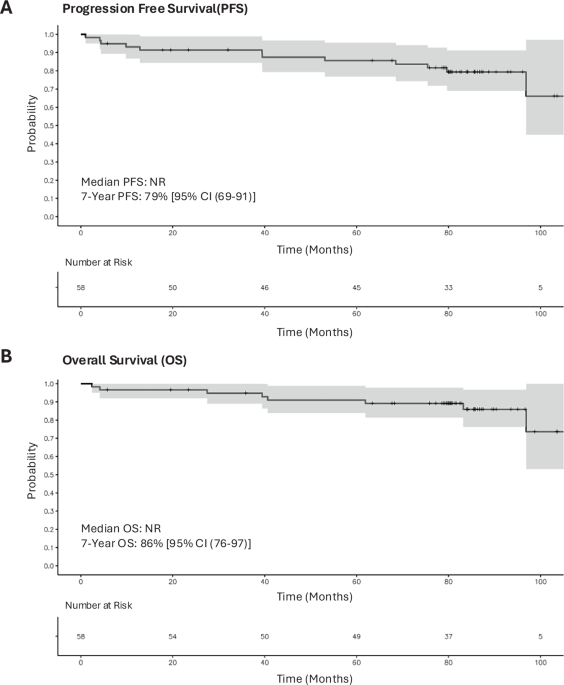
Evaluating long-term survival, with a median follow-up time of 84.1 months (95% CI, 80.9–86.3), the median PFS and OS were not reached (Fig. 1A, B). At the 7-year time point, PFS was 79% (95% CI, 69–91%), and OS was 86% (95% CI, 76–97%). A total of eight death events occurred within the treated cohort, four additional death events since the original publication [9]. Three deaths were determined to be lymphoma-related, either secondary to disease progression (n = 1) or infectious complications in the setting of treatment (n = 2). The remaining patient deaths were secondary to unrelated solid tumor malignancies [breast cancer (n = 1), pancreatic adenocarcinoma (n = 1), cholangiocarcinoma (n = 1)] and unknown causes (n = 2). Eight patients were determined to have progressive disease during the updated follow-up period. Since the last published follow-up, three new lymphoma progression events occurred at 47, 70, and 75 months from the end of therapy. When stratified by IPI risk category (IPI 0–1, 2, and 3–5) and molecular subtype (ABC, GCB, and unclassified), no significant differences in PFS or OS were observed, suggesting treatment failures were not enriched in a specific molecular or risk subgroup (log-rank P > 0.05). Pathology results (available in five patients) demonstrated a progressive B-cell lymphoma in all patients (high-grade B-cell lymphoma: n = 1; GCB B-cell lymphoma with anaplastic features: n = 1; non-GCB DLBCL: n = 2; B-cell lymphoma not otherwise specified (NOS): n = 1). Among five patients with disease progression and available treatment details, three received salvage therapy followed by CD19-directed chimeric antigen receptor (CAR) T-cell therapy (one of whom underwent autologous stem cell transplantation prior to CAR T), all achieving CR and remaining in remission at last follow-up. Two patients underwent salvage therapy followed by autologous stem cell transplantation; one achieved CR but subsequently died from a secondary solid tumor malignancy, while response status was unknown in the other, who also died during follow-up.
Fig. 1: Long-term survival outcomes.
A Progression-free survival; B Overall survival. Outcomes determined from time point of therapy initiation. Patients with no clinical event censored at time of last follow-up. NR not reached.
Acute adverse events during treatment were described in detail in the original publication; the most common events included nausea, peripheral sensory neuropathy, and diarrhea, while the most common grade ≥3 events were neutropenia, thrombocytopenia, and anemia [9]. On this updated analysis, no unexpected long-term safety signals were observed. Among the 60 safety-evaluable patients, 11 (18%) developed secondary malignancies, including breast cancer (n = 3), melanoma (n = 2), colorectal cancer (n = 2), pancreatic cancer (n = 1), cholangiocarcinoma (n = 1), hepatocellular carcinoma (n = 1), and chronic myeloid leukemia (n = 1). Additionally, two patients developed reduced ejection fraction heart failure: one was attributed to anthracycline exposure while the patient remained asymptomatic, and one to atherosclerotic coronary artery disease.
This updated analysis of the Smart Start trial establishes the long-term safety and durability of response with novel targeted therapy combination regimens in patients with newly diagnosed DLBCL. An important contextual consideration is that the cohort in this trial was enriched for patients with ABC-DLBCL, a subtype historically associated with inferior outcomes [4, 5]. Despite this adverse baseline risk profile, the integration of novel targeted agents may have mitigated this prognostic disadvantage and contributed to the improved outcomes. Given substantial differences in study design and patient populations, no direct comparisons can be made with prior trials. However, for context, survival outcomes in the present study appear numerically higher than those reported in historical cohorts. These included the long-term outcomes for patients treated with R-CHOP on the GOYA trial, where a 5-year PFS and OS of 63% and 78% were reported [11]. Furthermore, the LNH-98.5 study, which evaluated older patients (60–80 years) with a median age of 70 years, observed a 10-year PFS and OS of 37% and 44% in those receiving R-CHOP [12].
Based on the Smart Start trial, a single-center retrospective study of 31 patients evaluated a frontline rituximab-lenalidomide-BTK-inhibitor (ibrutinib, zanubrutinib or orelabrutinib) combination (SMART regimen) for the treatment of DLBCL in elderly or unfit patients [13]. Elderly patients received 6–8 cycles of this regimen (SMART group) while unfit patients received 2–3 cycles followed by chemotherapy (SMART-START group). ORR and CR rates were 88% and 63% in the SMART group and 92% and 62% in the SMART-START group, respectively. One-year PFS was 81% and 84%, and median PFS and OS were not reached [13]. These results provide external validity to the evolving paradigm of targeted therapy treatment for patients with newly diagnosed aggressive lymphoma, including the rituximab-lenalidomide-BTKi-based regimens, and additionally demonstrate that second-generation BTK inhibitors are also viable options in this combination that merit further investigation.
Prompted by the Smart Start results, the Smart Stop trial (NCT04978584) evaluated a chemotherapy-free lead-in with LTRA (lenalidomide, tafasitamab, rituximab and acalabrutinib) followed by PET-adapted therapy for newly diagnosed DLBCL [14, 15]. Interim results from Cohort 1 were presented at the American Society of Hematology 2023 meeting, demonstrating a 100% ORR and 64% CR rate among 30 patients after four cycles of LTRA. At the end of therapy, a 100% CR rate was observed, with no patients having progressive lymphoma [14]. Overall, both the Smart Start and Smart Stop trials demonstrate the ongoing efforts for a targeted therapy-based approach where curative intent is preserved, potentially reducing or removing the need for chemotherapy for some patients.
In conclusion, this updated analysis of the Smart Start study demonstrates an impressive long-term survival outcome (7-year: PFS – 79% and OS – 86%) with no unexpected late toxicity events. The limitations of this trial include the small sample size at a single center; thus, further investigations of this strategy in later phases and multi-center trials are needed. Given the impressive efficacy of RLI-alone, future studies that evaluate novel targeted therapy-based combination approaches to de-escalate from cytotoxic therapy for frontline DLBCL treatment are both feasible and warranted, in patients with advanced age or poor performance status and in fit patients where chemotherapy may be administered if suboptimal responses are seen to targeted therapies alone. The Smart Start study illustrates that innovation and evolution away from an empiric 6 cycles of chemotherapy for newly diagnosed aggressive lymphomas are possible.
