


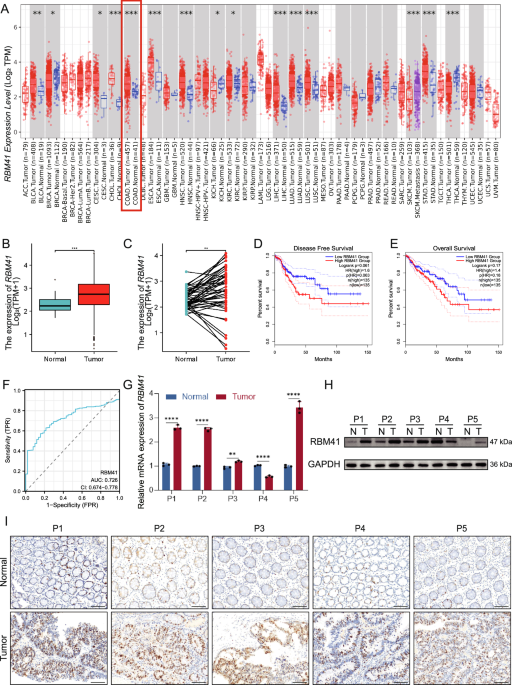
Upregulated RBM41 in CRC tissues is closely associated with poor patient prognosis
Analysis of public databases indicated that RBM41 is aberrantly overexpressed in various cancer types (Fig. 1A), with significantly higher RBM41 expression in CRC tissues compared to adjacent normal tissues in both unpaired and paired comparisons (Fig. 1B, 1C). We next investigated the clinical correlation between RBM41 expression and prognosis in CRC patients. Survival analysis showed that patients with high RBM41 expression have a shorter disease-free survival and overall survival, compared to patients with lower RBM41 levels (Fig. 1D, E). Receiver operating characteristic (ROC) curve analysis further supported the diagnostic relevance of RBM41 expression for CRC, with an area under the curve (AUC) value of 0.726 (Fig. 1F).
Fig. 1: RBM41 is upregulated in colorectal cancer and correlates with poor prognosis.The alternative text for this image may have been generated using AI.
A Analysis of RBM41 mRNA expression levels across multiple cancer types and corresponding normal tissues from the XIANTAO database. B Comparison of RBM41 mRNA expression between unpaired colorectal cancer (CRC) tissues and normal tissues based on TCGA data (n = 619 tumor tissues, n = 51 normal tissues; biological replicates). C Comparison of RBM41 mRNA expression between paired CRC tissues and adjacent normal tissues from the TCGA database (n = 50 paired samples, biological replicates). D Disease-free survival analysis of CRC patients stratified by high versus low RBM41 expression (n = 322 high expression, n = 322 low expression; biological replicates). E Overall survival analysis of CRC patients stratified by high versus low RBM41 expression (n = 322 high expression, n = 322 low expression; biological replicates). F The diagnostic value of RBM41 for distinguishing CRC from normal tissues by the receiver operating characteristic (ROC) curve. The area under the curve (AUC) and 95% confidence interval (CI) are indicated. AUC = 0.726, 95% CI: 0.674–0.778. G Relative RBM41 mRNA levels in CRC tissues and their matched adjacent normal tissues from five patients (P1–P5), as determined by RT‑qPCR. Data are presented as mean ± SD of n = 3 technical replicates per patient. H Western blot analysis of RBM41 protein levels in five pairs of CRC (T) and adjacent normal (N) tissues from five patients (P1–P5). GAPDH served as a loading control. Representative blots from n = 3 technical replicates per patient. I Immunohistochemical (IHC) staining of Ki‑67 in paired CRC and adjacent normal tissues from five representative patients. Scale bar, 100 μm. Representative images from n = 3 technical replicates per patient. Statistical significance was determined using Student’s t‑test (B, C, G) or log‑rank test (D, E). *, P < 0.05; **, P < 0.01; ***, P < 0.001; ****, P < 0.0001.
To validate these findings, we assessed RBM41 expression in clinical samples from five CRC patients. Results showed that both mRNA and protein levels of RBM41 were markedly upregulated in tumor tissues compared to matched adjacent tissues in four of the five patients (Fig. 1G, H). Given the association between high RBM41 expression and poor prognosis, we sought to assess its potential functional impact on tumor cell proliferation. Immunohistochemical analysis of paired sections from five patients revealed enhanced Ki-67 staining in tumor tissues from four cases (Fig. 1I). Together, these results indicate that RBM41 exhibits high levels in CRC and that its expression level is closely correlated with poor prognosis in patients.
RBM41 promotes CRC cell proliferation and inhibits cell death
Next, we assessed the expression profiles in a panel of CRC cell lines and found that RBM41 was highly expressed in T84 and HT29 cells, whereas its expression was lowest in SW480 cells (Fig. 2A, B). HT29 and T84 cells were thus selected for the subsequent loss-of-function studies, whereas SW480 cells were selected for gain-of-function experiments to investigate the biological function of RBM41 in CRC. Compared to control cells, knockdown of RBM41 in HT29 and T84 cells significantly inhibited cell proliferation and viability (Fig. 2C) and clonogenic ability (Fig. 2D, E), while markedly increasing the proportion of apoptotic cells (Fig. 2F, G). Conversely, overexpression of RBM41 in SW480 cells accelerated the cell proliferation rate, enhanced clonogenic ability, and improved cell survival (Fig. 2H–L). Collectively, these results demonstrate that RBM41 promotes CRC proliferation and clonogenic activity while inhibiting the rate of cell apoptosis in vitro, suggesting its role as an oncogene in CRC.
Fig. 2: RBM41 promotes colorectal cancer cell proliferation and suppresses cell death.The alternative text for this image may have been generated using AI.
A Relative RBM41 mRNA levels in a panel of human CRC cell lines (HCT116, HT29, SW480, SW620, T84) and a normal colonic epithelial cell line (NCM460), as determined by RT-qPCR. Data are presented as mean ± SD of n = 3 biological replicates. B Western blot analysis of RBM41 protein expression in the indicated CRC cell lines. GAPDH served as a loading control. The blots shown are representative of n = 3 biological replicates. C Cell proliferation assessed by CCK-8 assay in HT29 (left) and T84 (right) cells transfected with control siRNA (siCtrl) or two independent siRNAs targeting RBM41 (siRBM41 #1, #2). Data are presented as mean ± SD of n = 3 biological replicates. D Representative images of colony formation assays in HT29 (upper) and T84 (lower) cells after RBM41 knockdown. The images shown are representative of n = 3 biological replicates. E Quantitative analysis of colony formation assays shown in (D). F Apoptosis analysis by flow cytometry using Annexin V-FITC/PI staining in HT29 (upper) and T84 (lower) cells after RBM41 knockdown. The images shown are representative of n = 3 biological replicates. G Cell viability assessed by Live/Dead staining (Calcein-AM/PI; green, live cells; red, dead cells) in HT29 (upper) and T84 (lower) cells after RBM41 knockdown. Scale bar, 200 μm. The images shown are representative of n = 3 biological replicates. H Cell proliferation was assessed by the CCK-8 assay in SW480 cells transfected with an empty vector (OE-Ctrl) or RBM41 overexpression plasmid (OE-RBM41). Data are presented as mean ± SD of n = 3 biological replicates. I Representative images of colony formation assays in SW480 cells after RBM41 overexpression. The data shown are representative of three independent experiments. The images shown are representative of n = 3 biological replicates. J Quantitative analysis of colony formation assays shown in (I). K Apoptosis analysis by flow cytometry in SW480 cells after RBM41 overexpression. The images shown are representative of n = 3 biological replicates. L Cell viability assessed by Live/Dead staining (Calcein-AM/PI; green, live cells; red, dead cells) in SW480 cells after RBM41 overexpression. Scale bar, 200 μm. The images shown are representative of n = 3 biological replicates. Statistical significance was determined using Student’s t test (J) or one-way ANOVA (A, E) or two-way ANOVA (C, H). Data are presented as mean ± SD. **, P < 0.01; ***, P < 0.001; ****, P < 0.0001.
RBM41 deficiency triggers synergistic lethality through concurrent apoptosis induction and autophagic flux blockade
To determine how RBM41 affects cell death in CRC, we first screened potential death pathways with pharmacological inhibitors. Treatment with either the autophagy inhibitor chloroquine (CQ) or the apoptosis inhibitor Z-VAD-FMK significantly rescued the decreased cell viability caused by RBM41 knockdown, whereas inhibitors of ferroptosis or necroptosis had minimal effects (Fig. 3A). We next examined molecular changes associated with these pathways. RBM41 knockdown concurrently upregulated the Bax while downregulating the BCL2; it also increased the LC3B-II/LC3B-I ratio along with P62 accumulation, confirming the activation of apoptosis and the impairment of autophagic flux in RBM41-deletion HT29 cells (Fig. 3B). Flow cytometry and TUNEL staining further corroborated the increased cell death and enhanced DNA fragmentation in HT29 cells following RBM41 deletion, respectively (Fig. 3C, D). To further characterize the autophagic disruption, we performed transmission electron microscopy (TEM) and autophagy flux assays. Abundant autophagosome accumulation rather than autolysosomes was confirmed in RBM41-deleted HT29 cells (Fig. 3E). In line with the changes of key autophagic proteins, lysosome-sensitive fluorescent probes confirmed impaired autophagosome-lysosome fusion, collectively demonstrating the late-stage autophagic flux disruption following RBM41 deletion (Fig. 3F). Interestingly, we found that changes in autophagy-related markers (LC3B and P62) occurred prior to alterations in apoptosis-related proteins (Bax and BCL2), indicating that autophagy precedes subsequent apoptosis upon RBM41 deletion (Fig. 3G). However, inhibiting autophagy did not reverse the changes of Bax and BCL2 caused by RBM41 knockdown; conversely, apoptosis inhibition did not alter autophagy markers in RBM41-deletion HT29 cells (Fig. 3H). Functionally, only simultaneous inhibition of both autophagy and apoptosis restored cell viability to the greatest extent (Fig. 3I), indicating that they act synergistically to mediate cell death induced by RBM41 deficiency. Together, these results demonstrate that the apoptosis and disrupted autophagy resulting from RBM41 loss are not mutually requisite but function through independent mechanisms to exert a synergistic lethal effect in CRC cells.
Fig. 3: RBM41 deficiency triggers synergistic lethality through concurrent apoptosis induction and autophagic flux blockade.The alternative text for this image may have been generated using AI.
A Cell viability measured by CCK 8 assay in HT29 cells transfected with siCtrl or siRBM41 #1 and treated with inhibitors of autophagy (CQ), apoptosis (Z-VAD-FMK), necroptosis (Nec-1), or ferroptosis (Fer-1). Data are presented as mean ± SD of n = 3 biological replicates. B Western blot analysis of RBM41, apoptosis-related proteins (BAX, BCL2), and autophagy-related proteins (LC3B I, LC3B II, P62) in HT29 cells transfected with siCtrl or siRBM41 (#1, #2). GAPDH served as a loading control. The blots shown are representative of n = 3 biological replicates. C Apoptosis analysis by flow cytometry in HT29 (left) and T84 (right) cells under the indicated conditions. The images shown are representative of n = 3 biological replicates. D TUNEL staining to detect DNA fragmentation in HT29 (upper) and T84 (lower) cells transfected with siCtrl or siRBM41 (#1, #2). TUNEL-positive cells (green) and nuclei (blue) were counterstained with DAPI. Scale bar, 20 μm. The images shown are representative of n = 3 biological replicates. E Representative transmission electron microscopy (TEM) images of HT29 cells transfected with siCtrl or siRBM41 #1. Red arrows indicate autophagosomes; yellow arrows indicate autolysosomes. Scale bar, 2 μm (left) and 500 nm (right). The images shown are representative of n = 3 biological replicates. F Assessment of autophagic flux by immunofluorescence staining using DALGreen (autophagosomes) and DAPRed (autolysosomes) probes in HT29 cells transfected with siCtrl or siRBM41 #1. Scale bar, 10 μm. The images shown are representative of n = 3 biological replicates. G Western blot analysis of apoptosis and autophagy markers at the indicated time points (24–72 h) after transfection with NC (siCtrl) or si (siRBM41 #1) in HT29 cells. The blots shown are representative of n = 3 biological replicates. H Western blot analysis of apoptosis and autophagy markers in HT29 cells under the indicated conditions. The blots shown are representative of n = 3 biological replicates. (I Cell viability measured by CCK-8 assay in HT29 cells under the indicated conditions Data are presented as mean ± SD of n = 3 biological replicates. Data shown in (B, G, H) are representative of at least three independent experiments. Statistical significance was determined using one-way ANOVA (A, I). Data are presented as mean ± SD. *, P < 0.05; ****, P < 0.0001; ns, not significant.
RBM41 suppresses NDRG1 by impeding its pre-mRNA maturation
To elucidate the downstream molecular mechanisms by which RBM41 regulates the malignant phenotype of CRC, transcriptome sequencing on RBM41-knockout cells was performed. The results revealed significant alterations in the expression of multiple genes following RBM41 depletion. Among these, NDRG1 was markedly upregulated and selected for further investigation due to its established role as a tumor suppressor in CRC [18,19,20] (Fig. 4A). We found that knockdown of RBM41 increased both mRNA and protein levels of NDRG1, while RBM41 overexpression decreased NDRG1 expression in CRC cells (Fig. 4B, C), indicating that RBM41 negatively regulates NDRG1 expression. As an RNA-binding protein, RBM41 likely exerts this regulation post-transcriptionally. However, actinomycin D assays showed RBM41 depletion did not alter NDRG1 mRNA stability (Fig. 4D), and quantification of nascent RNA revealed no effect on NDRG1 transcription (Fig. 4E). Thus, we imply that RBM41 regulates NDRG1 through a mechanism distinct from controlling mRNA stability or transcription.
Fig. 4: RBM41 suppresses NDRG1 by impeding its pre-mRNA maturation.The alternative text for this image may have been generated using AI.
A Volcano plot of transcriptome sequencing (RNA seq) analysis in HT29 cells transfected with siCtrl (n = 3 biological replicates) or siRBM41 #1 (n = 3 biological replicates). B Relative NDRG1 mRNA levels measured by RT-qPCR in HT29 cells with RBM41 knockdown (left) and SW480 cells with RBM41 overexpression (right). Data are presented as mean ± SD of n = 3 biological replicates. C Western blot analysis of NDRG1 protein levels in HT29 cells with RBM41 knockdown (left) and SW480 cells with RBM41 overexpression (right). GAPDH served as a loading control. The blots shown are representative of n = 3 biological replicates. D mRNA stability assay for NDRG1 (left) and GAPDH (right) transcripts in HT29 cells treated with actinomycin D (5 μg/mL) under the indicated conditions. Data are presented as mean ± SD of n = 3 biological replicates. E Levels of nascent NDRG1 RNA (biotin-EU pull-down & RT-qPCR) with RBM41 knockdown (left) or overexpression (right). Data are presented as mean ± SD of n = 3 biological replicates. F Western blot analysis of RBM41 protein levels in total cell lysates (TCL), nuclear fractions (Nuc), and cytoplasmic fractions (Cyt) of HT29 cells. GAPDH was used as a cytoplasmic marker. The blots shown are representative of n = 3 biological replicates. G Subcellular localization of FLAG-RBM41 (red) by immunofluorescence. F-actin (green), DAPI (blue). Scale bars: 20 μm and 5 μm (inset). The images shown are representative of n = 3 biological replicates. (H) Relative levels of mature NDRG1 mRNA (left) and pre-mRNA (right) measured by RT-qPCR in HT29 cells transfected with siCtrl or siRBM41 #1. Data are presented as mean ± SD of n = 3 biological replicates. I Stability assay for NDRG1 pre mRNA (upper) and mature mRNA (lower) in HT29 cells treated with actinomycin D after transfection with siCtrl or siRBM41 #1. Data are presented as mean ± SD of n = 3 biological replicates. J RNA immunoprecipitation (RIP) assay using control IgG or anti RBM41 antibody, followed by RT-qPCR analysis of NDRG1 mature mRNA (left) and pre-mRNA (right) levels. Data are presented as mean ± SD of n = 3 biological replicates. Statistical significance was determined using one-way ANOVA (B left, E left) or Student’s t test (B right, E right, H, J) or two-way ANOVA (D, I). Data are presented as mean ± SD. **, P < 0.01; ***, P < 0.001; ****, P < 0.0001; ns, not significant.
The subcellular localization of RBPs is closely related to their biological function and potential molecular roles [21]. We therefore investigated the subcellular localization of RBM41 and found it is predominantly localized in the nucleus in HT29 cells (Fig. 4F, 4G). As RBPs located in the nucleus are usually associated with post-transcriptional gene regulation [22], we hypothesized that RBM41 might regulate NDRG1 expression by modulating pre-mRNA processing. Indeed, RBM41 knockdown led to a significant reduction in NDRG1 pre-mRNA levels, accompanied by an increase in mature mRNA (Fig. 4H). Furthermore, stability assays demonstrated that the degradation rate of NDRG1 pre-mRNA was significantly accelerated upon RBM41 depletion (Fig. 4I), indicating that depletion of RBM41 relieves the block on pre-mRNA processing and accelerates its conversion to mature mRNA, thus demonstrating that RBM41 impedes this processing. To directly investigate the interaction between RBM41 and NDRG1 transcripts, we performed RNA immunoprecipitation (RIP) experiments. Our data confirmed that RBM41 exhibits a stronger binding affinity for the pre-mRNA than for the mature transcript of NDRG1 (Fig. 4J). These findings support that RBM41 participates in pre-mRNA processing of NDRG1 in CRC cells.
Identification of a stem-loop structure in the 3′UTR of NDRG1 pre-mRNA as the RBM41- binding site
Since RBM41 binds predominantly to the precursor rather than the mature mRNA of NDRG1, we hypothesized that RBM41 directly binds to the non-coding regions of NDRG1 pre-mRNAs. To test this, we performed RIP assay coupled to RT-qPCR analysis and revealed the highest enrichment in the 3’ UTR of NDRG1 pre-mRNA (Fig. 5A). To further identify the RBM41-binding sequence in NDRG1 pre-mRNA, we constructed a series of biotin-labeled RNA truncations spanning different segments of the NDRG1 3’ UTR. Pull-down experiments indicated that RBM41 preferentially recognizes and binds within an approximately 120 nucleotides (nt) of the NDRG1 3’ UTR (Fig. 5B, C). Furthermore, we subdivided this 120 nt region into four segments. Unexpectedly, all subdivided fragments effectively pulled down RBM41 protein, and mutants that were designed based on the overlapping sequence also retained binding ability (Figs. 5D, E), implying that the RBM41/NDRG1 interaction might not depend on a specific short linear motif but rather on RNA secondary structure.
Fig. 5: RBM41 binds to a stem-loop structure in the 3′UTR of NDRG1 pre-mRNA.The alternative text for this image may have been generated using AI.
A RNA immunoprecipitation (RIP) assay followed by RT-qPCR analysis of the indicated regions (5’ UTR, Intron 1–15, and 3’ UTR) of NDRG1 pre mRNA in HT29 cells transfected with FLAG-tagged RBM41, using control IgG or an anti-FLAG antibody. Data are presented as mean ± SD of n = 3 biological replicates. RNA pull-down assays using biotin-labeled fragments covering different regions of the NDRG1 3’ UTR: 1–497 nt, 454–898 nt, 830–1330 nt, and 1199–1648 nt (B); 1199–1527 nt and 1458–1648 nt (C); 1458–1557 nt, 1486–1587 nt, 1518–1617 nt, and 1548–1648 nt (D); and truncated variants of 1479–1578 nt (E). RBM41 protein bound to these RNA fragments was detected by Western blot. The blots shown are representative of n = 3 biological replicates. F Predicted secondary RNA structures of the key binding fragment and a non-binding control fragment, as obtained from the RNAfold web server (http://rna.tbi.univie.ac.at/). The conserved GCAAUGA motif within the stem-loop structure is boxed in red. G Western blot analysis of RBM41 binding to wild-type (WT) and mutant stem-loop RNA probes, in which the GCAAUGA motif was systematically disrupted. The blots shown are representative of n = 3 biological replicates. Data shown in (B–E, G) are representative of at least three independent experiments.
To verify this hypothesis, we predicted the secondary structures of the M1, M2, M3, M4, and wild-type (WT) fragments using bioinformatics tools (http://rna.tbi.univie.ac.at/) and compared them with the non-binding control fragment Trunc #4-1, which revealed that Trunc #4-1 lacked the GCAAUGA-containing stem-loop structure present in all RBM41-binding fragments (Fig. 5F). Thus, we designed three mutant variants in which the conserved GCAAUGA motif was systematically disrupted to explore the functional importance of this stem-loop structure. Interaction with RBM41 proteins was detected in the pull-down experiments with the wild-type fragment, but not with those three mutants (Fig. 5G), indicating the binding between RBM41 and the stem-loop structure in NDRG1 pre-mRNA. These results demonstrate that RBM41 recognizes and binds to a specific secondary structure characterized by a stem-loop containing the GCAAUGA motif within the 3′UTR of NDRG1 pre-mRNA, thereby inhibiting the processing and maturation of the NDRG1 pre-mRNA into functional mRNA.
NDRG1 is the key downstream effector mediating RBM41-regulated cell death
To clarify the role of NDRG1 in the RBM41-regulated functional effects in CRC, we performed a series of rescue experiments. Simultaneous knockdown of NDRG1 in RBM41-deletion CRC cells effectively reversed the upregulation of NDRG1 expression caused by RBM41 deficiency (Fig. 6A). Western blot results showed that restoring NDRG1 expression significantly ameliorated the aberrant expression of apoptosis-related proteins and autophagy-related markers induced by RBM41 knockdown (Fig. 6B). NDRG1 deletion markedly alleviated the increase in cell death induced by RBM41 knockdown, and the restored cell survival rate was evidenced by consistent results from both flow cytometric analysis (Fig. 6C) and live/dead staining (Fig. 6D). We also observed a significant rescue of apoptosis and of impaired autophagic flux in RBM41-underexpressing CRC cells when simultaneously knocking down NDRG1 (Fig. 6E, F). Conversely, overexpression of NDRG1 counteracted the pro-survival effects of RBM41 in RBM41-overexpressing SW480 cells (Fig. 6G-L). These results consistently demonstrate that NDRG1 is a key downstream effector molecule through which RBM41 regulates both autophagy and apoptosis, thereby mediating its oncogenic functions in CRC.
Fig. 6: NDRG1 is the key downstream effector mediating RBM41-regulated cell death.The alternative text for this image may have been generated using AI.
A–F HT29 cells were transfected with control siRNA (siCtrl), RBM41-targeting siRNA (siRBM41 #1), or siRBM41 #1 combined with two independent NDRG1-targeting siRNAs (siRBM41 #1 + siNDRG1 #1/#2). All experiments were performed with n = 3 biological replicates. (A) Cell viability measured by CCK-8 assay. B Western blot analysis of RBM41, NDRG1, apoptosis-related (BAX, BCL2), and autophagy-related (LC3B, P62) proteins. C Apoptosis analysis by flow cytometry. D Cell viability was assessed by Live/Dead staining (Calcein-AM/PI; green, live cells; red, dead cells). Scale bar, 200 μm. E Autophagic flux was assessed by immunofluorescence staining using DALGreen (autophagosomes) and DAPRed (autolysosomes) probes. Scale bar, 10 μm. F DNA fragmentation detected by TUNEL staining. TUNEL-positive cells (green) and nuclei (blue) were counterstained with DAPI. Scale bar, 20 μm. G–L SW480 cells were transfected with empty vector (OE-Ctrl), RBM41 overexpression plasmid (OE-RBM41), or OE-RBM41 combined with NDRG1 overexpression plasmid (OE-RBM41 + OE-NDRG1). All experiments were performed with n = 3 biological replicates. G Cell viability measured by CCK-8 assay. H Western blot analysis of RBM41 and NDRG1 protein levels. I Apoptosis analysis by flow cytometry. J Cell viability assessed by Live/Dead staining (Calcein-AM/PI; green, live cells; red, dead cells). Scale bar, 200 μm. K Autophagic flux was assessed by immunofluorescence staining using DALGreen (autophagosomes) and DAPRed (autolysosomes) probes. Scale bar, 10 μm. L DNA fragmentation detected by TUNEL staining. TUNEL-positive cells (green) and nuclei (blue) were counterstained with DAPI. Scale bar, 20 μm. Data shown in (B, H) are representative of at least three independent experiments. Statistical significance was determined using one-way ANOVA (A, G). Data are presented as mean ± SD. **, P < 0.01; ***, P < 0.001; ****, P < 0.0001.
In vivo experiments confirm that RBM41 promotes CRC growth by regulating NDRG1
To validate the anticancer effects of the RBM41-NDRG1 axis in vivo, we established xenograft tumor models in nude mice. In the HT29 cell xenograft model, the RBM41-knockout group showed significantly slowed tumor growth, as evidenced by markedly reduced tumor volume and weight at day 27 compared to the control group. Importantly, this tumor growth inhibitory effect by RBM41 depletion was significantly reversed when NDRG1 was simultaneously knocked out (Fig. 7A, B, E). Conversely, overexpression of RBM41 markedly promoted tumor growth, which was effectively counteracted by co-overexpression of NDRG1 in the SW480 xenograft model (Fig. 7C, D, 7F). Consistently, Ki-67 immunohistochemistry showed that RBM41 depletion suppressed tumor cell proliferation, and this effect was reversed by simultaneous NDRG1 knockout (Fig. 7G, H). Notably, immunofluorescence co-staining further supported our statement that the tumor areas with the highest proliferative activity were precisely those exhibiting high RBM41 and low NDRG1 expression (Fig. 7I, J). It should be noted that the cytoplasmic signal can be attributed to the subcellular site of protein synthesis and processing, as well as to potential non-specific binding of the polyclonal antibody. Collectively, these in vivo results demonstrate that RBM41 drives colorectal tumor growth through the regulation of NDRG1.
Fig. 7: RBM41 promotes colorectal tumor growth by regulating NDRG1 in vivo.The alternative text for this image may have been generated using AI.
A Growth curves of HT29-derived xenograft tumors in nude mice from the following groups: control (Ctrl), RBM41 knockdown (KO-RBM41), and RBM41 knockdown combined with NDRG1 knockdown (KO-RBM41 + KO-NDRG1). Tumor volumes were measured at the indicated time points (7–27 days). Data are presented as mean ± SD of n = 5 biological replicates. B Tumor weights of HT29-derived xenografts from the Ctrl, KO-RBM41, and KO-RBM41 + KO-NDRG1 groups on day 27. Data are presented as mean ± SD of n = 5 biological replicates. C Growth curves of SW480-derived xenograft tumors in nude mice from the following groups: control (Ctrl), RBM41 overexpression (OE-RBM41), and RBM41 overexpression combined with NDRG1 overexpression (OE-RBM41 + OE-NDRG1). Data are presented as mean ± SD of n = 5 biological replicates. D Tumor weights of SW480-derived xenografts from the Ctrl, OE-RBM41, and OE-RBM41 + OE-NDRG1 groups on day 27. Data are presented as mean ± SD of n = 5 biological replicates. E Representative images of HT29-derived tumors from the Ctrl, KO-RBM41, and KO-RBM41 + KO-NDRG1 groups. The images shown are tumors from n = 5 biological replicates. F Representative images of SW480-derived tumors from the Ctrl, OE-RBM41, and OE-RBM41 + OE-NDRG1 groups. The images shown are tumors from n = 5 biological replicates. G Immunohistochemical staining of Ki-67 in HT29-derived tumor sections from the Ctrl, KO-RBM41, and KO-RBM41 + KO-NDRG1 groups. Scale bar, 100 μm. The images shown are representative of n = 5 biological replicates. H Immunohistochemical staining of Ki-67 in SW480-derived tumor sections from the Ctrl, OE-RBM41, and OE-RBM41 + OE-NDRG1 groups. Scale bar, 100 μm. The images shown are representative of n = 5 biological replicates. I Immunofluorescence staining of RBM41 (red) and NDRG1 (green) in HT29-derived tumor sections from the Ctrl, KO-RBM41, and KO-RBM41 + KO-NDRG1 groups. Nuclei were counterstained with DAPI (blue). Scale bar, 20 μm. The images shown are representative of n = 5 biological replicates. J Immunofluorescence staining of RBM41 (red) and NDRG1 (green) in SW480-derived tumor sections from the Ctrl, OE-RBM41, and OE-RBM41 + OE-NDRG1 groups. Nuclei were counterstained with DAPI (blue). Scale bar, 20 μm. The images shown are representative of n = 5 biological replicates. Statistical significance was determined by one-way ANOVA (B, D) or two-way ANOVA (A, C). Data are presented as mean ± SD.*, P < 0.05; ***, P < 0.001; ****, P < 0.0001.
RBM41 expression level predicts patient prognosis and PDO drug sensitivity
Then, we investigated the expression of RBM41 and NDRG1 in tumors and matched normal tissues from five CRC patients. In patient tumors, high RBM41 generally associates with low NDRG1 (Fig. 8A), providing direct clinical support for their regulatory relationship in CRC. PDOs are recognized as a superior ex vivo platform for investigating chemotherapy resistance mechanisms, as they can recapitulate the molecular heterogeneity, pathological features, and drug response profiles of the primary tumors [23,24,25]. Our established PDOs retained the molecular characteristics of the parental tumors, especially the negative correlation between RBM41 and NDRG1 expression (Fig. 8B). To investigate the potential of RBM41 as a predictor of chemotherapy response, we treated the organoids with three first-line clinical chemotherapeutic agents and measured cell viability via adenosine triphosphate (ATP) activity assays. PDOs with high RBM41 expression had significantly higher half-maximal inhibitory concentration (IC₅₀) for various chemotherapeutic agents compared to those with low RBM41 expression (Fig. 8C). Moreover, correlation analysis could also support that RBM41 expression levels positively correlated with IC₅₀ values for clinical first-line chemotherapy regimens (Fig. 8D), indicating that elevated RBM41 expression was associated with increased chemoresistance in CRC. These results collectively indicate that RBM41 expression is a biomarker for malignant proliferation but also for drug resistance to standard chemotherapies, highlighting its potential value as a prognostic molecule and therapeutic target in CRC.
Fig. 8: RBM41 expression correlates with chemoresistance in colorectal cancer and patient-derived organoids.The alternative text for this image may have been generated using AI.
A Immunofluorescence staining of RBM41 (red) and NDRG1 (green) in five representative pairs of CRC and matched adjacent normal tissues. Nuclei were counterstained with DAPI (blue). Scale bar, 100 μm. The images shown are representative of n = 3 biological replicates. B Characterization of PDOs. From left to right: bright-field images of PDO structures (scale bar, 200 μm); immunofluorescence staining of RBM41 (red) and NDRG1 (green) in PDOs (scale bar, 20 μm); H&E staining of primary tumor tissues (scale bar, 100 μm); and immunofluorescence staining of RBM41 and NDRG1 in corresponding tumor sections (scale bar, 20 μm). Nuclei were stained with DAPI (blue). The images shown are representative of n = 5 biological replicates. C IC₅₀ values of first-line chemotherapeutic agents (5-fluorouracil, oxaliplatin, and irinotecan) in PDOs derived from five CRC patients, determined by ATP-based viability assays. The horizontal dashed line represents 50% inhibition. Data are presented as mean ± SD of n = 3 biological replicates. D Spearman correlation analysis between RBM41 protein expression levels (quantified by grayscale analysis) in tumors from five patients and IC₅₀ values of chemotherapeutic agents. RBM41 expression positively correlates with IC₅₀ values. E Schematic model illustrating that RBM41 binds to a specific site in the 3′UTR of NDRG1 pre-mRNA, thereby inhibiting its maturation; targeting this RBM41/NDRG1 axis induces autophagic cell death and apoptosis in CRC.
