


CRISPR KO screening identifies Polr1a as a potential driver of melanoma metastasis
To identify new drivers of metastasis, we have designed a custom CRISPR loss-of-function library targeting specific genes that we determined as being associated with poor prognosis in melanoma patients using bioinformatic analysis (Table S1). This library included 6 sgRNAs targeting each of 348 selected genes and 114 ( ~ 5% of all sgRNAs) non-targeting sgRNAs (Table S2) cloned into the pLentiGuide backbone. Then, we generated a stable SW1/Cas9 cell line expressing Cas9 (Fig. S1A) as our CRISPR library was designed as a two-vector system. To ensure the same level of Cas9 activity in all the cells used for the CRISPR screen, we have selected single-cell clones, tested them in the GFP-Cas9 activity assay using the pXPR-11 plasmid, and selected clone 5 for subsequent CRISPR screen as the one having the most active Cas9 (Fig. S1B, C). Although SW1/Cas9 cells showed decreased tumor growth, they exhibited metastatic ability comparable to parental SW1 cells (Fig. S1D–F).
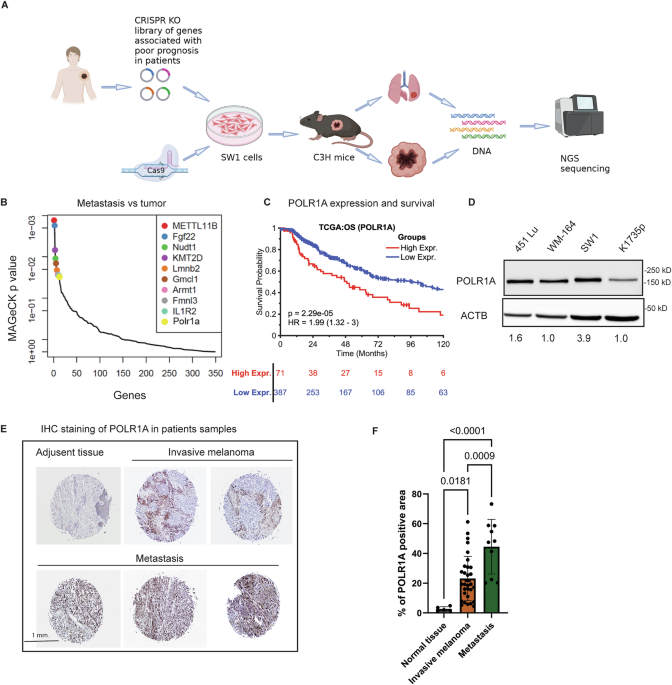
To perform an in vivo screen, we transduced enough SW1/Cas9 cells to achieve 500x sgRNA coverage with 0.3 MOI of CRISPR KO library and selected cells with puromycin. 10 days after library transduction, 1 M cells (500X coverage) were injected subcutaneously, and 1 M cells were harvested as a pre-inoculation sample. 38 days after tumor inoculation, tumors and lung metastases were harvested, with individual lung metastases being excised and pooled together, and all samples were processed for next-generation sequencing (Fig. 1A). We first examined global characteristics of the sequencing results. As anticipated, read count distributions varied significantly between samples. The Gini index was 0.1088 in the pre-implementation sample, indicating even coverage in the library at the start of the in vivo experiment. However, Gini indices rose to 0.6406 in the tumor sample and 0.6837 in the metastatic lesions sample (Fig. S1G). This suggests that marked clonal competition and evolution occurred over the course of tumor growth and continued slightly during the metastatic process. We then used MAGeCK analysis to reveal sgRNAs enriched or depleted in the metastasis compared to tumor samples. Among the identified top hits depleted from the metastasis sample, there were genes with already well-established roles in metastasis and tumorigenesis, such as KMT2D and LMNB2 (Fig. 1B), confirming the validity of this screen. Some top-scoring sgRNAs showed inconsistent enrichment trends and were excluded from further validation despite scoring significantly. From the top candidates, the Polr1a gene was selected for further validation because of its recognized cellular function and unknown role in melanoma metastasis.
Fig. 1: In vivo CRISPR knockout screen identifies Polr1a as a metastasis driver.The alternative text for this image may have been generated using AI.
A Workflow of CRISPR knockout in vivo screen to identify the potential targets for metastasis regulation. B Top depleted genes in lung metastasis versus tumors in the CRISPR KO screen. C Survival curve showing that induced expression of POLRIA correlates with lower overall survival in patients with melanoma, P < 0.005. D Western blot of Polr1a content in the non-metastatic (K1735p and WM-164) versus metastatic (SW1 and 451 Lu) melanoma cell lines. The numbers under the ACTB bands represent the quantification of the ratio of Polr1a content in metastatic/ non-metastatic cell lines. E IHC staining of POLRIA in normal human skin tissue, invasive melanoma tissue, and metastasis (representative samples from TMA are shown). F Quantification of human melanoma microarray stained with IHC for POLRIA expression (one-way ANOVA, normal tissue = 5, invasive =32, metastasis=10).
High levels of POLR1A expression correlate with higher metastatic potential and lower survival in patients
To assess the clinical relevance of our findings, we examined the association between POLR1A expression and overall survival in melanoma patients using the log-rank test with TCGA data. Gene expression and corresponding clinical data were obtained from the UCSC Xena browser (https://xenabrowser.net/datapages). The TCGA melanoma cohort included a total of 473 patients with cutaneous primary and metastatic tumors, among whom 458 had both clinical information and RNA-seq expression data available. Of these, 105 cases were primary melanomas, and 353 were metastatic melanomas. Overall survival (OS) data for these patients were originally curated by Liu et al. [19].
We evaluated the prognostic significance of POLR1A expression in both the full cohort of 458 melanoma patients (Fig. 1C) and the subset of 353 metastatic melanoma patients (Fig. S1H). High POLR1A expression was significantly associated with poorer overall survival compared to low expression in both the full cohort and the metastatic subset, with a more pronounced effect observed among patients with metastatic disease (Fig. S1H,I).
Assessment of sibling pairs of melanoma cell lines that differ in their metastatic potential revealed a substantial increase in Polr1a level in SW1 and B16F10 mouse cells in comparison with non-metastatic K1735p and B16F1, respectively (Figs. 1D; S1J). Similarly, 451Lu human metastatic cells exhibited higher Polr1a levels than their parental poorly metastatic cell line WM-164 (Fig. 1D).
IHC analysis of human melanoma tissue microarray revealed that invasive melanoma samples had significantly higher Polr1a expression in comparison with normal adjacent tissue, and Polr1a expression levels in metastatic samples were further significantly elevated in comparison with the invasive tumors (Fig. 1E, F). Overall, these results show higher levels of POLR1A in metastatic melanoma and its association with poor overall survival, further supporting our hypothesis that Polr1a plays a significant role in melanoma metastasis.
Polr1a stimulates migration and invasion of melanoma cells
At least two specific Polr1 (CX-5461) and Polr1a (BMH-21) inhibitors were developed and implemented previously in preclinical cancer models [17, 20,21,22,23]. In addition, CX-5461 is currently used in two stage 1 clinical studies in patients with solid tumors (NCT04890613; NCT06606990), one clinical trial stage 1 has already been completed (NCT02719977), and CX-5461 was shown to be well tolerated at therapeutic doses [24]. However, these small molecules were not tested for their potential anti-metastatic activities. To investigate the role of Polr1a in melanoma metastasis, we evaluated the in vitro effect of pharmacological inhibition on the proliferation and migration rates of cells.
The same doses of BMH-21 caused much smaller effects on proliferation (Fig. S2A, B) compared to migration rate (Figs. 2A; S2C, D): whereas 50 nM of BMH-21 just slightly inhibited SW1, B16F1 proliferation, it dramatically impaired the migration ability. The same effect was observed with CX-5461 treatment: while 50 nM just slightly inhibited the proliferation of B16F1 (Fig. S2E) and SW1 (Fig. S2F), it had a strong effect on the migration rate (Figs. 2B; S2G).
Fig. 2: In vitro validation of CRISPR KO screen results.The alternative text for this image may have been generated using AI.
A SW1 cells migration rate measured with the IncuCyte live cell analysis imaging system after 24 h pretreatment with corresponding doses of BMH-21 (n ≥ 3, N = 3). B B16F1 cells migration rate measured with the IncuCyte live cell analysis imaging system after 24 h pretreatment with corresponding doses of CX5461(n ≥ 3, N = 3). C SW1 cells’ migration rate measured with the IncuCyte live cell analysis imaging system. (n ≥ 3, N = 3). D Quantification of invasion of SW1 cells with Polr1a KD #3 (Mann-Whitney test, n = 4/group, N = 3) and representative pictures of cells invaded through the matrigel or migrated through the control inserts. E SW1 cells with re-expressed Polr1a migration rate measured with IncuCyte live cell analysis imaging system. (n ≥ 3, N = 3). F Western blot showing representative protein levels of Polr1a re-expressed in sh ctrl or sh Polr1a #3 SW1 cells. G A375 cells’ migration rate measured with the IncuCyte live cell analysis imaging system. (n ≥ 3, N = 3). F Quantification of the invasion rate of A375 cells and representative pictures. (Unpaired t test, t = 3.330, df=4, n = 3/group).
To further investigate the effects of Polr1a on tumorigenic properties of melanoma cells, we used the shRNA-mediated knockdown of Polr1a (shPolr1a) that efficiently decreased Polr1a protein levels (Fig. S2H), but did not affect viability (Fig. S2I), colony formation (Fig. S2J), anchorage-independent growth (Fig. S3A) and proliferation (Fig. S3B, C) of mouse melanoma cells. However, migration of SW1 (Fig. 2C) and B16F1 (Fig. S3D) mouse melanoma cells was severely impaired. Moreover, Polr1a KD led to an over 2-fold reduction in invasion of SW1 cells compared to the non-targeting shRNA control (Fig. 2D). Ectopically expressing Polr1a in the SW1 cells with Polr1a KD rescued the migration phenotype and promoted the migration rate of sh ctrl cells (Fig. 2E, F).
To support our observations in mouse melanoma cells, we generated doxycycline-induced POLR1A KD in human melanoma cells (Fig. S3, F) to investigate its impact on migration and invasion. Reduction in POLR1A level caused a notable decrease in migration (Figs. 2G; S3G, I) and invasion (Figs. 2H; S3H, J) of A375 and 451 Lu cells.
These data suggest that Polr1a downregulation particularly decreases migration and invasion of melanoma cells.
Polr1a regulates migration in an NF-κB-dependent manner
Consistent with the established role of Polr1a in transcription of ribosomal RNA, knockdown of Polr1 led to decreased Polr1-mediated transcriptional activity in SW1 cells (Fig. S4A). However, to our surprise, Ribo-seq analysis of SW1 cells upon Polr1a KD revealed no change in global translation efficiency (Fig. 3A), and the amount of 28S and 18S rRNA also did not change in shPolr1a cells (Fig. S4B). These results suggest that effects on translation of specific mRNA, rather than global translation, are likely responsible for the observed Polr1a-mediated phenotypes in melanoma cells. To further investigate this specific effect and the potential pathways regulated by Polr1a we performed a joint analysis of RNA-seq and Ribo-seq data and divided all genes into 5 groups: regulated only on transcription level (808 genes), translation level (850 genes), both transcription and translation levels (439 genes), having opposite trends in transcription and translation [4] and unchanged (19,962 genes) (Fig. 3B). KEGG enrichment pathway analysis revealed the MAPK/ NF-κB signaling pathway as the top hit affected on the translational (Fig. 3C) level by Polr1a KD. Closer evaluation of the genes regulated by Polr1a within MAPK/ NF-κB signaling revealed specific enrichment of genes belonging to the non-canonical NF-κB signaling pathway (Fig. S4C).
Fig. 3: Polr1a regulates the non-canonical NF-κB signaling pathway.The alternative text for this image may have been generated using AI.
A TE distribution violin map in each group, B Scatter plot of genes affected by Polr1a KD classified in each direction of differences in translation and transcription level based on joint analysis of RNA-seq and Ribo-seq data. Shown subgroups of genes are: “Transcription”: regulated only on transcription level (808 genes), “Translations”: regulated only on translation level (850 genes), “Homodirection”: regulated both on transcription and translation levels (439 genes), “Opposite”: having opposite trends in transcription and translation [4] and unchanged (19 962 genes). C KEGG enrichment bar chart of genes affected by Polr1a KD on translation level D Representative western blot showing protein levels of RelB and p52 in SW1 and B16F1 cells with Polr1a KD (N = 2) E NF-κB activity measured using NF-kB reporter system and dual luciferase assay in B16F1 cells with Polr1a KD, transduced with either WT p100 or mutated p100 ss/aa (2-way ANOVA, n = 3, N = 3) F B16F1 cells migration rate measured with IncuCyte live cell analysis imaging system (n = 4, N = 2) G SW1 cells with re-expressed RelB migration rate measured with IncuCyte live cell analysis imaging system (n = 4, N = 3). H Quantification of (G) at the 20 h timepoint (ordinary one-way ANOVA, n = 4). I Representative western blot showing the levels of p100, p52, and RelB in the cells used for migration assay in (G) (N = 2).
To validate the finding that Polr1a regulates the non-canonical NF-κB pathway, we performed polysome profiling of SW1 cells with subsequent analysis of NF-κB and RelB mRNA % in each monosome and polysome fraction, and confirmed that NF-κB2 and RelB translation is downregulated in the cells with Polr1a KD (Fig. S4D). Then we analyzed the levels of RelB and p52 proteins in SW1 and B16F1 cells and observed that they were downregulated in the cells with Polr1a KD (Fig. 3D). Polr1a KD caused a 2.1-fold decrease in the NF-κB transcriptional activity of B16F1 cells estimated using the luciferase reporter. To efficiently suppress non-canonical NF-κB signaling, we expressed mutant p100, which has a serine to alanine amino acid substitution (p100ss/aa) that prevents effective phosphorylation of p100 by IKKα, which in turn blocks activation of non-canonical NF-κB [25]. Ectopic expression of p100ss/aa resulted in a dramatic decrease of NF-κB activity, and that activity could no longer be regulated by Polr1a (Fig. 3E). The finding that Polr1a KD decreased NF-κB activity was confirmed in SW1 cells using another NF-κB reporter system (Fig. S4E).
To strengthen the causality argument, we induced POLR1A KD in 451Lu and A375 cells and demonstrated that p100 and RelB protein levels diminished in parallel with POLR1A reduction (Fig. S5A). Furthermore, Polr1a KD in mouse SW1 and human A375 and 451Lu melanoma cells also resulted in the downregulation of mRNA expression of target genes of the non-canonical NF-kB pathway, such as TNFSF13B, TRAF3, and Cxcl-13 (Fig. S5D, E).
Finally, we evaluated the effects of blocking the non-canonical NF-κB pathway on the migration properties of B16F1 cells. While cells with Polr1a KD had impaired migration ability in comparison with control, overexpression of mutant p100 caused inhibition of migration and negated the effect of Polr1a on the rate of migration. (Figs. 3F; S4F). Reciprocally, overexpression of transcriptional activator of non-canonical NF-κB signaling, RelB, alone or in combination with p100 (Figs. 3G–I and S5B, C), rescued the migration phenotype induced by Polr1a KD. To further evaluate possible NF-κB pathway downstream targets directly affecting migration properties, we assessed the epithelial-mesenchymal transition markers and found that vimentin and Slug were downregulated both in mouse and human Polr1a KD cells (Fig. S5F). These data further substantiate our findings that Polr1a regulates migration properties through the non-canonical NF-κB pathway.
Polr1a KD impairs the metastatic potential of melanoma cells in vivo by reducing their lung colonization ability
To further investigate the role of Polr1a in the metastatic potential of melanoma cells, we used the experimental metastasis model. Mice IV injected with SW1 cells with Polr1a KD had significantly lower metastatic burden in the lung tissue compared to the control (Figs. 4A, B; S6A). To discriminate the probability of Polr1a affecting the tumor cells’ survival in the bloodstream, we IV injected sh ctrl and sh Polr1a cells expressing luciferase and collected blood after 0.5 h, 1.5 h and 2.5 h. Polr1a KD did not significantly change the numbers of circulating tumor cells (CTC) in the bloodstream (Fig. 4C), suggesting that Polr1a may regulate later stages of the metastatic process, such as extravasation, homing and colonization of distant sites, but not survival of CTC in the bloodstream.
Fig. 4: Polr1a inhibition as a therapeutic strategy.The alternative text for this image may have been generated using AI.
A Quantification of total area of metastatic burden in lungs of mice IV injected with SW1 cells with Polr1a KD (Mann-Whitney test, n = 10/group). B H&E staining of lungs quantified in (A). C Number of CTC in mice IV injected with SW1 cells with Polr1a KD (2-way ANOVA, n = 4/group). D Tumor growth dynamics in C3H mice treated with CX-5461 (n ≥ 8 per group). Data are represented as mean ± SD. p values are comparing the control group vs CX-5461-treated group by unpaired t test with Welch correction. *P < 0.05. E Pictures of lungs with metastasis on day 37 and H&E-stained lungs. F Number of macrometastases in mice treated with CX-5461 (Mann-Whitney test, ≥ 8 per group). G Scheme of experiment to evaluate the effect of CX-5461 treatment on lung metastasis in the absence of the primary tumor. H Pictures of lungs with metastasis on day 35 after surgery and H&E-stained lungs. I Number of macrometastases in mice with resected tumors treated with CX-5461 (Mann-Whitney test, n = 7). J Quantification of tumor burden in the lung tissues (Mann-Whitney test, n = 7).
Polr1a is a potential therapeutic target for metastatic melanoma treatment
To evaluate the effect of Polr1 inhibition on spontaneous melanoma metastasis, we inoculated SW1 cells subcutaneously into the syngeneic C3H mice to generate the tumors and treated mice with CX-5461 (in previously-reported non-toxic doses [26]). CX-5461 significantly slowed down the tumor growth (Fig. 4D) and decreased final tumor mass and size (Fig. S6B, C). Finally, we observed a striking decrease in the number of lung metastases in mice treated with CX-5461 (Fig. 4E, F). To confirm this observation with human melanoma cells, we treated NSG mice bearing 451Lu tumors with CX-5461. CX-5461 significantly decelerated tumor growth and decreased the tumor masses (Fig. S6D, E). Only 20% of control mice developed lung micrometastases; however, there were no micrometastases detected in the CX-5461 group (Fig. S6F). These findings indicate that CX-5461 efficiently inhibits melanoma progression.
To confirm that the observed effect of Polr1 pharmacologic inhibition on metastasis is due to specific inhibition of bona fide metastatic properties, not just due to the inhibition of primary tumor growth, we performed survival surgeries to resect primary tumors and then analyzed lung metastases (Fig. 4G). CX-5461-treated mice did not demonstrate a decrease in body mass, which confirms the good tolerance to the drug (Tables S6; S7) and had a significantly lower number of lung metastases (Fig. 4H, I). Also, CX-5461 treatment resulted in significantly lower lung masses, evidencing the absence of the massive metastatic burden that was observed in the control group (Fig. S6G). This observation was confirmed using the quantification of H&E-stained lung specimens, which demonstrated a significant decrease in the surface area of lung tissues occupied by metastases (Fig. 4J). Thus, Polr1 inhibition specifically affects metastatic spread, independent of the effect on the primary tumor. These results demonstrate that CX-5461 exhibits a potent anti-metastatic effect. Observed in all in vivo experiments, high variability in the tumor sizes and number of lung metastases is consistent for the SW1 spontaneous metastasis model in our experience. Despite the unified genetic background of C3H mice, the immune context varies from animal to animal. Due to the complexity and multiple stages involved in the spontaneous metastasis process, metastasis counts always exhibit significant biological variation. However, this does not prevent the achievement of statistically significant differences. Finally, we assessed the immune context of tumors treated with CX-5461 and observed a trend toward reduced CD8⁺ infiltration along with a significant decrease in PD-L1 expression (Fig. S6H).
All together, these results establish a promising basis for the use of Polr1 inhibition as a strategy for the treatment of melanoma metastatic disease.
