


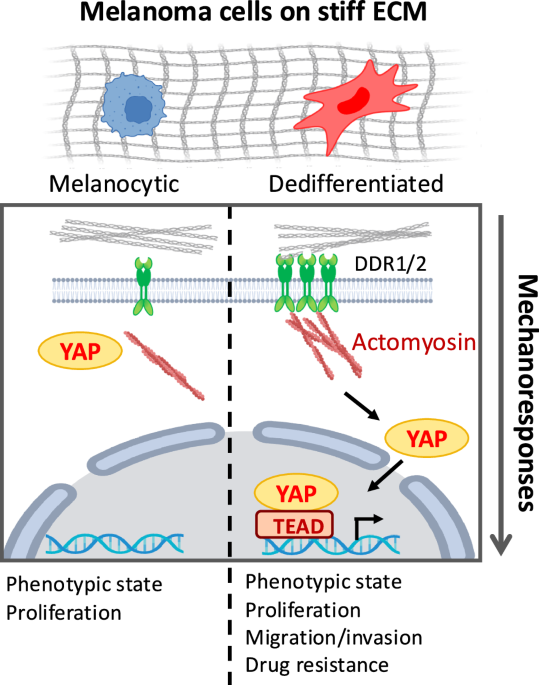
Extracellular matrix (ECM) stiffening is a biophysical hallmark of solid tumors. Cutaneous melanoma is an aggressive malignancy characterized by high heterogeneity and phenotypic plasticity in which melanoma cells switch from a proliferative and differentiated phenotype to an invasive, dedifferentiated and therapy-resistant state. However, the impact of ECM stiffness on the diverse cellular phenotypes of melanoma remains poorly defined. Here, we show that melanoma cell subpopulations differ in their responses to mechanical signals. Compared to melanocytic/transitory cells, dedifferentiated cells exhibited heightened sensitivity to stiff collagen matrices, characterized by increased cell spreading, focal adhesion maturation, YAP nuclear translocation and contractility. ECM stiffening enhanced proliferation, migration and invasion in dedifferentiated cells, whereas highly proliferative and poorly migratory melanocytic/transitory cells were less affected by collagen stiffness. Importantly, a soft ECM sensitized dedifferentiated cells, but not melanocytic/transitory cells, to BRAF/MEK inhibition. Mechanistically, the mechanosensitivity of dedifferentiated cells relies on collagen receptors DDR1 and DDR2, which control cytoskeleton reorganization and YAP mechanosignaling. Genetic or pharmacological inhibition of DDR, actomyosin contractility, or YAP suppressed stiffness-induced proliferation and migration, reduced traction forces, and restored sensitivity to targeted therapy in dedifferentiated cells. Conversely, ectopic DDR1/DDR2 expression confers mechanosensitive properties to melanocytic cells. Our results thus reveal that phenotypic plasticity endows dedifferentiated melanoma cells with increased addiction to mechanical cues and implicate DDR1/2-YAP-dependent signaling in this aggressive behavior.
The alternative text for this image may have been generated using AI.
