


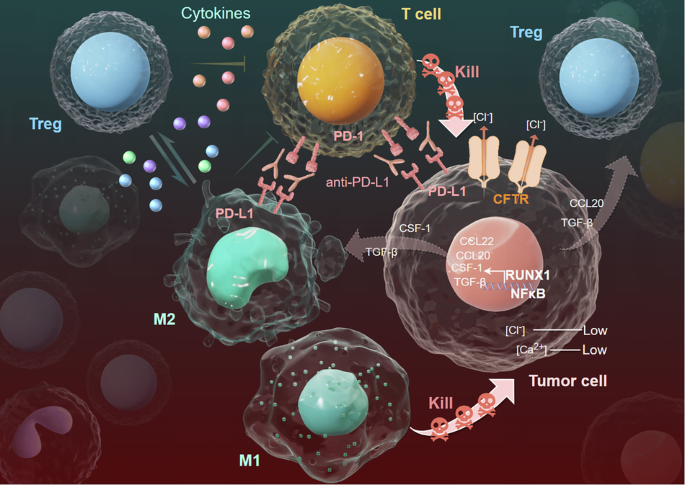
Immune checkpoint inhibitors, notably PD-1/PD-L1 monoclonal antibodies, are now used as first-line treatments for hepatocellular carcinoma (HCC) and have improved outcomes for some patients. Nevertheless, their response rate remains below 30%, largely due to HCC’s immunosuppressive microenvironment and insufficient T-cell infiltration. Strategies to address these limitations are urgently needed. Ion homeostasis has been recognized as a pivotal factor in modulating the tumor immune microenvironment. This study found that the expression and functionality of CFTR, a chloride channel, in human HCC tissues and cells were negatively correlated with HCC progression. Furthermore, it was utilized human/murine HCC cell lines, mouse models, and human HCC organoids to investigate how CFTR activation (genetic/pharmacological) impacts HCC biology. Key assessments included: (1) tumor cell ion homeostasis, (2) downstream signaling proteins, (3) tumor microenvironment cytokine levels, and (4) functional changes in TAMs, CD8 + T cells, and Tregs. We further assessed combined effects with PD-L1 antibodies to explore CFTR-immune checkpoint interplay, providing multidimensional insights into CFTR-mediated HCC pathogenesis and immunomodulation. The results showed that upregulation of CFTR expression and channel activity reduced intracellular Cl⁻ and Ca²⁺ concentrations in HCC cells, thereby suppressing the expression of chloride-associated transcription factor RUNX1 and calcium pathway transcription factor NF-κB. This regulatory mechanism orchestrates the synthesis and secretion of cytokines/chemokines (CSF-1, TGF-β, CCL20, CCL22), driving macrophage polarization toward M1 phenotype while promoting M1 macrophage and CD8 + T lymphocyte infiltration. Concurrently, it suppressed Treg proliferation and tumor infiltration. These immunomodulatory effects synergistically enhanced PD-1/PD-L1 immune checkpoint blockade efficacy, ultimately augmenting therapeutic outcomes in HCC. Therefore, this study establishes CFTR potentiation as a novel immunomodulatory axis, proposing biomarker-driven combination regimens to enhance therapeutic efficacy while mitigating immune-related adverse events, thereby addressing an urgent unmet need in translational hepatology.
The alternative text for this image may have been generated using AI.
