


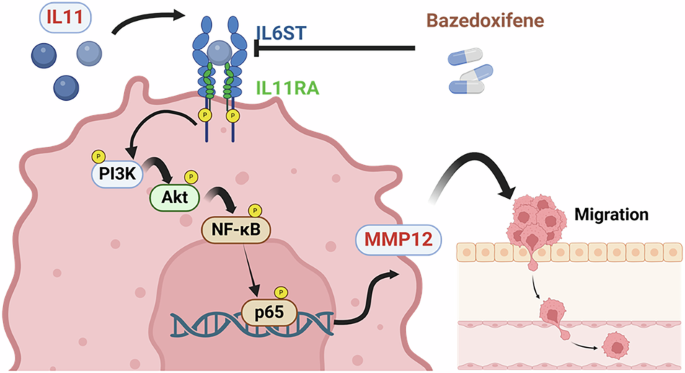
Lung cancer is a leading cause of cancer-related mortality, with metastasis significantly reducing patient survival. Interleukin 11 (IL11), a member of the IL-6 cytokine family, has been associated with cancer progression, yet its role in non-small cell lung cancer (NSCLC) metastasis remains unclear. This study analyzed public datasets and demonstrated that IL11 is upregulated in NSCLC and correlates with lymphatic metastasis and poor prognosis. Functional assays revealed that IL11 enhances lung cancer cell migration through upregulation of matrix metalloproteinase 12 (MMP12). Mechanistically, IL11 acts via the IL11 receptor subunit alpha (IL11RA)/ IL6 cytokine family signal transducer (IL6ST) complex to activate the PI3K/Akt/NF-κB signaling pathway, which in turn drives MMP12 expression and promotes metastatic behavior. Notably, the clinically approved selective estrogen receptor modulator bazedoxifene effectively inhibited IL11-induced signaling, reduced MMP12 levels, and suppressed cancer cell migration in vitro. In an orthotopic lung cancer mouse model, IL11 knockdown significantly reduced tumor growth and intrapulmonary spread, accompanied by decreased IL11, MMP12, and phosphorylated NF-κB p65 levels in lung tissues. These findings uncover a novel IL11-driven pathway contributing to metastatic behavior in NSCLC and identify the IL11/IL11RA/IL6ST axis as a potential therapeutic target.
The alternative text for this image may have been generated using AI.
Schematic representation of bazedoxifene-mediated suppression of IL11-induced pro-metastatic signaling in lung cancer. Non-small cell lung cancer (NSCLC) cells secrete IL11, which binds to the IL11RA/IL6ST receptor complex and activates the PI3K/Akt signaling pathway. This activation enhances NF-κB transcriptional activity, leading to upregulated MMP12 expression and promoting lung cancer cell migration. Notably, bazedoxifene effectively blocks IL11-induced PI3K/Akt activation, thereby suppressing NF-κB signaling and reducing MMP12 expression, which ultimately attenuates NSCLC metastasis.
