


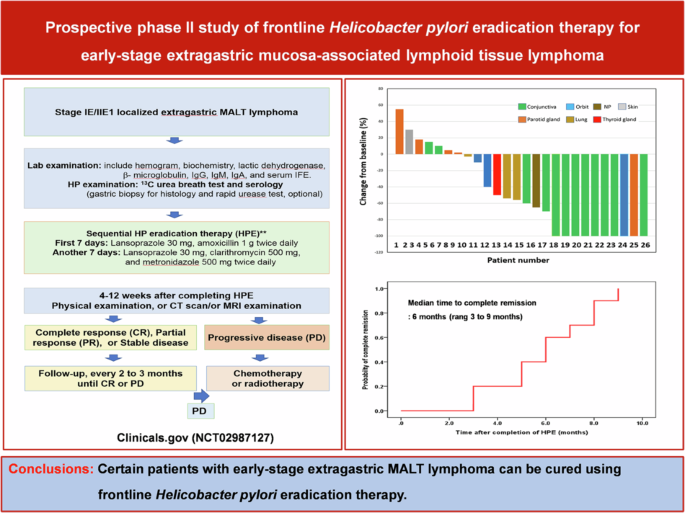
To the best of our knowledge, this is the first study to reveal that a few patients with localized extragastric MALT lymphoma can be treated successfully using frontline HPE and are long-term lymphoma-free after HPE. In this study, among 15 patients with ocular adnexal MALT lymphoma (OAML), eight with conjunctival and one with orbital MALT lymphoma achieved CR, whereas two with conjunctival and one with orbital MALT lymphoma achieved PR. These findings indicate that frontline HPE is effective in the treatment of patients with localized OAML.
In this study, we detected HP infection in the stomach of five patients based on histological findings of HP in gastric biopsy samples. Additionally, the rapid urease test, which measures an increase in reagent pH, was used to identify HP infection in the stomachs of three patients. We previously discovered that HP can directly translocate CagA into B lymphocytes via phosphorylation, after which it interacts with SHP-2 to activate ERK/p38 MAPK and upregulate BCL2 and Bcl-xL, thereby promoting B-cell survival in MALT lymphoma [7]. Furthermore, CagA expression in lymphoma cells was significantly correlated with the CR status of patients with gastric MALT lymphoma who received frontline HPE [8]. In this study, we evaluated the expression of CagA in the original tumor cells of 22 cases of extragastric MALT lymphoma. We detected CagA in the tumor cells of eight (66.7%) of the 12 patients with gastric HP-positive status (all CR), but not in patients with gastric HP-negative status (P = 0.002) (Fig. S3). Our results suggest that the HP-encoded CagA oncoprotein may directly participate in lymphomagenesis in a proportion of antibiotic-responsive extragastric MALT lymphomas, even though we did not use PCR to evaluate HP infection in primary tumors.
In a recent pooled analysis that detects infection by assessing the DNA of HP in samples of ocular adnexal lymphoma (OAL) or HP-associated gastric infection (serology, culture, histology, or rapid urease test) from 11 studies, the presence of HP infection was detected in 16.8% (95% CI, 2.7% to 59.1%) of patients with OAL and in 22.7% (95% CI, 2.9% to 74.3%) of patients with OAML [9]. However, the heterogeneity in the prevalence rate of HP in patients from the aforementioned 11 studies was high [9]. Among these studies, a large cohort study (83 patients with OAL, 101 with extra-OAL, and 61 with ocular MALT lymphoma/lymphoplasmacytoma [LPL]) conducted in France by Decaudin et al. reported a significant correlation between HP infection in gastric tissue samples (histopathological analysis and HP-specific PCR assessment) and ocular MALT lymphoma/LPL when compared with ocular non-MALT lymphoma/LPL (44% vs. 29%, P = 0.003) [10]. By assessing HP infection using the urea breath test, histology, and serology, Gruenberger et al. showed that the positive rate of HP infection was 38% in 45 Austrian patients with OAML [11]. Hasosah et al. reported the case of a patient with localized MALT lymphoma of the lacrimal gland, and HP was detected using the rapid urease test and histology of gastric biopsy samples. CR was achieved 12 months after HPE and the patient remained lymphoma-free 4 years after completion of HPE [12]. These findings revealed that gastric HP infection may be associated with the tumorigenesis of OAML.
In addition to OAML, one patient with parotid gland MALT lymphoma (presence of gastric HP infection) achieved CR after HPE, and two patients with pulmonary MALT lymphoma (one patient with gastric HP infection) achieved PR after HPE. A previous anecdotal case series showed that two patients with salivary gland MALT lymphoma had a gastric HP infection and achieved CRs at 6 and 22 months after starting frontline HPE [2]. Berrebi et al. showed that a 10-year-old boy who presented with MALT lymphoma of the labial minor salivary gland and had histological HP infection in gastritis samples achieved CR after successful eradication of HP via 3 weeks of HPE [13]. Ishimatsu et al. reported that two patients with pulmonary MALT lymphoma responded well to the long-term administration of clarithromycin (200 mg/d for several months) [14].
In the case of antibiotic-responsive extragastric MALT lymphoma with gastric HP infection but no HP infection in the original tumors, we hypothesized that continuous HP stimulation may activate B lymphocytes in the gastric milieu through their interaction with HP-specific T cells. These B lymphocytes may then develop into malignant B-cell clones, which may eventually spread to the extragastric mucosal regions and cause MALT lymphoma. Antigen presentation in the stomach and stimulation of HP-specific T cells homing to the extragastric milieu are interrupted once HP is eradicated by HPE, causing regression of lymphomas in extragastric locations. However, we cannot exclude the possibility that HPE regimens may eliminate unidentified bacteria linked to the development of antibiotic-responsive extragastric MALT lymphoma in patients without HP infection in the extragastric and gastric areas by reducing the interaction between antigen presentation and microenvironmental T cells or survival signaling triggered by unidentified bacteria.
Despite the lack of gastric HP infection, Kikuchi et al. described three patients with colonic MALT lymphoma whose tumors invaded beyond the deep submucosal layer but completely regressed after frontline HPE [15]. Niino et al. examined the effectiveness of antibiotics consisting of amoxicillin and clarithromycin in patients with rectal MALT lymphoma and found that five (62.5%) of eight patients had CR, four (80.0%) of whom had gastric HP infection according to HP test results [16]. In addition to eradicating bacteria, the macrolide antibiotic clarithromycin, which is frequently used as the primary component of the HPE regimen, may have direct antineoplastic effects, such as increasing apoptotic activity and decreasing NF-κB activity, or immunomodulatory effects, such as increasing nature killer and CD8 cell levels and decreasing IL-6 production [17, 18].
In a pilot study examining the effectiveness of the long-term administration of 500 mg of clarithromycin twice daily for 6 months in 13 patients with relapsed or refractory MALT lymphoma (including one patient with HP infection and four patients with Chlamydia psittaci (CP) infection; eight patients received frontline doxycycline), Govi et al. reported that five of 13 patients (38.5%) achieved an overall response (two with CR and three with PR), with responses observed OAML lesions [19]. The frontline clarithromycin treatment efficacy (CR) was consistent with two OAML case reports: one patient received 500 mg of clarithromycin three times daily for 21 d, whereas the other patient (who had neither HP nor CP infection) received 500 mg twice daily for 28 d [20, 21]. Furthermore, in a phase II trial investigating the use of 2000 mg of clarithromycin (days 1–14, every 21 d) for four courses in 23 patients with relapsed or refractory MALT lymphoma, Ferreri et al. observed an ORR of 52.2% (six patients with CR and six patients with PR) [22]. However, at the time of enrollment, neither HP nor CP infections were found in the registered patients, suggesting that the antineoplastic effect of clarithromycin may not result from an antimicrobial effect.
The antibiotic regimens used in this trial, which included lansoprazole 30 mg and amoxicillin 1000 mg for the first week and lansoprazole 30 mg, clarithromycin 500 mg, and metronidazole 500 mg for the second week, were primarily intended to eradicate HP rather than CP. Additionally, our study’s use of 1000 mg/d of clarithromycin for 1 week differed from earlier clinical studies that used a long-term course of 1000 mg/d of clarithromycin for 6 months and four courses of 2000 mg/d of clarithromycin, as well as case reports that used 1000 mg/d of clarithromycin for 4 weeks or 1500 mg/d for 3 weeks [19,20,21,22].
Further studies are warranted to assess HP infection in the gastric and extragastric areas by PCR and to evaluate CagA protein expression in tumor samples from the extragastric area in patients with extragastric MALT lymphoma. It is worth determining whether immune-related molecules, tumor-infiltrating T cells, costimulatory molecules, cytokines, and chemokines linked to the lymphomagenesis of HP-dependent gastric MALT lymphoma also contribute to the antibiotic-responsive mechanisms of extragastric MALT lymphoma. Further exploration of unknown bacteria involved in lymphomagenesis and investigation of the molecular mechanisms and immune responses of this HP-negative extragastric MALT lymphoma that responds to antibiotic treatment are warranted.
Previous studies have revealed that t(11;18)(p21;q21) is a crucial biomarker for predicting the antibiotic-unresponsive gastric MALT lymphomas [23, 24]. Notably, t(11;18)(p21;q21) has been more frequently detected in MALT lymphomas of the stomach, lung, and ocular adnexal area, but is rarely observed in lesions of the salivary gland, thyroid, and skin [25, 26]. However, the association between t(11;18)(p21;q21) and antibiotic unresponsiveness in extragastric MALT lymphoma remains unclear. To the best of our knowledge, this is the first study to show a significant correlation between t(11;18)(p21;q21) and antibiotic unresponsiveness in patients receiving frontline HPE for limited-stage extragastric MALT lymphoma. Previous studies have shown that t(11;18)(p21;q21), which forms a fusion protein of BIRC3-MALT1, constitutively promotes lymphoma cell growth by activating canonical and noncanonical NF-κB signaling [26, 27]. Constitutive activation of NF-κB by t(11;18)(p21;q21) may contribute to antibiotic unresponsiveness in extragastric MALT lymphoma. In this study, we found that the presence of t(11;18)(q21;q21) was significantly associated with non-CR status among patients with extragastric MALT lymphoma, supporting the biological significance of t(11;18)(q21;q21) in contributing to antibiotic unresponsiveness in extragastric MALT lymphoma.
A 14-d regimen is widely used as the standard therapy for HP infections in Taiwan. The prevalence of clarithromycin resistance in Taiwan ranged from 16% to 21% (39/243 and 53/251) in multicenter studies [28]. In a large Taiwanese randomized trial, the intention-to-treat eradication rates were 90.4% for a 10-d bismuth quadruple therapy, 85.9% for a 10-d concomitant therapy, and 83.7% for a 14-d triple therapy [29]. Additionally, a multicenter randomized trial demonstrated that 14-d sequential therapy achieved an eradication rate of 90.7%, which was significantly higher than that of 14-d triple therapy (82.3%) [6]. Therefore, in this study, we use a 14-d sequential therapy for frontline HPE regimen. We agree that P-cab (vonoprazan)-based therapy achieves higher eradication rates than proton pump inhibitor (PPI)-based therapy [30]. With its increasing availability in Taiwan, vonoprazan is expected to further improve eradication success. We conclude that improved HP eradication, particularly with vonoprazan, may enhance CR rates in gastric MALT lymphoma, thereby supporting the therapeutic role of eradication therapy for extragastric MALT lymphoma. Further clinical trials are warranted to evaluate the therapeutic responses to frontline vonoprazan-based HPE regimens in patients with HP-positive localized extragastric MALT lymphoma.
In summary, the current study showed that a proportion of patients with extragastric MALT lymphoma are responsive to frontline HPE regimens, especially in cases of positive HP infection or OAML. Considering that extragastric MALT lymphoma is an indolent lymphoma [31, 32], a trial involving 2 weeks of frontline antibiotics, such as the HPE regimen, is required for patients with localized extragastric MALT lymphoma before starting systemic chemotherapy, immunotherapy, and radiotherapy.
