


Population
This longitudinal observational study was performed in the CCSS, a multi-institutional, hospital-based retrospectively-constructed cohort with longitudinal follow-up of childhood cancer survivors that were diagnosed and treated at 31 institutions in the US and Canada4,6,16,17,40,41. The CCSS included those who had received a cancer diagnosis at age <21 years between 1970 and 1999, and who were alive five years after the diagnosis. The study methods and design have been described in detail previously42. This study complies with all relevant ethical regulations. The CCSS was approved by the institutional review boards at each of the 31 participating centers, with current continuing review at St. Jude Children´s Research Hospital of January 2026, with expiry date January 30th, 2027. All participants provided written informed consent. Participants received USD 10 per completed follow-up survey. CCSS participants were included in our analysis if they were ≥18 years at their first questionnaire-based assessment and had participated in at least two questionnaires, contributing data on exposures and outcomes from different questionnaires. To compare the associations between lifestyle and CHCs in childhood cancer survivors with the associations in non-survivor controls, we included sibling controls from the CCSS.
Exposures
Self-reported data on smoking status, alcohol consumption, body weight and height, and vigorous physical activity were collected from each questionnaire. The questions used have been described previously16,27,28. Responses for each lifestyle behavior were categorized and scored6. Smoking was dichotomized as having ever smoked ≥100 cigarettes (0 point)6 or not (1 point). Alcohol consumption was dichotomized as having heavy or risky drinking ( > 7 drinks per week or >3 drinks per day for women, and >14 drinks per week or >4 drinks per day for men, 0 point) or not (1 point)43. BMI (kg/m2) was calculated using weight and height and categorized as underweight or normal weight ( < 25 kg/m2, 1 point), overweight (25–29.9 kg/m2, 0.5 point), or obese ( ≥ 30 kg/m2, 0 point). Self-reported vigorous physical activity was converted into average metabolic equivalent task (MET) hours per week16, and was categorized as sedentary (0- < 3 MET-h/wk, 0 point), low physical activity (3–8 MET-h/wk, 0.5 point), or sufficient ( ≥ 9 MET-h/wk, 1 point), approximating to <20, 20 to <60, or ≥60 minutes of vigorous physical activity per week, respectively6. The four scores were summed for a combined lifestyle score (0–4 points) at each questionnaire and categorized as unhealthy (0–2), moderately healthy (2.5–3), or healthy (3.5–4). This score has been used previously and was associated with late excess mortality, except our study added 0.5 for overweight, resulting in 0.5 point increase in the score range for our study6.
Outcomes
The time of first occurrence of each CHC over time was assessed by a series of questions in every study questionnaire, available at www.ccss.stjude.org. 42,44 Using a well-established algorithm, a multidisciplinary team reviewed and adjudicated all reported conditions, which were graded and scored according to the National Cancer Institute’s Common Terminology Criteria for Adverse Events (CTCAE v4.03)45.
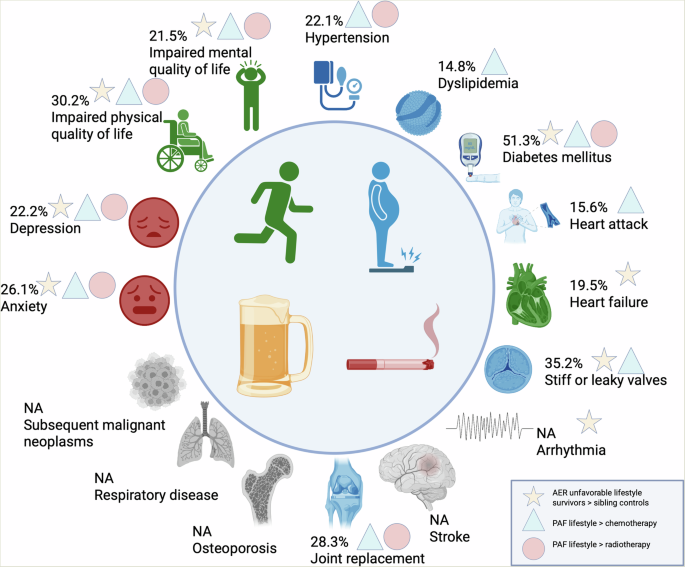
Outcomes of emotional distress included depression and anxiety and were assessed cross-sectionally with the 18-item Brief Symptom Inventory-18 (BSI-18), which includes symptoms over the previous 7 days46. Raw scores were converted to T-scores based on U.S. population norms and dichotomized using a cut-point of 63; for depression and anxiety, participants with a T-score ≥63 (90th percentile) were classified as having clinically significant concerns46. The Medical Outcomes Short Form-36 (SF-36) was used to evaluate health-related QoL cross-sectionally46. Participants answered 36 questions about general health, well-being, and quality of life over the previous 4 weeks. The SF-36 has two component summary scales, physical and mental (PCS and MCS, respectively). For each summary scale, T scores ≤40, corresponding to 1 standard deviation below the mean of the US general population, were categorized as impaired. The PCS and MCS are referred to as physical and mental QoL in the manuscript.
The following CHCs were prespecified for inclusion in our analysis, all known to be associated with lifestyle in the general population12: hypertension (CTCAE grades 2-5), dyslipidemia (CTCAE 2-5), diabetes mellitus (CTCAE 2-5), heart attack (CTCAE 3-5), heart failure (CTCAE 3-5), valvular heart disease (CTCAE 4-5), arrhythmia (CTCAE 2-5), stroke (CTCAE 4-5), joint replacement (CTCAE 3-5), osteoporosis (CTCAE 2-5), respiratory disease (CTCAE 1-5), SMNs (CTCAE 3-5), anxiety, depression, and impaired QoL (PCS and MCS).
Cancer treatments
Data regarding childhood cancer diagnosis and treatment in the five years following diagnosis, including chemotherapy and radiotherapy exposures, were extracted from medical records of all participants42. We included exposures (yes/no) to a range of chemotherapy classes and radiation exposure to relevant organs (yes/no). The treatment exposures to be included in the analyses for each CHC were based international guidelines, where applicable9,10, and using backward selection for CHCs where no consensus was available. The treatment exposures of interest are listed in Table 1.
Statistics and reproducibility
Analyses were performed according to a pre-specified statistical analysis plan, available online (https://ccss.stjude.org/design-a-study/process/approved-concept-proposals.html)47. No formal sample size/power calculation was performed as this was an analysis of an existing database and there were several primary outcomes48. All eligible participants in the CCSS who met the inclusion criteria were included in the analyses. Participants with pre-existing conditions were excluded from specific outcome analyses. No randomization or blinding was performed, as this was an observational study.
Associations between lifestyle score and subsequent CHCs were analyzed with piecewise exponential models with the start of the at-risk time at the first questionnaire (baseline) with information on lifestyle (the exposure) and the end at the earliest of the target CHC(s), death, or last follow-up. Since lifestyle behaviors are dynamic and assessed at multiple questionnaire time-points, they were included as time-varying covariates (changes at the midpoints between adjacent questionnaires) so that changes over time are accounted for in the analyses. Since lifestyle impacts health over long time periods and to minimize the possibility of bias due to reverse causality from lifestyle change or weight loss prompted by chronic illness (such as low physical activity due to progressive heart failure), only lifestyle scores at least five years prior to the event of interest were considered (time-dependent)6. Associations between the lifestyle score and emotional distress (depression/anxiety) and health-related QoL were analyzed using logistic regression models with generalized estimating equations to account for potential correlation across longitudinal measurements of the same individual. All analyses were adjusted for potential confounders, selected based on a hypothesized directed acyclic graph: attained age as cubic splines, self-reported sex, race/ethnicity, age at cancer diagnosis, time-dependent socioeconomic status (SES) including education, marriage status, household income, and insurance, and treatment exposures. Socioeconomic status was categorized as in Table 1. The treatment exposures were chosen from backward selection for each outcome. Attained age was modeled using restricted cubic splines with five knots placed at the 5th, 25th, 50th, 75th, and 95th percentiles of the age distribution to allow for non-linear associations with each outcome. To evaluate whether associations between lifestyle and outcomes differed across age, interaction terms between attained age and the lifestyle score were assessed using likelihood ratio tests. Associations between the individual lifestyle components and the outcomes were assessed with piecewise exponential models, as in the primary analyses but including smoking, heavy/risky drinking, physical activity, and BMI independently instead of the lifestyle score. All statistical tests were two-sided. All analyses were performed in SAS 9.4.
The outcomes were analyzed separately, each as an outcome of interest, with death due to other causes in the analysis of a specific CHC being the only competing risk event. No correction was performed for multiple testing since all outcomes were distinct hypotheses of individual interest, and the significance level was set to 5%. Results are presented as RR estimates with standard large-sample 95% confidence intervals (CI). PAF was estimated as (observed event counts–expected event count)/observed, where expected is the count assuming each participant’s lifestyle as being healthy. AER was estimated (observed event counts–expected event count)/person-year in childhood cancer survivor and in sibling controls. For emotional distress (depression/anxiety) and QoL, risk reduction was estimated: (expected probability in the unhealthy–expected probability assuming this group is healthy). Nonparametric bootstrap was used to test statistical significance of the differences in AERs by resampling families49.
Reporting summary
Further information on research design is available in the Nature Portfolio Reporting Summary linked to this article.
