


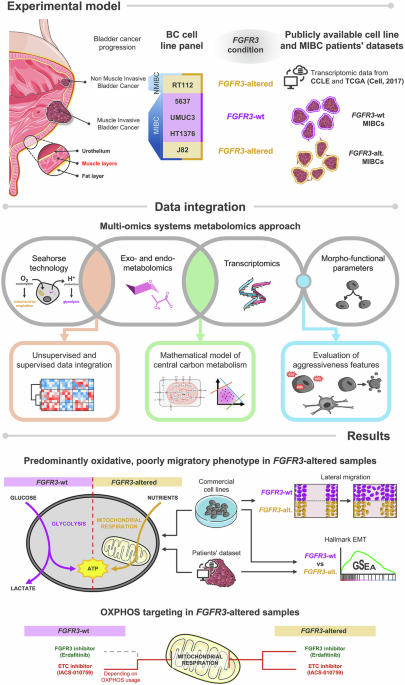
Bladder cancer is one of the most common malignancies worldwide, impacting public health systems due to its high rate of recurrence. Metabolic alterations enable the identification of novel, needed prognostic markers and therapeutic vulnerabilities for precision oncology. Here, we use a systems metabolomics approach that integrates metabolic functional data with multi-omics, transcriptomics and metabolomics, through biostatistics and mathematical modelling to characterise metabolic rearrangements associated with FGFR3 oncogenic activation, one of the most frequent lesions in bladder cancer. The analyses conducted on a panel of five human bladder cancer cell lines reveal a significant correlation between FGFR3 alterations and the acquisition of a predominantly oxidative, poorly migratory phenotype, regardless of tumour progression. These preclinical results, validated through FGFR3 and oxidative phosphorylation pharmacological inhibition, and computational analysis on bladder cancer cell line and patient publicly available datasets, support the therapeutic potential of targeting oxidative metabolism in FGFR3-altered tumours, including more aggressive subtypes.
The alternative text for this image may have been generated using AI.
