


Drawing offers a powerful means of expressing lived experience when words fail. This commentary analyzes the final drawings of a woman with breast cancer, examining how her artwork reflects an evolving confrontation with mortality across diagnosis, recurrence, and metastatic disease. Grounded in existential psychology, the article highlights grief, hope, faith, and death awareness, and argues for integrating psychological and spiritual perspectives into palliative and end-of-life care for patients and families.
Drawing pictures is a fundamental human activity that expresses and intensifies our experience of existence in the world1. It serves as a therapeutic process that allows mute, wordless, and silent emotions to find expression and release through the body2. There are over a million end-of-life visualization images of cancer patients on various platforms. These images foster understanding of the end-of-life experience in cancer care and evoke empathy in viewers3,4.
The authors were the patient’s treating oncologists and followed her clinical course over many years in this article. Throughout this period, a close physician–patient relationship developed, during which the patient intermittently shared her drawings with her physicians. The interpretations presented in this article are therefore based not only on the authors’ reflections as clinicians, but also on conversations held with the patient while she was alive, during which she voluntarily described the emotions, meanings, and personal experiences reflected in her artwork at different stages of her illness.
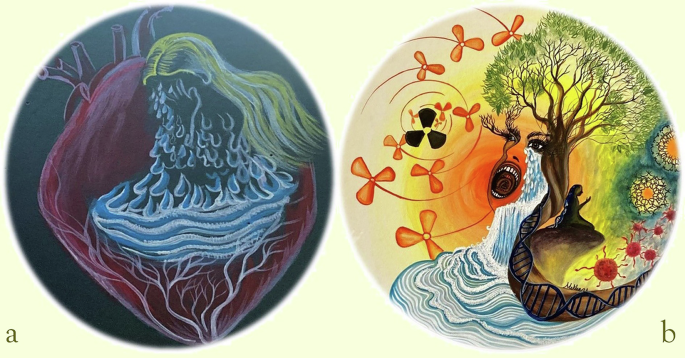
Among visual narratives, the most compelling are those depicting real patient stories5,6, such as the drawings created by this patient, who deeply experienced the reality of death (Fig. 1). These drawings highlight the emotional and spiritual experiences individuals undergo as they approach the end of life. This article suggests that confronting death should be recognized as a significant emotional response—alongside fear, anxiety, and anger—as it reflects core aspects of self and identity, as exemplified by the final drawings of a woman with breast cancer during her decline.
Fig. 1: Pages from the visual diary created by painter Melike Nur Uzunoğlu during the final stage of her cancer journey consist of drawings that reflect the evolving emotional and existential landscape of the disease.The alternative text for this image may have been generated using AI.
a The Feelings of Recurrence (2019), portraying sorrow and inner withdrawal following disease recurrence. b The Cry of Feelings Before Death (2023), drawn shortly before her death, expressing profound vulnerability, suffering, and hope. Some drawings from the terminal stage of the illness were not shared during the patient’s lifetime and were recognized only after her death, highlighting art as an intimate and private space for confronting mortality. (Copyright of the images belongs to the author).
At the age of 29, the patient was diagnosed with breast cancer for the first time and was confident she would overcome the disease. In 2011, she underwent breast-conserving surgery and completed adjuvant treatments. However, in 2019—8 years after her initial diagnosis—she received a second cancer diagnosis during the coronavirus pandemic. A metachronous tumor developed in the contralateral breast, along with metastatic involvement of the same breast. In a drawing from this period (Fig. 1a), she depicted her sadness by illustrating herself sheltering within her heart, accompanied by tears. Her second battle lasted four years, and she passed away in 2023 at the age of 41. As radiotherapy, chemotherapy, hormone therapy, and genetic–molecular treatments failed to control the disease, her emotional distress became increasingly visible in her artwork (Fig. 1b), characterized by tears streaming down her face. In a drawing created shortly before her death, she imagined herself sprouting anew like a tree, expressing faith in newly initiated genetic–molecular treatments after previous therapies had failed to respond to her suffering.
At this stage, genetic testing revealed a PIK3CA mutation. Treatment with pimreva (alpelisib) was initiated using medication obtained by the patient from abroad at her own expense. She continued this treatment until her admission to the intensive care unit, approximately one week before her death. Despite treatment, the disease progressed, and she ultimately died due to widespread lung, liver, and bone metastases.
Had she been a poet, she might have expressed her feelings through the following poem, adapted from Orhan Veli Kanık:
If I cry, can you hear my voice?
To the tears in my paintings, with your hands?
I didn’t know pain could be this deep,
Or that words were inadequate
Before I fell into this cancer.
There is a place, I know;
Where everything can be said;
I’ve come quite close, I can feel it
As treating physicians, we were not merely observers but active participants in a long and emotionally demanding therapeutic relationship. Periods of clinical response were accompanied by hope and cautious optimism, whereas disease progression and treatment failure evoked frustration, helplessness, and moral distress. Accompanying a young patient through repeated recurrences and ultimately death confronted us with the limits of medicine and led us to reflect on the meaning of care, responsibility, and shared humanity at the end of life.
Individuals cannot fully comprehend another person’s personal experience of death7,8. Death is “the loneliest torment”8,9. Death carries a “spiritual and existential weight” due to its physical and cognitive aspects”10. When an individual fears death, this situation leads to “non-existence or inauthentic existence,” characterized by any one of four main existential anxieties. These are meaninglessness, responsibility for a meaningful life, freedom, and death10. When an individual “embraces /faces death”—there is a potential for enlightenment or eternity. The concept of “embracing death” lies at the heart of Yalom’s existential-enlightenment definition of death11. After losing his wife Marilyn, Yalom addressed death, love, and the complex emotions associated with loss in his book “A Matter of Death and Life”12. He has stated that a person’s life experiences play an important role in their perception of death. He has also pointed out the paradoxical nature of death: “Although the physicality of death destroys us, the idea of death can save us”12,13. Facing death is actually liberating for patients and their loved ones. Death is frightening because of its universal nature and the anxiety it evokes. Moreover, death is inevitable and all around14.
How can we come to terms with the inevitable reality of death for all humanity?
“The acceptance of death approach”—Results from the natural flow of life and the eternal laws that govern the world. The idea of death is simplified in people’s minds by the logic that “what exists must die”15, stemming from the assumption that “there is no point in discussing this.”
“Worldview-based approach”—Individuals who possess a vision of the afterlife that guarantees existence after death and meets the expectations of their cultures and sacred religions can face death16,17.
“The existentialist approach”—Viewed from the perspective of one’s own finitude, concludes that the most compelling image of the self is one of complete acceptance of one’s own death13.
There are two effective approaches to avoiding facing death: the “anxiety-based approach,” which involves concerns about death and its physical aspects, the funeral process, and being a burden to others, and the “avoidance approach,” which involves not thinking about death18. The approach we observed in our patient, described as an inability to face death, can be added here as the “doctor and patient approach” that makes one “forget and ignore death,” which can be considered “the approach of living/keeping alive forever” attributed to new treatment possibilities.
In addition to palliative end-of-life support, psycho-oncological and spiritual support that are appropriate to the individual’s beliefs can be provided to terminally ill patients. The fundamental doctrines and teachings of religions accept death as an inevitable part of life. Death is considered a transition and a new beginning rather than an end. In numerous belief systems, our life and death belong to the Creator. After death, we return to Him19. Death occurs only by the command of the Creator20,21. Thanks to this belief, each individual can find comfort in surrendering to divine providence, which governs the timing and manner of their death. Research shows that when patients receive comprehensive support that meets their physical, emotional, and spiritual needs, they tend to experience greater overall well-being in the final stages of life2,22,23.
As a result, the aggressive nature of cancer, the availability of multiple treatment options, healthcare providers’ desire to prolong life, societal expectations regarding cancer treatment, and the interest of patients or their families in novel therapies often lead to an ongoing search for new treatments. This tendency is largely driven by the focus of advanced medical technology and the contemporary medical community on survival rates. Taken together, these factors may cause patients to become alienated from the reality of death they ultimately must face. While the patient shared many of her drawings with her physicians during the course of her illness, several works created near the end of life were discovered only after her death during a visit to her family, underscoring art as a deeply personal and sometimes private space for confronting mortality.
In this context, the patient’s drawings function not merely as illustrations of illness but as a coping mechanism and communicative tool through which emotional, existential, and spiritual distress could be expressed when verbal articulation was insufficient.
Integrating spiritual support into end-of-life palliative care allows the patient’s overall well-being to be prioritized. Confronting death can be facilitated through the intersection of physical treatment with psycho-oncological and spiritual support. Such an approach may lead to improved psychological support for both patients and their families and promote a more humane model of end-of-life care—one that emphasizes comfort, meaning, and quality of life rather than aggressive treatment measures alone.
