


Notch1 and Notch2 expression in BrCa cells and their role in the interaction with SNOs
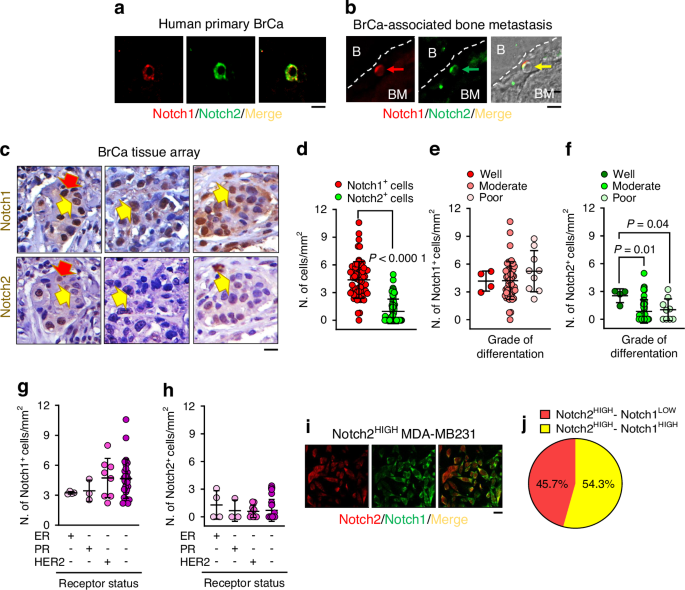
To investigate whether Notch1 and Notch2 were expressed in BrCa cells, we performed double immunofluorescence for Notch1 and Notch2 in human primary BrCa tissue and associated bone metastasis, derived from our internal tissue biobank. Figure 1a and Fig. S1a show primary cancer cell co-expressing Notch1 and Notch2. Similar Notch1 and Notch2 co-staining was observed in single cancer cells located near the endosteum in a sample of human BrCa-associated bone metastasis (Fig. 1b, Fig. S1b). Furthermore, single immunohistochemistry for Notch1 and Notch2 in serial sections of human BrCa tissue array (Table S1) revealed a higher number of Notch1+ cells compared to Notch2+ cells in contiguous sections (Fig. S1c). Most Notch1+ cells were Notch2- (yellow arrows), while only a small number of them was positive to both Notches (red arrows) (Fig. 1c). Quantitative evaluations confirmed that Notch1+ cells were more numerous in primary BrCa compared to Notch2+ cells (Fig. 1d), with no differences associated with the grade of tumour differentiation (Fig. 1e). In contrast, Notch2+ cells were less numerous in moderately and poorly differentiated cancers vs well differentiated cancers (Fig. 1f).
Fig. 1The alternative text for this image may have been generated using AI.
Expression of Notch1 and Notch2 in BrCa. a Immunofluorescence detection of a Notch1+/Notch2+ cell in a primary BrCa sample. b Immunofluorescence detection of a Notch1+/Notch2+ cell (arrow) located near the endosteal surface (dotted line) in an associated bone metastasis. B: bone; BM: bone marrow. c Immunohistochemical detection of Notch1+ and Notch2+ cells in a BrCa tissue array. Yellow arrows: Notch1+/Notch2− cells; red arrows: Notch1+/Notch2+ cells. d Quantification of Notch1+ and Notch2+ cells in the tissue array analysed in (c). e Stratification of Notch1+ and f Notch2+ cells according to the grade of BrCa differentiation. g Distribution of Notch1+ and h Notch2+ cells in BrCa tissue array samples according to the oestrogen receptor (ER), progesterone receptor (PR) and human epidermal growth factor receptor 2 (HER2) status. i Co-expression of Notch1 in MDA-MB231 BrCa cells sorted for high expression of Notch2 (Notch2HIGH). j Evaluation of the percentage of MACS-sorted Notch2HIGH MDA-MB231 cells expressing low (red) or high (yellow) levels of Notch1. Results are representative (a–c, i) (bars = 10 µm) or the mean ± SD (d–h, j) of 3 independent samples per group. Statistics: unpaired t test
Notch1 and Notch2 expression showed no association with the receptor status of the human primary cancers (Fig. 1g, h). Furthermore, in vitro analysis on Notch2+ MDA-MB231 cells demonstrated that 54.3% of them were also Notch1+ (Fig. 1i, j), prompting us to investigate the roles of these two molecular determinants in cellular dormancy.
Our previous reports11,12 demonstrated that human MDA-MB231 and mouse 4T1 cell lines include small populations of Notch2HIGH cells. Here we extended the analysis, and flow cytometry showed that a small population of the total human MDA-MB231 were Notch1HIGH and Notch2HIGH (Table S2, Fig. 2a). Similar Notch2HIGH/Notch1HIGH coexistence was observed in small populations of other BrCa cell lines, including human ZR75D cells (Table S2, Fig. 2b) and mouse 4T1 cells (Table S2, Fig. 2c). In contrast, human T47D cells were Notch2- and presented a small Notch1HiGH population (Table S2, Fig. 2d), while human BT474 cells were Notch1- with a small Notch2HIGH population (Table S2, Fig. 2e) and human MCF-7 cells were negative to both Notches (Table S2). These observations confirmed the paucity of the Notch1HIGH and Notch2HIGH populations in several BrCa cell lines and demonstrated heterogeneity in their expression.
Fig. 2The alternative text for this image may have been generated using AI.
Expression of Notch1 and Notch2 in breast cancer cells and interaction with SNOs. a Human MDA-MB231, b human ZR75D, c mouse 4T1, d human T47D and e human BT747 BrCa cell lines were analysed by flow cytometry for their expression of Notch1 and Notch2. f Quantification of human MDA-MB231 GFP+ BrCa cells (MDAGFP) MACS-sorted for low or high expression of Notch1 after 72 h of culture on SNO and NON-SNO monolayers. g Quantification of human MDA-MB231 GFP+ BrCa cells (MDAGFP) MACS-sorted for low or high expression of Notch2 after 72 h of culture on SNO and NON-SNO monolayers. h Quantification of human T47D BrCa cells labelled with the PKH26 membrane dye, MACS-sorted for low or high expression of Notch1 after 72 h of culture on SNO and NON-SNO monolayers. Results are (a–e) representative or (f–h) the mean ± SD of 3 independent experiments. Statistics: unpaired t-test
We have previously demonstrated that Notch2HIGH MDA-MB231 cells proliferate less than Notch2LOW cells when interacting with SNOs.11 To investigate if Notch1 played a similar role as Notch2, we plated MDA-MB231 GFP+ cells MACS-sorted for Notch1HIGH, Notch1LOW, Notch2HIGH and Notch2LOW onto NON-SNO and SNO monolayers, and performed GFP+ cell counting after 72 h of co-culture. Results demonstrated that Notch1HIGH and Notch2HIGH MDA-MB231 cells were less numerous compared to Notch1LOW and Notch2LOW cells plated on SNOs and on NON-SNOs, and to Notch1HIGH and Notch2HIGH cells plated on NON-SNOs (Fig. 2f, g). However, given that about 50% of the two sorted populations shared high levels of both Notch1 and Notch2 (Fig. 2a), this experiment did not clarify the roles of each of the two Notches in the SNO-induced MDA-MB231 cell dormancy. Therefore, to remove the confounding effects of the co-expression of Notch1 and Notch2, we performed a similar experiment using T47D cells sorted for Notch1HIGH, which were shown to be negative for Notch2 (Fig. 2d). In this context, cells were loaded with the impermeant cell surface fluorescent dye PKH26, whose fluorescence decreases at each doubling of the cells. Results showed a similar proliferation rate of PKH26-positive cells in each condition tested, demonstrated by the reduced number of PKH26-positive cells (Fig. 2i), mitigating a potential role of Nocth1 in SNO-induced cancer cell dormancy.
RNAdSeq and Gene Ontology (GO) analysis of the differentially expressed mRNAs in Notch1 and Notch2 HIGH and LOW cells
To further characterize the molecular and functional differences between the Notch1HIGH and Notch2HIGH cell subsets, we settled a broad approach by RNAdSeq analysis, focusing on the MDA-MB231 as cellular model. We used a “systemic and systematic” strategy to identify transcriptional differences between MDA-MB231 cells MACS-sorted for Notch1HIGH, Notch1LOW, Notch2HIGH and Notch2LOW expression. We found 522 genes differentially expressed in the Notch1HIGH vs Notch1LOW cells and 1799 genes differentially expressed in the Notch2HIGH vs Notch2LOW cells (Fig. S2a, b). Then, by bioinformatics analysis the upregulated and downregulated transcripts were normalized and grouped according to the represented biological processes (BPs), molecular functions (MFs) and cellular components (CCs) GO terms and pathways, focusing on the differentially expressed transcripts identified for each condition tested (Supplementary Data file 1, 2). The total GO and KEGG pathway analyses are reported in the Supplementary Data files 3–6.
As first step of comparison, we identified statistically significant GO terms associated with upregulated and downregulated transcripts found in Notch1HIGH and Notch2HIGH cells vs their LOW counterparts (Tables S3 and S4), then we searched for shared GO terms between Notch1HIGH and Notch2HIGH cell populations. Interestingly, no shared upregulated biological processes and molecular functions, and only 3 shared cellular components GO terms, including collagen-containing extracellular matrix, basement membrane and endoplasmic reticulum lumen were observed between the two groups (Fig. 3a–c, Table 1).
Fig. 3The alternative text for this image may have been generated using AI.
Bioinformatics analysis of RNAdSeq data. MACS-sorted Notch1HIGH and Notch2HIGH MDA-MB231 cells were subjected to RNAdSeq and analysed for differential mRNA expression. a Schematic representation of BP, b MF and c CC over-represented GO terms and d BP, e MF and f CC under-represented GO terms. g KEGG pathway analysis of under-represented mRNAs in Notch1HIGH cells. h KEGG pathway analysis of over-represented mRNAs in Notch2HIGH cells. i KEGG pathway analysis of under-represented mRNAs in Notch2HIGH cells. j Pluripotency gene signature in Notch1HIGH and Notch1LOW cells and k in Notch2HIGH and Notch2LOW cells. l HSC gene signature in Notch1HIGH and Notch1LOW cells and m in Notch2HIGH and Notch2LOW cells. Results are representative of 3 independent cell preparations per group evaluated by the Benjamini-Hochberg adjustment P-value procedure
Table 1 Shared upregulated GO terms in the Notch1HIGH and Notch2HIGH MDA-MB231 cells
In contrast, many more GO terms associated with downregulated transcripts were shared between Notch1HIGH and Notch2HIGH cells, with 70 shared BP terms, 21 MF terms and 14 CC terms (Fig. 3d–f). Among these shared terms, the majority were associated with DNA replication, transcription, modification, organization and binding, suggesting a negative impact on cell cycle and proliferation (Table 2).
Table 2 Shared dowregulated GO terms in the Notch1HIGH and Notch2HIGH MDA-MB231 cells
Next, the KEGG pathway analysis in Notch1HIGH and Notch2HIGH cells demonstrated that the underrepresented mRNAs in Notch1HIGH vs Notch1LOW cells were associated with pathways involved in focal adhesion and adherens junctions (Fig. 3g), suggesting a reduced ability to perform cell-substrate and cell-cell interactions, typical of aggressive cancer cells.16 Interestingly, while Notch2HIGH cells showed enriched lysosome and glycosaminoglycan degradation pathways (Fig. 3h) vs Notch2LOW cells, relevant for the metastatic process,17,18 they displayed various downregulated pathways, including nucleocytoplasmic transport, spliceosome, hepatocellular carcinoma, ubiquitin-mediated proteolysis, cell cycle, lysine degradation, mRNA surveillance and DNA replication (Fig. 3i), compatible with the quiescent status associated with a possible cellular dormancy.19,20,21,22,23,24,25 Therefore, we propose that Notch2 rather than Notch1 affects the molecular machinery necessary for the quiescent status of a small subgroup of human BrCa MDA-MB231 cells.
Stem cell signature and HSC mimicry
An important feature of dormancy is represented by the ability of metastatic cells to retain stem-like features.18 Furthermore, we had observed in our previous works that dormant cancer cells able to interact with SNOs expressed various stem cell markers.11,12 Therefore, we next asked whether the transcriptome analysis could unveil if Notch1HIGH and Notch2HIGH MDA-MB231 cells shared a pluripotency signature. Hence, Gene Set Enrichment Analysis (GSEA) was performed on our RNAdSeq datasets demonstrating that Notch1HIGH cells showed no pluripotency signature compared to Notch1LOW cells (Fig. 3j), while Notch2HIGH cells displayed a clear-cut enrichment of pluripotency-associated transcripts (Fig. 3k) vs Notch2LOW cells. These results support the hypothesis that Notch1 does not drive a stem-like phenotype in MDA-MB231 cells.
In our previous work, we also observed that Notch2HIGH MDA-MB231 cells displayed similarities with the HSC population.11 Therefore, we asked whether Notch1HIGH and Notch2HIGH cells shared HSC signatures. GSEA results ruled out any HSC signature in Notch1HIGH cells (Fig. 3l), while they showed a prominent HSC signature in Notch2HIGH cells (Fig. 3m). Taken together, these data suggest that Notch2 rather than Notch1 cells display HSCs-like molecular phenotype.
Role of HSC genes
HSCs maintain their quiescence status through interactions with their respective niches, such as the endosteal niche.8,9 Our prior study demonstrated that Notch2HIGH BrCa cells compete with HSCs for engraftment within the endosteal microenvironment.11 We examined the role of the HSC mimicry in MDA-MB231 cell cancer progression in bone, focusing on three HSC genes, CXCR4, CD34, and TIE2, that we previously found upregulated in MDA-MB231 dormant cells12 and that contributed to the HSC signature shown in Fig. 3m. MDA-MB231 cells were MACS-sorted for CXCR4, CD34, and TIE2 high and low expression and investigated for their ability to grow in vitro and generate bone tumours in vivo. CXCR4HIGH cells were less positive to the proliferation marker Ki67 (Fig. 4a) and incorporated less 5-Ethynyl-2′-deoxyuridine (EdU) (Fig. 4b), suggesting an intrinsic lower proliferation ability. Consistently, when injected into the tibia of CD1 nu/nu immunocompromised mice, CXCR4HIGH cells induced lesser extension (Fig. 4c) and incidence of osteolytic lesions as indicated by the lower number of mice presenting with tibia lytic areas (Fig. 4d) and their higher tibia cortical volume (Fig. 4e) compared to CXCR4LOW cells.
Fig. 4The alternative text for this image may have been generated using AI.
Role of HSC genes in BrCa progression. MDA-MB231 BrCa cells were MACS-sorted for LOW and HIGH expression of CXCR4, CD34 and TIE2 HSC genes. a Expression of the proliferation marker Ki67 and b incorporation of the thymidine analogue EdU in CXCR4HIGH and CXCR4LOW cells. c CXCR4LOW and CXCR4HIGH MDA-MB231 cells were intratibially injected in 4 weeks old CD1nu/nu immunocompromised mice. After 4 weeks, mice were sacrificed, and tibias were subjected to microCT analysis to identify osteolytic lesions. d Quantification of the number of mice developing osteolytic lesions and (e) of the tibia cortical bone volume in mice injected with CXCR4LOW and CXCR4HIGH MDA-MB231 cells. f Expression of the proliferation marker Ki67 and g incorporation of the thymidine analogue EdU in CD34HIGH and CD34LOW cells. h CD34LOW and CD34HIGH MDA-MB231 cells were intratibially injected in CD1nu/nu as described in c and subjected to microCT analysis to identify osteolytic lesions. i Quantification of the number of mice developing osteolytic lesions and j of the tibia cortical bone volume. k Expression of the proliferation marker Ki67 and l incorporation of the thymidine analogue EdU in TIE2HIGH and TIE2LOW cells. m TIE2HIGH and TIE2LOW MDA-MB231 cells were intratibially injected in CD1nu/nu mice as described in (c) and subjected to microCT analysis to identify osteolytic lesions. n Quantification of the number of mice developing osteolytic lesions and (o) of the tibia cortical bone volume. q Quantification of formation efficiency in CXCR4HIGH and CXCR4LOW cell mammosphere assay r. Measurement of mammosphere size in CXCR4HIGH and CXCR4LOW cell cultures (Bar = 150 µm). Results are the mean ± SD of 3–4 independent in vitro experiments or 5–7 mice/group; Statistics: unpaired t test (a–o, q, r) and multiple t test (p)
Like CXCR4HIGH cells, CD34HIGH MDA-MB231 cells showed less positivity to the proliferation marker Ki67 (Fig. 4f) and incorporated less EdU (Fig. 4g). However, CD34HIGH and CD34LOW cells showed similar extension (Fig. 4h) and incidence (Fig. 4i) of osteolytic lesions and tibia cortical volume (Fig. 4j).
TIE2HIGH MDA-MB231 cells exhibited lower proliferation ability in monolayers in vitro (Fig. 4k,l) and showed less in vivo extension (Fig. 4m) but equal incidence (Fig. 4n) of osteolytic lesion and more tibia cortical bone (Fig. 4o) compared to mice injected with TIE2LOW cells.
Finally, the high and low expression of CXCR4 (Fig. S3a), CD34 (Fig. S3b) and TIE2 (Fig. S3c) did not change the expression of the cancer stem genes CD24, CD44 and ALDH1A2, except for a slight increase of CD24 in CD34HIGH compared to CD34LOW cells (Fig. S3b). Interestingly, the overexpression of the NOTCH2 gene transfected in MDA-MB231 cells induced a higher expression of the CXCR4 mRNA, with no impact on the expression of CD34 and TIE2 mRNAs (Fig. 4p). Additional evidence supporting the involvement of CXCR4 in MDA-MB231 cellular dormancy, was provided by a mammosphere assay, which demonstrated that CXCR4HIGH cells generated fewer mammospheres than CXCR4LOW cells (Fig. 4q), while the differences in mammosphere size were not significant (Fig. 4r). Altogether these results demonstrated that the expression of HSCs genes reduced the MDA-MB231 cell proliferation in vitro and their aggressiveness in vivo, except for the CD34. Moreover, overexpression data suggested a possible interaction between Notch2 and CXCR4 in MDA cells.
ER stress signature
ER stress has been implicated in various malignancies.26,27,28 Therefore, we aimed to investigate its potential role in the cellular dormancy of BrCa, focusing on Notch2HIGH and Notch2LOW MDA-MB231 cells. We first confirmed that Notch2HIGH MDA-MB231 cells showed an intrinsic lower ability to incorporate the thymidine analogue EdU compared to Notch2LOW cells (Fig. 5a), indicative of decreased proliferation, a characteristic potentially conferring protection against ER stress.29 Subsequently, we derived the ER stress-associated molecular network from RNAdSeq analysis and compared it between Notch2HIGH and Notch2LOW MDA-MB231 cells (Fig. 5b). We observed a higher expression of the ER associated ATF3, DDIT3, EIF2α, DUSP1, IRF1 and NGF mRNAs in Notch2HIGH cells compared to the low counterpart (Fig. 5c, d), along with a higher expression of the canonical ER stress markers BIP1, IRE1, PERK and ATF4, and the Unfolded Protein Response (UPR) genes, WARS and GADD34 (Fig. 5e, f). In line with these results, immunofluorescence analysis revealed an increased PERK phosphorylation (Fig. 5g, Fig. S4) and CHOP nuclear translocation (Fig. 5h, Fig. S5) in the Notch2HIGH compared to Nocth2LOW MDA-MB231 cells. In contrast, no XBP1 splicing was observed (Fig. 5i). Similar results were obtained in Notch2-transfected MDA-MB231 cells (Fig. 5j–m). Finally, the treatment with either dithiothreitol (DDT) or tunicamycin did not induce any further activation of ER stress in Notch2HIGH vs Notch2LOW MDA-MB231 cells (Fig. 6a–h), suggesting that the untreated Notch2-transfected cells had already achieved their maximal response. Overall, these data demonstrated the activation of an ER stress-associated molecular network in the Notch2HIGH and Notch2-transfected MDA-MB231 cells, associated with the PERK pathway.
Fig. 5The alternative text for this image may have been generated using AI.
ER stress signature. a Incorporation of the thymidine analogue EdU in Notch2LOW and Notch2HIGH MDA-MB231 cells. b Notch2HIGH MDA-MB231 cell ER stress and associated molecular network extrapolated from the RNAdSeq data. c–f Transcriptional expression of the indicated ER stress and associated genes in Notch2HIGH vs Notch2LOW MDA-MB231 cells. g Immunofluorescence detection of phosphorylated (p)-PERK protein in Notch2LOW vs Notch2HIGH MDA-MB231 cells (Bar= 10 µm). h Nuclear accumulation of CHOP protein in Notch2LOW vs Notch2HIGH MDA-MB231 cells (Bar = 15 µm). i Transcriptional expression of hXBP1 in Notch2LOW vs Notch2HIGH MDA-MB231 cells. DTT (Dithiothreitol): hXBP1 splicing positive control. j–l Transcriptional expression of the indicated ER stress and associated genes in Notch2-transfected vs empty vector-transfected MDA-MB231 cells. m Transcriptional expression of hXBP1 in Notch2-transfected vs empty vector-transfected MDA-MB231 cells. DTT: hXBP1 splicing positive control. Results are the mean ± SD of 3 independent experiments. Statistics: unpaired t-test
Fig. 6The alternative text for this image may have been generated using AI.
Induction of ER stress by DTT and Tunicamycin. a–c Transcriptional expression of the indicated ER stress and associated genes in Notch2LOW and Notch2HIGH MDA-MB231 cells treated with 1 mmol/L DTT. d p-PERK expression in control, Notch2LOW and Nocth2HIGH MDA-MB231 cells treated with 1 mmol/L DTT (Bar=10 µm). e Nuclear accumulation of CHOP in Notch2LOW and Nocth2HIGH MDA-MB231 cells treated with 1 mmol/L DTT (Bar=15 µm). f–h Transcriptional expression of the indicated ER stress and associated genes in Notch2LOW and Notch2HIGH MDA-MB231 cells treated with 3 μmol/L Tunicamycin. Results are the mean ± SD of 3 independent experiments. Statistics: unpaired t-test
Breast cancer cell-SNO interactome
According to the complexity of BrCa dormancy process in the endosteal niche, we took advantage of our Notch2 RNA dataset to identify new determinants mediating this interaction. Indeed, the RNAdSeq analysis unveiled several transcripts differentially expressed in Notch2HIGH vs Notch2LOW MDA-MB231 cells (Fig. S2 and Supplementary Data file 2). From this list we extracted the data relative to the most regulated mRNAs and focused on the transcripts associated with pluripotency, HSC signatures and Cluster of Differentiation (CD) (Fig. 7a–c and Table 3). From this list we selected mRNAs encoding for cell surface proteins, including IFTM1, JAG2, KDR, NOTCH4, CD22, CD55, CD63, CD163L1 and CD177, that could be potentially involved in the interaction with SNOs.
Fig. 7The alternative text for this image may have been generated using AI.
BrCa cell-SNO interactome. a Plots illustrating up-regulated, down-regulated and unchanged pluripotency, b HSC and c cluster of differentiation mRNAs in Notch2HIGH vs Notch2LOW MDA-MB231 cells. d Transcriptional expression of genes extrapolated from panels a–c encoding for cell surface proteins potentially involved in the cell-cell interaction between Notch2HIGH cells and SNOs. e Protein expression in Notch2HIGH and Notch2LOW MDA-MB231 cells of the genes confirmed to be upregulated in d (Bar=20 µm). f–h Transcriptional expression in NON-SNO and SNO cells of potential CD177 and i CD163L1 ligands. NON-SNO values were normalised to 1 and SDs of the original unnormalized data were incorporated in the statistical analysis. j Kaplan-Meier plot in a cohort of BrCa patients with CD177 and k CD163L1 HIGH and LOW expression. l Expression of CXCR4, CD34 and Notch2 in MDA-MB231 cells MACS-sorted for CD177HIGH and CD177LOW expression. m Expression of the proliferation marker Ki67 and n incorporation of the thymidine analogue EdU in CD177HIGH and CD177LOW MDA-MB231 cells. o Proliferation assay performed by preincubation of CD177HIGH cells with fluorescent cell tracer dye prior to their co-culture on SNO and NON-SNO monolayers (fluorescence intracellular retention associated with lower proliferation rate). p Immunofluorescence for the indicated proteins in osteoblast-CD177HIGH MDA-MB231 cell co-cultures (arrows: CD177HIGH MDA-MB231 cells located on N-Cadherin-positive osteoblasts (SNOs) (Bar = µm). q Kaplan-Meier plot in cohorts of BrCa patients with PLAUR, r ITGAM and s CEACAM1 HIGH and LOW expression. Results are representative of the mean ± SD of 3-4 independent experiments. Statistics: unpaired t test
Table 3 Transcript associated with pluripotency and HSC signatures and Cluster of Differentiation (CD) in Notch2HIGH cells
We then subjected the Notch2HIGH and Notch2LOW cells to conventional real time RT-PCR to validate the differential expression of the selected genes. Results demonstrated that CD177, CD163L1, CD55 and IFITM1 mRNAs were significantly upregulated in Notch2HIGH vs Notch2LOW cells, whereas changes in CD22 and KDR genes were not confirmed (Fig. 7d). Finally, although significant, the expression of CD63 in Notch2HIGH was only 1.1-fold higher than in Notch2LOW cells, whereas the expression of JAG2 and NOTCH4 was neglectable in both groups (Fig. 7d).
Based on these results we focused on CD177, CD163L1, CD55 and IFITM1 genes and investigated the differential expression of their encoded proteins by immunofluorescence in Notch2HIGH and Notch2LOW MDA-MB231 cells (Fig. 7e). We observed that CD177, CD163L1 and CD55 proteins were more expressed in Notch2HIGH than in Notch2LOW cells, while IFTIM1 was equally expressed in the two groups (Fig. 7e).
We then excluded from the subsequent analysis the IFTIM1 protein, whose differential expression between Notch2HIGH and Notch2LOW cells was not confirmed, and used the String analysis to identify the known cell surface ligands of the CD177 (Fig. S6a), CD163L1 (Fig. S6b) and CD55 (Fig. S6c) encoded proteins, that could be expressed by SNO and NON-SNO cells. From this list, we extrapolated the cell surface proteins with an intracellular signal transduction activity (Fig. S6a–c) and evaluated the transcriptomic expression of their genes in SNOs and NON-SNOs. We found that the genes encoding the CD177 ligands Plaur (Fig. 7f), Itgam (Fig. 7g), and Ceacam1 (Fig. 7h), and the gene encoding the CD163L1 ligand Cd180 (Fig. 7i) were expressed several folds more in SNOs vs NON-SNOs, whereas all other identified ligands were downregulated or not expressed in SNOs vs NON-SNOs (Fig. S6d–h).
To provide a translation meaning to these observations, we investigated if CD177, CD163L1 and CD55 correlate with the severity of human BrCa disease. To this purpose, we interrogated the Kaplan–Meier plots (KMPlot®) database containing 4929 public transcriptomes from primary BrCa. We observed that there was a statistically positive correlation in Kaplan-Meyer diagrams between the high expression of CD177 and the overall survival of patients (Fig. 7j), whereas this correlation was negative when the CD163L1 (Fig. 7k) and CD55 (Fig. S6i) transcriptomes were interrogated. Furthermore, overexpression of Notch2 induced an increase of CD177 expression in MDA-MB231 cells, while CD163L1 and CD55 expressions were unremarkable (Fig. S6j), further suggesting an association only between Notch2 and CD177. Finally, given the poor expression in SNOs of the genes encoding for the CD163L1 and CD55 protein ligands and the positive correlation in the Meyer-Kaplan diagrams observed only for the CD177 expression in cancer cells, we focused on the protein encoded by this gene and sorted MDA-MB231 cells for CD177HIGH and CD177LOW expression, analysing whether there were phenotypic and functional similarities between them and Notch2HIGH and Notch2LOW cells. Results demonstrated that CD177HIGH cells were also CXCR4HIGH, CD34HIGH and Notch2HIGH (Fig. 7l) and proliferated less than CD177LOW cells (Fig. 7m, n). Interestingly, CD177HIGH cells exhibited reduced proliferation when cultured on SNOs compared to NON-SNOs (Fig. 7o), suggesting that interactions with SNOs impaired their doubling ability.
To investigate the role of CD177 and its associated SNO cell ligands in cellular dormancy, an in vitro functional assay was conducted in which CD177HIGH cells were labelled with Violet 450 proliferation tracer and cultured on SNO and NON-SNO monolayers. Proliferation was quantified by measuring the fluorescence intensity of CD177HIGH cells, with fluorescence diminishing over time because of cell division. The results demonstrated enhanced proliferation of CD177 HIGH cells plated on NON-SNOs, as shown with the fluorescent dye reaching near baseline in 48 hours (Fig. 7o). In contrast, CD177HIGH cells plated on SNOs retained higher fluorescence levels up to 72 h, reflecting reduced proliferative activity and greater dye retention (Fig. 7o).
We then investigated where Plaur, Itgam, and Ceacam1 proteins were located in osteoblast-CD177HIGH MDA-MB231 cell co-cultures. As shown in Fig. S7, SNOs (N-CadherinHIGH osteoblasts) expressed Plaur, Itgam, and Ceacam1, consistent with expectations, whereas NON-SNOs (N-CadherinLOW osteoblasts) lacked these proteins. Notably, CD177HIGH MDA-MB231 cells tended to be associated with SNOs (Fig. 7p), implying specific interaction, potentially mediated by binding between CD177 on MDA-MB231 cell and the Plaur, Itgam, and Ceacam1 present on SNOs. Furthermore, we discovered that the CD177HIGH MDA-MB231 cells themselves expressed the human proteins PLAUR, ITGAM, and CEACAM1 (Fig. S7), adding further complexity to these cellular interactions.
To thoroughly assess the potential translational significance of our observations, we utilized the Kaplan-Meier platform to examine the relationships between PLAUR, ITGAM, and CEACAM1 expression in BrCa and patient prognosis. The analysis indicated that, surprisingly, elevated PLAUR expression (Fig. 7q) was associated with poorer outcomes, whereas increased ITGAM (Fig. 7r) and CEACAM1 (Fig. 7s) expression were significantly linked to more favourable prognoses. These findings suggest meaningful translational relevance, but at the same time underscore distinct differences emphasizing the need for further studies to clarify their roles in cellular dormancy.
