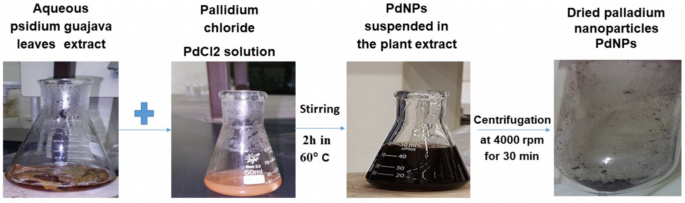
Bone cancer is an uncommon type of malignant tumor that begins in bone tissue and can destroy normal bone structure or develop as metastases from another malignancy. At 30% of all bone cancer cases, osteosarcoma is the most typical primary malignant bone cancer. It frequently appears in the metaphyses of adolescent long bones, which have the most capacity for growth. Therefore, the recent study aims to synthesize safer phytoconstituent mediated- palladium nanoparticles (PdNPs) utilizing aqueous leaves extract of Psidium guajava (PGLE) and for insight into the produced nanoparticles’ therapeutic impacts on the pathways that inhibit MG-63 cancer cell lines. The obtained PdNPs displayed amorphous spherical morphology with an average diameter of 4.72±1.616 nm and a zeta potential value of -14.8 mV. The extract-suspended palladium nanoparticles (PdNPs-PGLE) exhibited a lower IC50 value of (89.81 ± 0.32 µg/ml) and had a superior cytotoxic effect towards MG-63 cell growth compared to the PGLE (110.65 ± 1.07µg/ml) and PdNPs (198.22 ± 0.24µg/ml) samples. It was shown that (PdNPs-PGLE) increased significantly the % of total apoptotic cells compared to PGLE and PdNPs with higher intensity comet nucleus in treated cells compared to control cells. It is shown that there was an arrest in the S cell cycle phase in MG-63-treated cells. The PdNPs-PGLE had a significant decrease in wound closure % (45.21) compared to control untreated cells (58.78). Furthermore, the PdNPs-PGLE severely suppresses the capacity of MG-63 of colony formation, with a plating efficiency of 0.9% and a surviving fraction of 0.009, compared to control cells. Additionally, the estimation of the expression of protein levels using the ELISA technique revealed that there was an increase in the Bax, cleaved active Caspase-3, and TP53 expression levels with a decrease in the Bcl-2, CDK2, MMP-2, and MMP-9 expression in the PdNPs-PGLE-treated cells compared to control cells (p < 0.05) .These findings point out the potential of Psidium guajava–mediated green synthesis not only as an eco-friendly route for nanoparticle fabrication but also as a means to harness phytochemical–nanomaterial synergy.
Trending
- Brain tumour patients call for more treatment options
- Interleukin-1 receptor-associated kinase 1 controls chemoresistance and immuno-killing in non-small cell lung cancer
- Indigenous Leader Raoni Receives Palliative Care in Brazil After Cancer Diagnosis
- Brazilian Indigenous Leader Chief Raoni Diagnosed With Cancer
- FDA Approves Lutetium Lu 177 Dotatate Injection for GEP-NETs
- Acrolein- thioredoxin 1- p38 signaling drives neutrophil-mediated immunosuppression and glioblastoma progression
- SOHO 2026 Sessions Reveal Key Updates Across Leukemia Populations
- Bayer’s Monsanto Unit Urges Missouri Judge to Approve $7.25 Billion Roundup Settlement


Tuesday, September 15
Synergetic anticancer activity of psidium guajava–mediated palladium nanoparticles via apoptosis induction and metastasis suppression in osteosarcoma cells
 By NewsCancer