


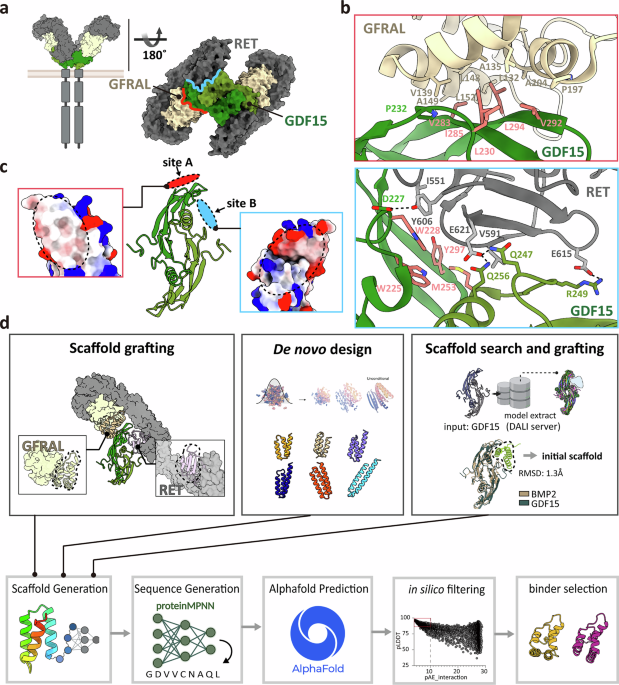
Structural analysis of GDF15/GFRAL/RET complex and rational design strategy for GDF15 antagonistic binders
The cryo-electron microscopy structure of the extracellular GDF15/GFRAL/RET complex reveals a 2:2:2 stoichiometry, wherein the dimeric GDF15 is centrally located, symmetrically bridging two GFRAL co-receptors and two RET receptors23. This characteristic batwing-shaped architecture brings the membrane-proximal cysteine-rich domains of RET into close proximity, thereby facilitating intracellular kinase dimerization for signal activation (Fig. 1a). Each GDF15 protomer interacts with the D2 domain of GFRAL (GFRAL D2) via the convex surface of its finger loops (site A) and with the cysteine-rich domains of RET through the opposite concave surface (site B) (Fig. 1a–c), effectively wedging the GDF15 dimer between GFRAL and RET. This dual engagement explains the cooperative requirement of both receptors for GDF15-mediated signaling.
On the basis of these structural insights into the GDF15/GFRAL/RET complex, we designed antagonistic binders to block either site A or site B. Site A forms a smooth, hydrophobic-rich convex surface, whereas site B exhibits a concave topology with fewer hydrophobic patches (Fig. 1b,c). Key hydrophobic residues at site A (L230, V283, I285, V292, and L294) and site B (W225, W228, M253, and Y297) were designated as binding hot spots for binder design (Fig. 1b). To generate candidate scaffolds, we applied three complementary strategies: (1) SG, (2) diffusion-based de novo design using RFdiffusion, and (3) SSG (Fig. 1d). For each backbone, amino acid sequences were generated using ProteinMPNN30, and their complex structures with the GDF15 dimer were predicted with AF2 initial guess31 and AF3 (ref. 24). Designed binders were subsequently evaluated in silico based on pAE, pLDDT scores, and predicted changes in binding free energy (ΔΔG). These filtering metrics facilitated the identification of the most promising candidates, which exhibited high structural integrity and advantageous predicted binding characteristics (Fig. 1d).
Design of GDF15 site A binders via scaffold grafting-based backbone generation
To generate antagonistic binders targeting site A of GDF15, we initially used an SG approach using a structural segment of the co-receptor GFRAL (Fig. 2a). Specifically, the triangular-shaped D2 domain of GFRAL (GFRAL D2, residues 129–211), which directly engages GDF15 site A, consists of five α-helices stabilized by five intramolecular disulfide bonds (Fig. 2b). This domain was extracted and used as the initial scaffold for binder design.
Fig. 2: Design and optimization of GDF15 site A binders via scaffold grafting.The alternative text for this image may have been generated using AI.
a Overall workflow of the scaffold-grafting (SG) design strategy for site A binders. The GFRAL D2 domain is extracted as a template, and its interface segment is sequence-designed using ProteinMPNN and evaluated by AlphaFold (AF) to yield the initial binders SGA1 and SGA2. The lead binder, SGA2, is then subjected to partial backbone re-design (via RFdiffusion, partial diffusion), followed by a second round of sequence design and AF-based filtering to generate SGA2 variants (SGA2-1 to SGA2-5). b Structure of the GFRAL extracellular domain with the D2 subdomain (residues 129–211) highlighted (left) and the isolated scaffold shown (right). Key structural elements, including labeled helices (α1–α5), the disulfide bond, and the N and C termini are indicated to define the framework for SG. c Backbone RMSD distribution of 100 ProteinMPNN-designed variants relative to the parental GFRAL D2 scaffold (mean RMSD = 0.85 Å). d Structural alignment of the initial scaffold GFRAL D2 (beige) with SGA1 (left, orange) and SGA2 (right, yellow). The GDF15 heterodimer is rendered as a green surface. RMSD with AF3-predicted structure and AF3 scores (pAE_interaction and pLDDT) for the binder/GDF15 complex are indicated, with the N and C termini labeled. e Sequence alignment of GFRAL_D2, SGA1, SGA2, and SGA2-4. Disulfide-forming cysteines are connected by lines. Residues mutated in the designed binders relative to GFRAL_D2 are colored cyan, whereas specific positions contributing to the affinity maturation from SGA2 to SGA2-4 are highlighted in red. f Structural comparison of GFRAL-D2, SGA1, and SGA2 at the binding interface. Residues that enhance binding, commonly observed in both SGA1 and SGA2, are indicated. The rightmost panel shows the superposition of three scaffolds, highlighting α5 displacement. GDF15 is colored in green. g Superposition of SGA1 (orange) and SGA2 (yellow), showing a unique electrostatic interaction in SGA2. h Structural alignment of SGA2 with its partial diffusion-derived variants (SGA2-1 to SGA2-5). RMSD with AlphaFold2-predicted structure and AlphaFold2 scores (pAE_interaction and pLDDT) for the binder/GDF15 complex are indicated, with the N and C termini labeled. The GDF15 heterodimer is rendered as a green surface. i Backbone RMSD distribution of partial diffusion-derived variants relative to the SGA2 scaffold (mean RMSD = 4.6 Å). j Structural model of SGA2-4 at the GDF15 binding interface, highlighting conserved residues inherited from SGA2 that maintain a core interaction cluster within a remodeled local environment. k Binding interface comparison of SGA2 and SGA2-4, highlighting the shifted α1 position and distinct interacting residues on this helix. pAE, predicted aligned error; pLDDT, predicted local distance difference test; RMSD, root mean-square deviation.
Using this scaffold, 100 sequence variants were generated with ProteinMPNN to stabilize the backbone and optimize the site A binding interface. Predicted structural models showed that most variants closely resembled the initial scaffold, maintaining a mean backbone root mean-square deviation (RMSD) of ~0.85 Å and preserving the relative orientation of the N and C termini (Fig. 2c,d). From this pool (28%, 28 out of 100 designs, pLDDT > 85, pAE_interaction < 10, ΔΔG < –30), two leading candidates were selected based on the metrics of pAE_interaction, pLDDT, and ΔΔG for subsequent experimental evaluation (Fig. 2d and Supplementary Fig. 1a). Interestingly, both binders carried cysteine substitutions (C10L/C16A in SGA1 and C10I in SGA2), which abolished the α1–α2 disulfide bond present in native GFRAL D2 (Fig. 2e and Supplementary Fig. 1d). Nevertheless, AF3 predictions demonstrated that both variants maintained the triangular fold, although SGA2 exhibited slight deviations from SGA1 and GFRAL D2 (RMSD 0.77 Å for SGA1 and 0.83 Å for SGA2 relative to GFRAL D2) (Fig. 2d). In the case of SGA2, new salt bridges formed between residues E47–K59 (α5-adjacent loop) and K75–D81 (α3 to α4), resulting in the displacement of helices α4 and α5 (Supplementary Fig. 1d). This structural rearrangement introduced subtle distortions to the triangular geometry of SGA2 compared with SGA1 and GFRAL D2, while still preserving the overall integrity of the scaffold (Fig. 2d).
When expressed in E. coli and purified using Ni–NTA affinity and SEC, both SGA1 and SGA2 exhibited high yield, solubility, and homogeneity (Supplementary Fig. 1b,c). Binding analysis indicated that, compared with the initial scaffold (KD = 90 nM), SGA1 and SGA2 achieved enhanced affinities with KD values of 50 nM and 5 nM, respectively (Table 1 and Supplementary Fig. 1e). On the basis of AF3 predictions, we speculate that this affinity enhancement resulted from hydrophobic core interactions between residue L73 (S201 in GFRAL D2) and GDF15 site A residues (I285, V292, and L294), together with electrostatic interactions mediated by D69, Q72, and Q76 (P197, Q200, and A204 in GFRAL D2) (Fig. 2f). In SGA2, the displacement of α5 brought this helix closer to the β-strand of GDF15 site A, thereby strengthening SGA2 Q76-GDF15 S293 main chain, SGA2 D69-GDF15 G291 main chain, and SGA2 Q72-GDF15 T290 interactions. Additionally, a new electrostatic contact between SGA2 E12 and GDF15 R233 further stabilized the SGA2–GDF15 interface (Fig. 2g). Although the atomic-resolution structure has yet to be determined, these interactions likely account for the ~10-fold higher affinity of SGA2 compared with SGA1.
Table 1 Binding kinetics summary for GFRAL D2 and designed GDF15 binders.
To further improve the binding affinity of SGA2, we applied partial diffusion in RFdiffusion with site A hot spots (L230, V283, I285, V292, and L294) specified as constraints and conducted cysteine-free sequence design (Fig. 2a). From a filtered pool, five leading variants (SGA2-1 to SGA2-5) were selected through in silico filtering (see Experimental section/methods) (Fig. 2a and Supplementary Fig. 1f,g). These variants exhibited 34–42% sequence identity to the parental scaffold SGA2 (Supplementary Fig. 1f), and a significant structural rearrangement of α3, which shifted by 5 ~ 6 Å (Fig. 2h). By eliminating disulfide bonds during sequence design, the rigid triangular form of scaffold gained increased flexibility, allowing it to adopt shapes more complementary to GDF15 site A and thereby increasing backbone diversity (Fig. 2i).
Notably, among these candidates, SGA2-3 and SGA2-4 exhibited approximately 10–17-fold higher binding affinity than parental SGA2 (SGA2 KD = 5 nM; SGA2-3 KD = 500 pM; SGA2-4 KD = 300 pM) (Table 1 and Supplementary Fig. 1h–j), whereas SGA2-2 was expressed but aggregated, precluding affinity measurement. Although the sequence identity between SGA2 and SGA2-4 is only 31.3%, the key interacting residues in α5 (D69, Q72, L73, and Q76) were conserved (Fig. 2j). By contrast, several GDF15-interacting residues in α1 were altered, and the slight difference in α1 between SGA2 and SGA2-4 may account for the higher binding affinity of SGA2-4 (Fig. 2e,k).
Collectively, SG followed by a single round of partial diffusion and sequence redesign yielded a high-affinity GDF15 binder, exhibiting a 300-fold enhancement in binding affinity compared with the original GFRAL D2 scaffold.
Design of GDF15 site A binders via diffusion-based de novo backbone generation
To further investigate structural diversity beyond SG, we used a diffusion-based de novo backbone generation strategy using RFdiffusion (Fig. 3a). Protein backbones comprising 50–90 amino acids were generated with site A hot spots (L230, V283, I285, V292, and L294) specified as constraints, resulting in the production of 1728 scaffolds. All outputs generated by RFdiffusion formed helical bundles consisting of one to five helices, predominantly adopting two-helix or three-helix bundles (Fig. 3b). For each backbone, three sequence variants were designed, resulting in 5178 unique sequences. These were evaluated by AF2 predictions and computational filtering (Supplementary Fig. 2a). From this pool (10.4%, 539 out of 5,184 designs, pLDDT > 85, pAE_interaction < 10, ΔΔG < –30), five top-ranked candidates (DEA1–DEA5) were selected for experimental validation (Fig. 3c). Structural modeling showed that all five candidates formed three-helix bundles covering the entire surface of GDF15 site A, with their N and C termini oriented in opposite directions (Fig. 3c).
Fig. 3: Design and optimization of GDF15 site A binders via diffusion-based de novo design.The alternative text for this image may have been generated using AI.
a Workflow of de novo binder design using RFdiffusion. A total of 1,728 initial scaffolds (50 ~ 90 a.a.) were generated, sequence-designed (three sequences per backbone), and computationally filtered using in silico evaluation metrics. The top five binders (DEA1–DEA5) were structurally analyzed and experimentally validated by expression, purification, and binding analysis. The best-performing DEA3 was further optimized by scaffold-guided partial diffusion, resulting in seven variants (DEA3-1 to DEA3-7). b Distribution of helix counts in RFdiffusion-generated scaffolds to analyze structural diversity. c AlphaFold2-predicted structural models of the five selected de novo binder candidates in complex with the GDF15 dimer. Binder lengths, pAE_interaction, and pLDDT values are indicated, with the N and C termini labeled. d SDS–PAGE analysis of binders (DEA1–DEA5, left; DEA3-1 to DEA3-7, right) after Escherichia coli expression and affinity purification. e Sequence alignment of the parental scaffold DEA3 and the scaffold-guided partial diffusion design DEA3-5. Key hydrophobic (yellow square) and electrostatic (blue square) residues interacting with GDF15 are marked. f Binding interface comparison of DEA3 (left) and DEA3-5 (right) with GDF15. Key interacting residues are shown as sticks and labeled. a.a., amino acid; GDF15, growth differentiation factor-15; pAE, predicted aligned error; pLDDT, predicted local distance difference test.
Expression screening in E. coli showed that DEA3, DEA4, and DEA5 were soluble and purified with high homogeneity, whereas DEA1 failed to express and DEA2 aggregated during purification (Fig. 3d, left and Supplementary Fig. 2b). Despite favorable in silico scores (low pAE_interaction and high pLDDT scores), variations in expression and solubility were pronounced. Additionally, binding affinities ranged from low nanomolar to hundreds of nanomolar (DEA3, KD = 7.6 nM; DEA4, KD = 39 nM; and DEA5, KD = 297 nM) (Table 1 and Supplementary Fig. 2c). These findings underscore the limitations of predictive metrics in comprehensively capturing the physiochemical properties of designed binders. DEA3 achieved the strongest binding through extensive hydrophobic contacts (A7, A14, V15, Y18, L21, A22, V27, A39, and F43 of DEA3 with L230, V283, I285, V292, and L294 of GDF15 site A). The binding was further stabilized by surrounding electrostatic interactions (DEA3 S3-GDF15 N280, DEA3 E4-GDF15 K303, DEA3 D17-GDF15 S231, and DEA3 K42-GDF15 D298). (Fig. 3e,f, left and Supplementary Fig. 3c).
Similar to the affinity maturation of the SGA2 binder described earlier, we used DEA3-guided partial diffusion, followed by sequence design, structural prediction, and computational filtering for the affinity maturation of DEA3 binder (Fig. 3a). Out of a total of 6,000 candidates, the top 100 candidates (pAE_interaction, 4.3–5.0; pLDDT, 94–97) were selected and further screened experimentally using yeast surface display (Supplementary Fig. 3a). Fluorescence-activated cell sorting with dual labeling (anti-Myc PE-Cy7 for binder expression and PE-conjugated Strep-Tactin for GDF15 binding) facilitated the recovery of the top 25% double-positive cells, and sequencing of these cells identified seven unique candidates (DEA3-1 to DEA3-7) (Supplementary Table 1). The sequence identities of DEA3-derived variants (DEA3-1 to DEA3-7) ranged from 46% to 58%, although their structures remained highly conserved (RMSDs 0.6–2.0 Å) (Supplementary Fig. 3b–d).
Among the seven DEA3-derived candidates, only three (DEA3-1, DEA3-2, and DEA3-5) were successfully expressed and purified in E. coli (Fig. 3d, right and Supplementary Fig. 3d,e). Notably, unlike SG-based backbone generation followed by partial diffusion, in which SGA2-3 and SGA2-4 enhanced affinity by 10–17-fold, DEA3-derived design variants did not exceed the performance of the parental DEA3 (DEA3, KD = 7.5 nM; DEA3-1, KD = 361 nM; DEA3-2, KD = 623 nM; and DEA3-5, KD = 6.9 nM) (Table 1 and Supplementary Fig. 3f). Structural analysis confirmed that DEA3-5 recapitulated the binding mode of DEA3, engaging the entire surface of site A on GDF15 through a hydrophobic core network further stabilized by neighboring electrostatic interactions (Fig. 3f, right). Although the affinities of DEA3 and DEA3-5 were ~20-fold weaker than that of SGA2-4, their three-helix bundle structure with oppositely oriented termini provided a distinct advantage for biosensor development (see Section “Development and optimization of a BAT biosensor using designed GDF15 binders for rapid detection.”).
Taken together, diffusion-based de novo backbone generation successfully produced nanomolar-affinity binders and enabled the development of GDF15 site A binders with distinct topologies compared with those derived from SG.
Design of GDF15 site B binders via scaffold-search and grafting for backbone generation
To design antagonistic binders targeting site B of GDF15, which has fewer exposed hydrophobic residues and more polar residues compared with site A (Fig. 1b,c), we initially assessed the RET receptor, which naturally interacts with this site. As described in section “Design of GDF15 site A binders via scaffold grafting-based backbone generation”, a domain segment of RET (residues 586–622), comprising five β-strands stabilized by two disulfide bonds, was extracted as an initial scaffold. One hundred sequence variants were generated and subsequently evaluated using AlphaFold2 predictions (Fig. 4a). However, aside from the two disulfide-stabilized β-strands, most elements unfolded, indicating that this RET-derived scaffold lacked sufficient stability for further development (Fig. 4b).
Fig. 4: Design of GDF15 site B binders via scaffold-search and grafting.The alternative text for this image may have been generated using AI.
a The RET domain segment (residues 586–622) was tested as an initial scaffold for site B binders design. b AlphaFold2 (AF2)-predicted structures of 100 RET-derived variants by sequence design. Only disulfide-constrained β-strands remained folded. c In silico filtering of 500 de novo backbones generated by RFdiffusion with site B hot-spot constraints (W225, W228, M253, and Y297). No candidates satisfied filtering thresholds (pLDDT > 85 and pAE_interaction < 10; red box). d Workflow of the scaffold-search and grafting (SSG) strategy. The GDF15 structure was used as a query in the DALI server to search the Protein Data Bank (PDB) for natural scaffolds with similar topology and surface geometry. Candidate scaffolds were then subjected to scaffold-guided partial diffusion and sequence design, followed by AF-based filtering to generate SSGB variants (SSGB1 to SSGB5). e Representative scaffold candidates identified from the DALI server search: follistatin/activin A (PDB 2B0U), BMP9 pro-complex (mature domain + prodomain) (PDB 4YCI), BMP2/RGMA (PDB 4UHY), TGF-β3/GC-1008 antibody (PDB 3EO1), and BMP2/BMP2 receptor A (PDB 1ES7). RMSD relative to GDF15 is indicated. f Structural comparison of GDF15/RET (green/pink) and BMP2/RGMA (gray/purple) complexes. GDF15 and BMP2 show overall similarity (RMSD = 2.5 Å), but interacting partners differ topologically. g Structural alignment of RGMA with RGMA-derived binder variants (SSGB1 to SSGB5). RMSD with AF2-predicted structures and AF2 scores (pAE_interaction and pLDDT) for the binder/GDF15 complex are indicated. h SDS–PAGE analysis of binders (SSGB1–SSGB5) after Escherichia coli expression and affinity purification. BMP2, bone morphogenetic protein-2; GDF15, growth differentiation factor-15; pAE, predicted aligned error; pLDDT, predicted local distance difference test; RGMA, repulsive guidance molecule A; RMSD, root mean-square deviation.
Next, we used de novo scaffold generation using RFdiffusion and ProteinMPNN with site B hot-spot constraints (W225, W228, M253, and Y297; hydrophobic residues at site B), producing 100 backbones of 50–90 amino acids and five sequence variants per backbone (500 total designs). Nonetheless, none of these candidates fulfilled the in silico filtering criteria (pLDDT > 85, pAE_interaction < 10, ΔΔG < –30), thereby underscoring the challenges associated with designing stable site B binders through direct extraction or de novo diffusion-based methods (Fig. 4c).
To address these limitations, we developed an SSG strategy aimed at identifying naturally stable scaffolds sharing comparable structural features (Fig. 4d). Using the GDF15 structure as a query, we searched the PDB using DALI to find proteins with similar topology and surface geometry, thereby leveraging evolutionary insights from natural complexes. From the search results obtained, structures in apo form (comprising solely GDF15-like folds) were excluded, whereas the top-ranking PDB entries in which GDF15-like folds participated in protein–protein interactions were retained. This search identified suitable scaffolds for accommodating GDF15 site B from the complex of follistatin/activin A (PDB 2B0U)32, BMP9 pro-complex (mature domain + prodomain) (PDB 4YCI)33, BMP2/RGMA (PDB 4UHY)34, TGF-β3/GC-1008 antibody (PDB 3EO1)35, and BMP2/BMP2 receptor A (PDB 1ES7)36 (Fig. 4e).
Among these, we selected RGMA in complex with BMP2 (PDB 4UHY) as the initial scaffold because it forms a compact and stable α-helical bundle, unlike the unstable RET-derived scaffold (Fig. 4b). Specifically, the GDF15 dimer was superimposed onto BMP2 in the BMP2–RGMA complex, and BMP2 was replaced with the aligned GDF15 dimer while preserving RGMA. Although BMP2 and GDF15 exhibit considerable structural similarity (RMSD = 2.5 Å), notable differences exist in their flexible loop regions (Fig. 4e,f). To account for these subtle variations, the resulting model was further optimized through scaffold-guided partial diffusion and sequence design, yielding a total of 3,000 designs (Fig. 4d). After filtering (0.3%, 10 out of 3,000 designs, pLDDT > 85, pAE_interaction < 10, ΔΔG < –30), five top candidates (SSGB1–SSGB5) were selected for experimental testing (Fig. 4g and Supplementary Fig. 4a,b). Although only about 0.3% of the designs passed the filters (10 of 3,000), the expression success rate was high at 80% (4 of 5), likely reflecting the stability of the natural scaffold.
Among these, only SSGB2 bound GDF15 measurably, with a KD of 121 nM (Table 1, Fig. 4h, and Supplementary Fig. 4c). SSGB2 retains only ~17% sequence identity to its original RGMA, indicating extensive sequence maturation toward GDF15 site B recognition (Supplementary Fig. 4d). Structural modeling of the SSGB2/BMP2 complex further supported this specificity, revealing that surface-exposed residues on SSGB2 create steric clashes and electrostatic repulsion with BMP2 residues, resulting in an unfavorable interface (Supplementary Fig. 4e). Consistent with this structural incompatibility, SPR analysis demonstrated no detectable binding of SSGB2 to BMP2 (Supplementary Fig. 4f). Regarding the GDF15 site B, structural prediction models suggested that two of the three helices in SSGB2 are positioned in direct contact with the concave binding surface at site B of GDF15. Although multiple electrostatic interactions are present across the binding interface, the limited availability of exposed hydrophobic residues at site B significantly restricts hydrophobic core formation between SSGB2 and GDF15 (Supplementary Fig. 4g).
Collectively, the SSG strategy offers a promising framework for binder design, particularly when natural binders are unavailable or unstable, and the target surface lacks sufficient hydrophobic residues for effective de novo design. This methodology significantly broadens the array of tools available for developing binders against previously inaccessible targets through conventional approaches.
Development and optimization of a BAT biosensor using designed GDF15 binders for rapid detection
Although SPR provides precise kinetic characterization of purified binders, clinical applications require rapid detection in complex biological fluids. Current FDA-approved immunoassays, although accurate, rely on multistep protocols and centralized equipment, limiting their accessibility.
To address this limitation and demonstrate the translational potential of our designed binders, we implemented the binding-activated tandem split-enzyme (BAT) system37. Originally developed for single-component biosensing, we adapted this platform to detect GDF15 by fusing a high-affinity binder to the N-terminal and C-terminal segments of NanoLuc luciferase (SmBiT and LgBiT). In this format, the luciferase fragments remain apart in the absence of GDF15, preventing reconstitution. Upon GDF15 binding, steric rearrangement brings the fragments into proximity, restoring luciferase activity and producing a luminescent signal (Fig. 5a,b).
Fig. 5: Development of a binding-activated tandem split-enzyme (BAT) biosensor for GDF15 detection.The alternative text for this image may have been generated using AI.
Schematic illustration (part a) and structural model (part b) of the BAT biosensor (SmBiT–GDF15 Binder–LgBiT) for GDF15 detection in the “OFF” and “ON” states. The BAT biosensor consists of a designed GDF15 binder (red) flanked by SmBiT at the N terminus (cyan, 1, SmBiT) and LgBiT at the C terminus (blue, 2, LgBiT). In the absence of GDF15, two split luciferase fragments remain apart (OFF state with only background activity). Upon GDF15 binding, steric constraints bring two split luciferase fragments into proximity, enabling fragment complementation and restoring NanoLuc activity (ON state). The lengths of linker1 and linker2 (part b left) are key determinants for background signals in the absence of GDF15. c SDS–PAGE analysis of SmBiT–DEA3–LgBiT with various linker combinations after Escherichia coli expression and affinity purification. d Screening of linker combinations for SmBiT–DEA3–LgBiT using a luminescence assay. Signal-to-noise ratios (luminescence intensity of each construct divided by that of the control without GDF15) are shown, with optimal linker combinations highlighted in red. Luminescent signals of SmBiT–DEA3–LgBiT with 0-10 linkers (part e) and of SmBiT–DEA3-5–LgBiT with 5-5 linkers (part g). Luminescence (arbitrary units, AU) is plotted against various concentrations of human or mouse GDF15 (n = 3). The linear detection range is indicated with a red box (0–10 nM). f Sequence alignment of human and mouse GDF15. Conserved residues at site A are marked with black circles; species-specific substitutions at the interface are highlighted with green circles. h AlphaFold3-predicted structures of DEA3 or DEA3-5 bound to human or mouse GDF15. Per-residue pLDDT values are color-coded according to the scale bar. GDF15, growth differentiation factor-15; pLDDT, predicted local distance difference test.
We hypothesized that this platform could enable a one-step, wash-free biosensing workflow capable of quantifying GDF15 directly in serum, thereby offering a cost-effective alternative for point-of-care diagnostics. To test this, we constructed BAT sensors using four top-performing binders (SGA2, SGA2-4, DEA3, and DEA3-5), which are derived from distinct design strategies (Figs. 2a, 3a, and 4d). Because signal output depends on the spatial orientation of luciferase fragments, we systematically optimized linker lengths between the binder and each luciferase fragment (SmBiT–linker1–GDF15 binder-linker2–LgBiT-His6). Four linker lengths (0, 5, 10, and 15 residues) were tested for both linker1 and linker2, generating 16 unique configurations per binder.
BAT sensors based on SGA2 and SGA2-4 exhibited modest signal-to-noise ratios (<4) across all linker combinations, likely due to the parallel orientation of their N terminus and C terminus, which restricts the steric displacement required for efficient luciferase complementation (Supplementary Fig. 5). The most effective SmBiT–linker1–SGA2–linker2–LgBiT construct (10 a.a. for linker1 and 10 a.a. for linker2 and 10-10 linker) could detect human GDF15 within the 10–100 nM concentration range, but not mouse GDF15 (Supplementary Fig. 5d,e). Conversely, the SmBiT–DEA3–LgBiT biosensor, characterized by oppositely oriented N terminus and C terminus, yielded markedly higher signal-to-noise ratios. Among the tested constructs, those with 0-10, 0-5, and 5-5 linker lengths exhibited the best performance (Fig. 5c,d). During the expression and purification of SmBiT–DEA3–LgBiT, the construct with a 10-0 linker proved difficult to express, and the 0-15 linker construct tended to aggregate; consequently, both were excluded from subsequent testing. When assessed across a concentration range of 0–100 nM of human GDF15, the 0-10 construct demonstrated the most linear dose–response curve and demonstrated consistent reproducibility, thereby selecting for subsequent analysis (Fig. 5e, left). Similar results were observed for the 0-5 and 5-5 linker combinations against human GDF15 (Supplementary Fig. 5i,j).
Sequence alignment of human and mouse GDF15 revealed 72% identity, with key hydrophobic residues at site A highly conserved (Fig. 5f). Consistent with this, the SmBiT–DEA3–LgBiT biosensor (0-10 linker) demonstrated a robust, concentration-dependent luminescence for both human and mouse GDF15, showing near-linear detection across 1–100 nM and maintaining performance in serum supplemented with recombinant GDF15 (Fig. 5e, right). These results underscore its potential for cross-species and clinically relevant detection.
Although structural predictions indicated that DEA3-5 possesses a scaffold highly similar to that of DEA3, the 0-10 linker construct for DEA3-5 could not be successfully expressed. Consequently, the biosensor incorporating the 5-5 linker configuration, which displayed superior detection performance among the alternative constructs, was utilized in subsequent experiments. Notably, the SmBiT–DEA3-5–LgBiT biosensor (5-5 linker) detected only human GDF15 with sub-nanomolar sensitivity, exhibiting a linear detection range of 0.5–500 nM (Fig. 5g). However, it failed to sensitively detect mouse GDF15 (Supplementary Fig. 5k). This limitation likely arises from subtle sequence differences at the interaction interface (N280, M282, L301 in human GDF15 versus T280, V282, V301 in mouse GDF15) (Fig. 5f), which may alter the positioning of the DEA3-5 N terminus. AF2 predictions of the DEA3-5/mouse GDF15 complex further support this interpretation, showing markedly reduced pLDDT values at the N-terminal interface compared with other complexes (DEA3/human GDF15, DEA3/mouse GDF15, and DEA3-5/human GDF15) (Fig. 5h, red circle), indicating increased flexibility that likely impaired luciferase complementation.
Collectively, our results demonstrate that BAT biosensors incorporating GDF15 binders provide a robust and versatile platform for rapid, cross-species detection of GDF15 with high sensitivity, underscoring their potential for clinical diagnostic applications.
Therapeutic potential of an Fc-fusion GDF15 binder
To assess the therapeutic potential of the highest-affinity binder, we generated an Fc-fusion GDF15 binder to inhibit GDF15/GFRAL/RET signaling axis. As an initial approach, a bispecific Fc-fusion construct was attempted by combining two designed binders targeting distinct sites on the GDF15 dimer (SGA2-4 for site A and SSGB2 for site B). However, in the knob-into-hole format, SSGB2-fused chain failed to express in any configuration, in contrast to the robust expression of the SGA2‑4-Fc knob (Supplementary Fig. 6a–c). We subsequently attempted to generate a conventional homodimeric SSGB2-Fc decoy. However, this construct also suffered from extremely low yields (Supplementary Fig. 6d), precluding the isolation of sufficient protein for further biochemical and functional characterization. Consequently, the high-affinity site A binder SGA2-4 was fused to both arms of a human IgG Fc domain as a homodimeric decoy receptor (Fig. 6a). The resulting SGA2-4-Fc protein was robustly expressed in a mammalian expression system and purified to high homogeneity and purity (Fig. 6b). These results suggest that even for designed binders that exhibit robust expression and purification in isolation, Fc-fusion compatibility can be significantly influenced by the specific binder scaffold.
Fig. 6: Development of GDF15 decoy receptors using GDF15 site A binder.The alternative text for this image may have been generated using AI.
a Schematic diagram of Fc-fused SGA2-4 binder (SGA2-4-Fc). b Size-exclusion chromatography profile of SGA2-4-Fc on a Superdex® 200 Increase 10/300 GL column (left) and SDS–PAGE analysis of elution fractions (right). c Surface plasmon resonance analysis of SGA2-4-Fc and ponsegromab binding to immobilized GDF15. Sensorgrams are shown for analytes ranging from 5 nM to 50 nM (SGA2-4-Fc or ponsegromab). d Inhibition of GDF15-induced RET, AKT, and ERK phosphorylation in HEK293T cells stably expressing GFRAL and RET. Cells were co-treated with GDF15 (10 nM, 246 ng/ml) and either SGA2-4-Fc or ponsegromab (100 nM; 7.8 μg/ml for SGA2-4-Fc or 14.6 μg/ml for ponsegromab) for 30 min. Phosphorylation was quantified relative to total protein (RET, AKT, and ERK each), normalized to the GDF15-only condition (n = 3). Statistical significance was determined using unpaired t test (****P < 0.0001; ***P < 0.001; **P < 0.01; *P < 0.05; ns, not significant). e Dose-dependent inhibition of GDF15-induced SRE-luciferase activity by SGA2-4-Fc or ponsegromab in HEK293T cells co-expressing GFRAL, RET, and an SRE-Luc2 reporter. Data were normalized to GDF15-induced luminescence (100%), and IC50 values were determined by nonlinear regression fitting in GraphPad Prism. GDF15, growth differentiation factor-15; SG, scaffold grafting.
Biophysical characterization revealed that Fc-mediated dimerization of SGA2-4 conferred a marked avidity gain, enhancing the apparent binding affinity from 330 pM for the monomeric binder to 81 pM for the Fc-fusion. Notably, this affinity is indistinguishable from that of ponsegromab (KD = 80 pM), a clinical-stage anti-GDF15 antibody currently in phase II trials for treating cancer cachexia20 (Fig. 6c). We next tested the functional activity of SGA2-4-Fc in blocking GDF15 signaling. In HEK293 cells stably expressing human GFRAL and RET, GDF15 stimulation induced phosphorylation of RET, AKT, and ERK. However, co-treatment with either SGA2-4-Fc or ponsegromab (100 nM) significantly suppressed phosphorylation of all three proteins (Fig. 6d). In parallel SRE-luciferase reporter assays, SGA2-4-Fc inhibited GDF15-induced GFRAL/RET signaling in a dose-dependent manner (IC50 = 7.2 nM), demonstrating a potency comparable to ponsegromab (IC50 = 10.8 nM) under identical experimental conditions (Fig. 6e).
Collectively, these results demonstrate that SGA2-4-Fc not only attains a binding affinity comparable to that of the clinical anti-GDF15 antibody ponsegromab but also effectively inhibits downstream GDF15 signaling. This highlights its potential as a promising alternative therapeutic approach, derived from a fully de novo designed protein scaffold, for the treatment of cancer cachexia.
