


Establishing a mouse model with conditional knock-in of the Q157R mutation at the U2af1 locus
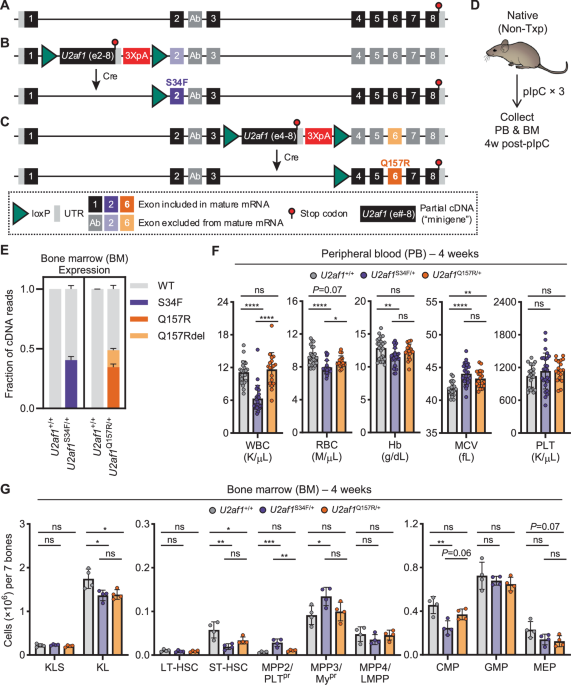
A conditional (Cre/lox-mediated) knock-in of the S34F mutation at the U2af1 locus (MGS34F or U2af1S34F/+) was previously generated (Fig. 1A, B and Supplementary Fig. 1A) [19]. To allow for direct comparison with the MGS34F mouse, a similar strategy was used to generate a conditional (Cre/lox-mediated) Q157R mutant allele at the endogenous U2af1 locus (MGQ157R or U2af1Q157R/+) of B6 mice (Fig. 1C and Supplementary Fig. 1B). Successful introduction of the targeting vector at the U2af1 locus was confirmed by Southern blot (Supplementary Fig. 1C). To confirm Cre/lox-mediated hematopoietic expression of U2af1Q157R mRNA and assess the short-term effects of U2AF1Q157R in a non-transplant model (i.e., native hematopoiesis), we crossed heterozygous U2af1Q157R/+ mice to Mx1-Cre transgenic mice (Fig. 1D–G and Supplementary Fig. 1D–I). Mx1-Cre is expressed in hematopoietic lineage cells following administration of polyinosinic-polycytidylic acid (pIpC) [22].
Fig. 1: Characterization of native hematopoiesis in U2af1S34F/+ and U2af1Q157R/+ conditional knock-in mice.The alternative text for this image may have been generated using AI.
Diagrams of the wild-type (WT) mouse endogenous U2af1 locus (A) and endogenous U2af1 locus with conditional knock-in of either the S34F mutation in exon 2 (TCT > TTT) and upstream loxP flanked (floxed) MiniGene (MG; encoding WT U2af1 exons 2-8) in intron 1 (“MGS34F”) (B) or Q157R mutation in exon 6 (CAG > CGG) and upstream floxed MG (encoding WT U2af1 exons 4-8) in intron 3 (“MGQ157R”) (C). Cre-mediated recombination of the floxed MGS34F or MGQ157R alleles results in the removal of the WT MG cassette and conditional expression of U2af1S34F or U2af1Q157R, respectively, from the mouse endogenous locus. 3XpA, three repeats of the SV40 late polyadenylation signal. See Supplementary Fig. 1A–C for targeting vectors and additional locus detail. D Non-transplant (native hematopoiesis) assay design. U2af1+/+, U2af1S34F/+, or U2af1Q157R/+ mice (all Mx1-Cre+) were treated with three doses of pIpC at 6–12 weeks of age. E Assessment of S34F and Q157R mRNA expression levels in BM KL cells at 4 weeks post-pIpC treatment. cDNA was prepared from KL cells for targeted NGS amplicon sequencing of the S34 (left) and Q157 (right) codons. The fraction of reads matching either WT or mutated alleles is plotted. U2af1+/+ mice were assessed for both S34F and Q157R/Q157Rdel alleles. The Q157R mutation in U2af1 creates an alternative 5’ splice site that leads to expression of a minor U2af1 isoform (termed “Q157Rdel”) with in-frame deletion of four amino acids immediately following the Q157R mutant codon. See also Supplementary Fig. 1D. N = 3 mice per genotype. F Complete blood count analysis (white blood cell [WBC], red blood cell [RBC], and platelet [PLT] counts, Hb [haemoglobin], and RBC mean corpuscular volume [MCV]) of PB samples from mice at 4 weeks post-pIpC. N = 18–26 mice per genotype, pooled from five independent experiments. G Absolute cell counts of BM hematopoietic stem and progenitor cell (HSPC) populations (KLS [Kit+Lineage−Sca-1+], KL [Kit+Lineage−Sca-1−], long- and short-term HSC [LT-HSC and ST-HSC], multipotent progenitors [MPP2, MPP3, and MPP4], common myeloid progenitors [CMP], granulocyte-macrophage progenitors [GMP], and megakaryocyte-erythrocyte progenitors [MEP]) were determined by flow cytometric analysis at 4 weeks post-pIpC. N = 4 mice per genotype. See also Supplementary Fig. 1E–G. Results represent the mean ± standard deviation (SD) (E–G). One-way analysis of variance (ANOVA) with Tukey multiple comparison correction (F, G) was used for the comparison of groups. *P < 0.05; **P < 0.01; ***P < 0.001; ****P < 0.0001. ns, not significant (or labeled if P < 0.10).
Four weeks after pIpC treatment of U2af1Q157R/+; Mx1-Cre mice, the U2af1 wild-type (WT) and Q157R alleles were expressed at similar levels in BM myeloid progenitor (KL) cells by targeted NGS amplicon sequencing of cDNA (Fig. 1E). As expected, the WT and S34F alleles were also expressed at similar levels in BM KL cells from U2af1S34F/+; Mx1-Cre mice and only the WT allele was detected in U2af1+/+; Mx1-Cre control mice (Fig. 1E). It was previously reported that the Q157R mutation in U2AF1 creates an alternative 5’ splice site that leads to expression of a minor U2AF1 isoform (termed “Q157Rdel”) with in-frame deletion of four amino acids immediately following the Q157R mutant codon [23]. The U2af1Q157R/+ mouse model recapitulates expression of the Q157Rdel isoform in BM KL cells (Fig. 1E and Supplementary Fig. 1D).
U2AF1S34F and U2AF1Q157R cause different hematopoietic changes in mice
To determine if S34F and Q157R result in similar short-term effects on native hematopoiesis, we performed complete blood counts and flow cytometric analysis on PB samples from U2af1Q157R/+, U2af1S34F/+, and U2af1+/+ control mice (all Mx1-Cre+) four weeks after pIpC treatment. Consistent with previous characterization, [19] U2af1S34F/+ mice had no change in platelet counts, modestly reduced red blood cell (RBC) counts and hemoglobin levels (with elevated mean corpuscular volume [MCV]), and markedly reduced white blood cell (WBC) counts compared to U2af1+/+ mice (Fig. 1F). Flow cytometric analysis of U2af1S34F/+ PB and BM demonstrated significant reductions in both myeloid and lymphoid lineages (Supplementary Fig. 1E, F). In contrast, U2af1Q157R/+ mice had no significant PB or BM changes except for elevated MCV (Fig. 1F and Supplementary Fig. 1E, F). Assessment of BM hematopoietic stem and progenitor cells (HSPC) four weeks after pIpC treatment revealed that U2af1S34F/+ mice had significantly reduced numbers of short-term hematopoietic stem cell (ST-HSC), KL, and common myeloid progenitor (CMP) populations with increased numbers of multipotent progenitor (MPP)2 and MPP3 populations compared with control mice (Fig. 1G). U2af1Q157R/+ mice also had significantly reduced numbers of ST-HSC and KL populations and non-significant reductions in both CMP and megakaryocyte-erythroid progenitor (MEP) cells compared with control mice (Fig. 1G). U2af1S34F/+ mice had a significant block in erythroid development in the BM and spleen, with an increased proportion of immunophenotypically defined nucleated erythroblasts (Ter119lo/hiCD71hi) and a decreased proportion of enucleated erythrocytes (Ter119hiCD71lo). In contrast, U2af1Q157R/+ mice had a smaller but non-significant increase in Ter119hiCD71hi cells in the spleen (Supplementary Fig. 1G–I).
To better evaluate the cell-intrinsic effects of both mutants on hematopoiesis, we transplanted BM from U2af1Q157R/+, U2af1S34F/+, or U2af1+/+ control mice (CD45.2+; all Mx1-Cre+) into lethally irradiated WT congenic (CD45.1+) recipient mice (average CD45.2+ chimerism was >85% at 6 weeks and >88% at 24 weeks post-pIpC for all genotypes). Following engraftment, we treated mice (including controls) with pIpC to induce expression of S34F and Q157R in donor-derived cells (Fig. 2A). Four weeks after pIpC treatment, PB (Fig. 2B, C) and BM changes (Supplementary Fig. 2A, C) reflected similar overall trends observed in native hematopoiesis (Fig. 1F and Supplementary Fig. 2E) for both mutant mice. At 24 weeks, both mutant mice had significantly reduced PB RBC counts with increased MCV, as well as decreased hemoglobin in U2af1S34F/+ mice. U2af1Q157R/+ mice also had mildly increased platelet counts (Fig. 2B). U2af1S34F/+ mice had significantly reduced PB and BM myeloid and lymphoid lineage cells, while U2af1Q157R/+ mice had significantly decreased PB monocytes and a non-significant increase in BM monocytes (Fig. 2C and Supplementary Fig. 2D). Although myeloid and lymphoid lineages were significantly decreased in U2af1S34F/+ mouse spleens at 4 weeks, there were no significant changes at 24 weeks (Supplementary Fig. 2B, E). HSPC populations reflected similar significant overall trends at 24 weeks compared to 4 weeks for U2af1S34F/+ mice (Fig. 2D and Supplementary Fig. 2C). U2af1Q157R/+ mice also showed similar, but non-significant, trends in HSPC population numbers at 24 weeks compared to 4 weeks (Fig. 2D and Supplementary Fig. 2C). A similar erythroid differentiation block was observed in the spleen at 24 weeks compared to 4 weeks (Supplementary Figs. 1H, I and 2F, G).
Fig. 2: U2AF1S34F and U2AF1Q157R cause different cell-intrinsic effects on hematopoiesis.The alternative text for this image may have been generated using AI.
A Transplant assay design. CD45.2+ donor BM cells from U2af1+/+, U2af1S34F/+, or U2af1Q157R/+ mice (all Mx1-Cre+) were transplanted into lethally irradiated WT congenic (CD45.1+) recipient mice. Recipient mice were treated with pIpC at 6 weeks post-transplant. B Complete blood counts of PB samples from recipient mice before (−1 week) and up to 24 weeks post-pIpC. C Flow cytometric analysis of PB samples was performed before and after pIpC to determine absolute counts of lymphoid (B-cells or T-cells) and myeloid (Neutrophils or Monocytes) cells. For (B, C), N = 28–30 recipient mice per genotype, pooled from two independent experiments. D Absolute cell counts of BM HSPC populations in recipient mice were determined by flow cytometric analysis at 24 weeks post-pIpC. N = 5–8 recipient mice per genotype, pooled from two independent experiments. See also Supplementary Fig. 2. Results represent the mean ± standard error of the mean (SEM) (B, C) or mean ± SD (D). A mixed effects analysis with repeated measures and Tukey multiple comparison correction (B, C) or one-way ANOVA with Tukey multiple comparison correction (D) was used for the comparison of groups. *P < 0.05; **P < 0.01; ***P < 0.001; ****P < 0.0001. ns, not significant (or labeled if P < 0.10). Symbols (U2af1+/+ vs U2af1S34F/+ [*]; U2af1+/+ vs U2af1Q157R/+ [#]; U2af1S34F/+ vs U2af1Q157R/+ [§]) are used to differentiate comparisons in (B, C).
U2af1
S34F/+ HSCs are significantly more impaired than U2af1
Q157R/+ HSCs in BM repopulation assays
To compare the effects of S34F or Q157R expression on HSC reconstitution capacity, we performed competitive BM transplantation experiments. Lethally irradiated WT congenic recipient mice (CD45.1+) were transplanted with whole BM “test” cells from U2af1Q157R/+, U2af1S34F/+, or U2af1+/+ control mice (CD45.2+; all Mx1-Cre+) mixed with an equal number of competitor BM cells from WT congenic mice (CD45.1+/CD45.2+). Following engraftment, we treated mice (including controls) with pIpC to induce expression of S34F and Q157R in donor-derived cells (Fig. 3A). Consistent with previous characterization, [19] we observed significant multi-lineage reductions in PB, BM, and spleen donor cell chimerism (CD45.2+) for U2af1S34F/+ compared to U2af1+/+ test cells (Fig. 3B–D and Supplementary Fig. 3A). In contrast, the reduction in overall and multilineage PB donor cell chimerism for U2af1Q157R/+ compared to U2af1+/+ test cells was less severe relative to U2af1S34F/+ test cells (Fig. 3B, C). In addition, there were variable reductions in donor cell chimerism of PB, BM, and spleen myeloid lineages for U2af1Q157R/+ compared to U2af1+/+ test cells (Fig. 3C, D and Supplementary Fig. 3A). Donor cell chimerism for all BM HSPC populations were significantly reduced for U2af1S34F/+ compared to U2af1+/+ test cells (Fig. 3E). However, reduced U2af1Q157R/+ donor cell chimerism was restricted to the HSC and MPP2 populations, but not to the same degree as for U2af1S34F/+ (Fig. 3E). As observed in primary transplants, U2af1S34F/+ HSPC and mature lineage cells are nearly absent in the BM and PB of secondary transplant recipients (Supplementary Fig. 3B–D). BM and PB donor cell chimerism were unchanged or modestly reduced for U2af1Q157R/+ HSPC and mature lineage cells following secondary transplant compared to chimerism values in primary transplant animals (Supplementary Fig. 3B–D). These results further suggest that U2af1Q157R/+ HSC are less functionally compromised than U2af1S34F/+ HSC. Since pIpC has been reported to have effects on HSC quiescence, proliferation, and stress responses, we also performed an additional competitive transplant study using isogenic transgenic mice that express a doxycycline-inducible single copy U2AF1S34F or U2AF1WT transgene from the Col1a1 locus [21]. Consistent with previous characterization [21], S34F mutant HSPCs have a competitive disadvantage compared to WT HSPCs in the absence of inflammation induced by pIpC, and the reduction in chimerism is dose dependent, further supporting that the effects are cell intrinsic (Supplementary Fig. 3E).
Fig. 3: U2af1S34F/+ HSCs are significantly more impaired than U2af1Q157R/+ HSCs in BM repopulation assays.The alternative text for this image may have been generated using AI.
A Competitive transplant assay design. CD45.2+ (test) donor BM cells from U2af1+/+, U2af1S34F/+, or U2af1Q157R/+ mice (all Mx1-Cre+) were each mixed 1:1 with CD45.1+/CD45.2+ competitor BM cells and transplanted into lethally irradiated WT congenic (CD45.1+) recipient mice. Recipient mice were treated with pIpC at 6 weeks post-transplant. B, C Donor cell chimerism (CD45.2+) was assessed on overall PB leukocytes (B) and lymphoid (B-cells or T-cells) and myeloid (Neutrophils or Monocytes) cell populations (C) from recipient mice before (−1 week) and up to 16 weeks post-pIpC. Input (−7 weeks) refers to the 1:1 BM cell mixtures transplanted into recipient mice. D, E Donor cell chimerism (CD45.2+) was assessed on BM lymphoid (B-cells or T-cells) and myeloid (PMNs or Monos) cell populations (D) and BM HSPC populations (E) from recipient mice at 16 weeks post-pIpC. N = 8-10 recipient mice per genotype pooled from two independent experiments (B–E). See also Supplementary Fig. 3. Results represent the mean ± SEM (B, C) or mean ± SD (D, E). A two-way ANOVA with repeated measures and Tukey multiple comparison correction (B, C) or one-way ANOVA with Tukey multiple comparison correction (D, E) were used for the comparison of groups. *P < 0.05; **P < 0.01; ***P < 0.001; ****P < 0.0001. ns, not significant (or labeled if P < 0.10). Symbols (U2af1+/+ vs U2af1S34F/+ [*]; U2af1+/+ vs U2af1Q157R/+ [#]) are used to differentiate comparisons in (B, C).
Hemizygous U2af1
Q157R/− and U2af1
S34F/− HSCs are both severely impaired in BM repopulation assays
We previously demonstrated that cell survival and reconstitution capacity are severely reduced for HSCs that express mutant U2AF1S34F without WT U2AF1 expression (hemizygous U2af1S34F/−) [20]. Given the mild reconstitution defect observed for U2af1Q157R/+ cells, we hypothesized that mutant U2AF1Q157R cells may not require the expression of WT U2AF1 for cell survival. To test this, we performed competitive BM transplantation experiments using test cells from three additional genotypes of mice: U2af1Q157R/−, U2af1S34F/−, and U2af1+/− mice (all Mx1-Cre+; Fig. 4A). Hemizygous conditional knock-in mice were generated by crossing heterozygous floxed mutant (S34F or Q157R) mice to heterozygous floxed knockout mice. Consistent with previous characterization [20], we noted a rapid and significant loss in mature cell and HSPC donor cell chimerism (CD45.2+) in the PB, BM, and spleen for hemizygous U2af1S34F/− (but not U2af1+/−) compared to U2af1+/+ test cells following administration of pIpC (Fig. 4B–D and Supplementary Fig. 4A, B). We also observed an identical rapid loss in mature cell and HSPC chimerism for hemizygous U2af1Q157R/− compared to U2af1+/+ test cells (Fig. 4B–D and Supplementary Fig. 4A, B). This indicates that the expression of WT U2AF1 is required for the viability of either U2AF1S34F or U2AF1Q157R mutant expressing HSCs, consistent with U2AF1 being a haplo-essential gene [20] and reinforcing that the U2af1Q157R allele impairs U2AF1 function despite the less severe phenotype compared to U2af1S34F.
Fig. 4: Hemizygous U2af1Q157R/− and U2af1S34F/− HSCs are severely impaired in BM repopulation assays.The alternative text for this image may have been generated using AI.
A Competitive transplant assay design. CD45.2+ (test) donor BM cells from U2af1+/+, U2af1+/−, U2af1S34F/+, U2af1Q157R/+, U2af1S34F/−, or U2af1Q157R/− mice (all Mx1-Cre+) were each mixed 1:1 with CD45.1+/CD45.2+ competitor BM cells and transplanted into lethally irradiated WT congenic (CD45.1+) recipient mice. Recipient mice were treated with pIpC at 5 weeks post-transplant. B Donor cell chimerism (CD45.2+) was assessed on PB from recipient mice before (−1 week) and up to 16 weeks post-pIpC. Input (−6 weeks) refers to the 1:1 BM cell mixtures transplanted into recipient mice. Overall, Myeloid (CD11b+ cells), and Lymphoid (B-cells and T-cells) PB chimerism are shown. C, D Donor cell chimerism (CD45.2+) was assessed on BM myeloid (CD11b+ cells) and lymphoid (B-cells or T-cells) cell populations (C) and BM HSPC populations (D) from recipient mice at 16 weeks post-pIpC. For (B–D), data are from a single experiment in which a pool of competitor BM cells (N = 3 donors) was individually mixed with test BM cells from N = 15 different donors (N = 2–4 per genotype) prior to transplant into N = 80 recipients (N = 5-8 recipient mice per BM cell mixture and N = 10–20 total recipient mice per genotype group). BM analysis was performed on a subset (N = 6–12 randomized mice) of each genotype group. Data from one U2af1S34F/− mouse was identified as a significant outlier (Grubb’s test, P < 0.05) and removed from final analysis. See also Supplementary Fig. 4. Results represent the mean ± SEM (B) or mean ± SD (C, D). A two-way ANOVA with repeated measures and Tukey multiple comparison correction (B) or one-way ANOVA with Tukey multiple comparison correction (C, D) were used for the comparison of groups. *P < 0.05; **P < 0.01; ***P < 0.001; ****P < 0.0001. ns, not significant (or labeled if P < 0.10). Symbols (U2af1+/+ vs U2af1S34F/+ [*]; U2af1+/+ vs U2af1Q157R/+ [#]; U2af1+/+ vs U2af1S34F/− [§]; U2af1+/+ vs U2af1Q157R/− [+]) are used to differentiate comparisons in (B–D).
U2AF1S34F and U2AF1Q157R induce distinct gene expression changes in mouse myeloid progenitor cells
To characterize the effects of mutant U2AF1 on gene expression in vivo, we performed RNA-seq of total RNA (rRNA-depleted) from BM myeloid progenitor (KL) cells from U2af1Q157R/+, U2af1S34F/+, or U2af1+/+ control mice (all Mx1-Cre+) under native hematopoiesis conditions (as in Fig. 1D). KL cells were isolated by FACS at 4 weeks after completion of pIpC injections and the variant allele frequencies of the S34F and Q157R mutations were near 50% (Supplementary Fig. 5A). Unsupervised principal component analysis of gene expression values (N = 19312 genes) segregated U2af1Q157R/+, U2af1S34F/+, and U2af1+/+ KL cells (Fig. 5A and Supplementary Table 3). Reanalysis of U2af1S34F/+ Native KL RNA-seq data published by Fei et al. [19] demonstrated a strong concordance in gene expression changes with our U2af1S34F/+ KL data (Supplementary Fig. 5B, C). In our dataset, we identified 185 differentially expressed genes (DEGs; FDR < 0.05 and |log2FC| > 1) in U2af1S34F/+ compared to U2af1+/+ control mice (Fig. 5B) and 77 DEGs in U2af1Q157R/+ KL cells (Fig. 5C). There were only 12 DEGs shared between U2af1S34F/+ and U2af1Q157R/+ KL cells (4.8%; Fig. 5D) with no overlap in gene ontology (GO) analysis (Supplementary Fig. 5D, E and Supplementary Table 4). Gene set enrichment analysis (GSEA) revealed significant positive enrichment of the p53 pathway in U2af1S34F/+ KL cells and negative enrichment of immune response-related Hallmark pathways in both U2af1S34F/+ and U2af1Q157R/+ KL cells compared to U2af1+/+ KL cells (Fig. 5E).
Fig. 5: U2AF1S34F and U2AF1Q157R induce distinct gene expression changes in myeloid progenitor cells.The alternative text for this image may have been generated using AI.
Assessment of differential gene expression by RNA-seq in BM KL cells from U2af1+/+, U2af1S34F/+, and U2af1Q157R/+ mice under native hematopoiesis conditions (as in Fig. 1D). N = 3 KL cell samples per genotype. A Unsupervised principal component (PC) analysis of gene expression levels in KL cells. Volcano plot of differentially expressed genes (DEG; FDR < 0.05 and |log2 FC| > 1 vs U2af1+/+) in KL cells from U2af1S34F/+ (B) or U2af1Q157R/+ (C) mice. The numbers of up- (▲) and down- (▼) regulated DEG are listed. D Overlap of upregulated (top) and downregulated (bottom) DEG in U2af1S34F/+ and U2af1Q157R/+ KL cells. E Gene set enrichment analysis (GSEA) for Hallmark gene sets that were significantly enriched (FDR < 0.05) in U2af1S34F/+ vs U2af1Q157R/+ KL cells (column 4). Normalized enrichment scores (NES) for U2af1S34F/+ vs U2af1+/+ (column 2) and U2af1Q157R/+ vs U2af1+/+ (column 3) KL cells are also shown. Reanalyzed RNA-seq data (GSE112174) from U2af1+/+ and U2af1S34F/+ KL cells under native hematopoiesis conditions in Fei et al. [19] (column 1) is also included. Circle color indicates the NES score for each term, and size is proportional to the magnitude of the FDR (q-value).
U2AF1S34F and U2AF1Q157R induce distinct alternative pre-mRNA splicing changes in myeloid progenitor cells
Using the same bulk RNA-seq data, we next characterized the effects of mutant U2AF1 on alternative mRNA splicing in vivo. We employed replicate multivariate analysis of transcript splicing (rMATS) [24] to assess differential alternative pre-mRNA splicing of five different types of annotated splicing events (alternative 3’ or 5’ splice sites [A3SS, A5SS], mutually exclusive exons [MXE], retained introns [RI], and skipped exons [SE]) in U2af1Q157R/+, U2af1S34F/+, and U2af1+/+ KL cells. Unsupervised principal component analysis of inclusion ratios (referred to as “percent spliced-in” or “PSI”) for all annotated alternative splicing events (N = 11580) revealed that global alternative pre-mRNA splicing is distinct between U2af1Q157R/+, U2af1S34F/+, and U2af1+/+ KL cells (Fig. 6A and Supplementary Tables 5–7).
Fig. 6: U2AF1S34F and U2AF1Q157R induce distinct alternative pre-mRNA splicing changes in myeloid progenitor cells.The alternative text for this image may have been generated using AI.
Assessment of differential alternative pre-mRNA splicing by RNA-seq in BM KL cells from U2af1+/+, U2af1S34F/+, and U2af1Q157R/+ mice under native hematopoiesis conditions (Fig. 1D). N = 3 KL cell samples per genotype. A Unsupervised principal component (PC) analysis of exon-inclusion ratios (referred to as “percent spliced-in” or “PSI”) for all annotated alternative splicing events in KL cells. B Number and type (alternative 3’ or 5’ splice sites [A3SS, A5SS], mutually exclusive exons [MXE], retained introns [RI], and skipped exons [SE]) of differentially spliced events (DSE; FDR < 0.05 and |ΔPSI| > 0.05 vs U2af1+/+) in KL cells from U2af1S34F/+ (left bars) or U2af1Q157R/+ (right bars) mice. C Overlap of DSE in U2af1S34F/+ and U2af1Q157R/+ KL cells. D Overlap of differentially spliced genes (DSG) in U2af1S34F/+ and U2af1Q157R/+ KL cells. DSE from (C) were converted to DSG for analysis. E Analysis of consensus 3’ splice site (3’SS) sequences from control (i.e., no change in mutant vs U2af1+/+) and differentially spliced SE events in U2af1S34F/+ (middle) or U2af1Q157R/+ (right) KL cells. The highlighted −3 and +1 positions of the 3’SS recapitulate the aberrant consensus 3’SS sequence dependencies identified previously in U2AF1S34F and U2AF1Q157R MDS patients. See also Supplementary Fig. 6.
We then applied rMATS to identify 1048 and 580 differentially spliced events (DSEs; FDR < 0.05 and |ΔPSI| > 0.05 vs U2af1+/+) in U2af1S34F/+ and U2af1Q157R/+ KL cells, respectively (Fig. 6B and Supplementary Table 8). We also applied our rMATS analysis pipeline to the U2af1S34F/+ Native KL RNA-seq dataset published by Fei et al. [19] (Supplementary Fig. 6A, B) and observed a strong concordance (i.e., unidirectional ΔPSI values) between DSEs shared between the two U2af1S34F/+ KL datasets (Supplementary Fig. 6C). Thus, rMATS analysis of independent RNA-seq data demonstrates that the U2af1S34F/+ mouse model produces robust and reproducible gene expression and alternative pre-mRNA splicing changes in hematopoietic cells in vivo (Supplementary Figs. 5B and 6C). In line with previous studies of U2AF1 mutant cell lines and patient HSPC, SE events represented the majority of DSEs identified in U2AF1 mutant mouse KL cells (Fig. 6B and Supplementary Fig. 6A) [13, 14, 19, 25]. U2af1S34F/+ SE DSEs also favored exon exclusion (“skipping”) over exon inclusion [14]. Of note, U2af1Q157R/+ DSEs were more equally distributed between RI and SE events (Fig. 6B). The overlap of DSE shared between U2af1S34F/+ and U2af1Q157R/+ KL cells was low (125 events or 8.3%; Fig. 6C). Conversion of DSE to differentially spliced genes (DSG) revealed 196 genes (17.5%) aberrantly spliced in common between the two mutants (Fig. 6D). GO analysis revealed that DSGs from U2af1S34F/+ KL cells were most significantly enriched in mRNA binding and metabolism gene sets, as well as histone post-translational modification and stress granule [14] related gene sets (Supplementary Fig. 6D and Supplementary Table 9). DSGs from U2af1Q157R/+ KL cells were enriched in mRNA gene sets to a weaker extent than U2af1S34F/+ (Supplementary Fig. 6D and Supplementary Table 9).
Analysis of consensus 3’ splice site (3’SS) sequences from differentially spliced SE events in U2af1S34F/+ and U2af1Q157R/+ KL cells confirmed previous dependencies identified in U2AF1 mutant cell lines and patient HSPC [11, 13, 14, 19, 21, 23, 25,26,27]. Specifically, exon inclusion favored a C and exon exclusion favored a T at the −3 position of the 3’SS in U2af1S34F/+ cells (Fig. 6E, middle). In contrast, exon inclusion favored a G and exon exclusion favored an A at the +1 position of the 3’SS in U2af1Q157R/+ cells (Fig. 6E, right). Overall, these findings highlight that the U2AF1S34F and U2AF1Q157R mutants induce significant but distinct changes to alternative mRNA splicing in vivo.
U2af1
S34F/+ and U2af1
Q157R/+ mouse models recapitulate alternative pre-mRNA splicing changes found in MDS and AML patients
To assess how well alternative splicing changes in mouse KL cells recapitulate changes seen in MDS and AML patient hematopoietic cells, we performed a meta-analysis using publicly available RNA-seq data from three published studies [11, 12, 28]. Each study included 2-10 U2AF1S34F and only 1-2 U2AF1Q157R patients. Therefore, U2AF1R156H and U2AF1Q157(P/R) patient samples were grouped together (N = 4–5 U2AF1R156H/Q157(P/R) patients per study; Fig. 7A), consistent with previous studies demonstrating similar 3’SS sequence dependencies [13, 23, 25]. In each study, samples from MDS/AML patients who did not have identifiable mutations in SF3B1 or SRSF2 were used as a comparator (Splicing Factor [SF]WT). To allow for a more rigorous analysis of differential splicing, we reanalyzed the FASTQ files for each study using the same analysis workflows and applied the same significance thresholds (FDR < 0.05 and |ΔPSI| > 0.05 vs SFWT) as used for the analysis of mouse KL cells. Using this approach, we credentialed each of the three datasets (referred to as Madan, [12] Pellagatti, [11] and Beat AML [28]) (Fig. 7A and Supplementary Fig. 7A–I and Supplementary Tables 10–15). Specifically, SE events were the most frequent DSE type identified in each study for S34F and R156/Q157 (Supplementary Fig. 7A–C) and these events favored the characteristic consensus 3’SS sequence dependencies identified previously (Supplementary Fig. 7G–I) [11, 13, 14, 19, 21, 23, 25,26,27]. To increase the rigor of our meta-analysis we prioritized only the DSEs that were shared between at least two of the three MDS/AML datasets for either U2AF1S34F or U2AF1R156/Q157 (Fig. 7B and Supplementary Table 16). The distribution of these DSEs was similar to each individual dataset, with SE events still representing the majority event type in U2AF1 mutant MDS/AML cells (Fig. 7C). As in the mice, the overlap of DSE shared between U2AF1S34F and U2AF1R156/Q157 MDS/AML cells was low (144 of 1978 events or 7.3%; Fig. 7D). Conversion of DSE to DSG revealed a total of 284 of 1305 genes (21.8%) aberrantly spliced in common between the two mutants (Fig. 7E).
Fig. 7: U2af1S34F/+ and U2af1Q157R/+ mouse models recapitulate alternative pre-mRNA splicing changes found in MDS and AML patients.The alternative text for this image may have been generated using AI.The alternative text for this image may have been generated using AI.
Assessment of differential alternative pre-mRNA splicing in BM cells from splicing factor WT [SFWT] MDS and AML patients and those harboring U2AF1S34F (S34F) or U2AF1R156H/Q157(P/R) (R156/Q157) mutations in three publicly available RNA-seq datasets (Madan et al., [12] Pellagatti et al., [11] and Beat AML [28]). RNA-seq data (GSE128429, GSE114922, and phs001657.v1.p1) were reanalyzed for this study. N = 2–10 samples per mutant genotype per study. N = 8 (Madan), 40 (Pellagatti), or 279 (Beat AML) SFWT samples. A BM cell variant allele frequencies (VAF) of S34F, R156H, and Q157(P/R) mutations in U2AF1 mRNA from MDS and AML patients harboring U2AF1 mutations in Madan, Pellagatti, and Beat AML. B Total number and intersection of differentially spliced events (DSE; FDR < 0.05 and |ΔPSI| > 0.05 vs SFWT patients) in BM cells from MDS and AML patients harboring S34F or R156/Q157 mutations in Madan, Pellagatti, and Beat AML. See also Supplementary Fig. 7. DSE shared (∩) between at least two datasets are underlined and bolded. C Number and type (alternative 3’ or 5’ splice sites [A3SS, A5SS], mutually exclusive exons [MXE], retained introns [RI], and skipped exons [SE]) of DSE (∩ ≥ 2 MDS/AML datasets) in BM cells from patients harboring S34F (left bars) or R156/Q157 (right bars) mutations. D Overlap of DSE (∩ ≥ 2 MDS/AML datasets) in BM cells from MDS and AML patients harboring S34F or R156/Q157 mutations. E Overlap of differentially spliced genes (DSG) in BM cells from MDS and AML patients harboring S34F or R156/Q157 mutations. DSE from (D) were converted to DSG for analysis. F, G Overlap of DSG from (E) (MDS-AML) with DSG from Fig. 6D (Mouse KL) for S34F (F) or R156/Q157 (G) mutations. H GO analysis of S34F (left) and R156/Q157 (right) shared DSGs from (F, G). Circle size is proportional to the gene count for each term, and the color indicates the magnitude of the FDR (q-value). REVIGO was used to consolidate 51 (S34F) or 40 (R156/Q157) gene sets into a representative subset of GO terms with gene counts ≥ 4 [43]. All significant GO terms are listed in Supplementary Table 17. I–L RT-PCR orthogonal confirmation of S34F or Q157R aberrantly spliced transcripts in mutant mouse KL (4 weeks post-pIpC) and MDS/s-AML patient cells. I Representative RT-PCR/polyacrylamide gel results for H2afy/H2AFY (aberrantly spliced by S34F, left) and Setd5/SETD5 (aberrantly spliced by Q157R, right) prior to gel densitometry quantification. N = 4 samples per genotype. Quantification of aberrantly spliced transcripts in S34F (J), Q157P/R (K), or both (L). Results represent the mean ± SD (J–L). A one-way ANOVA with Tukey multiple comparison correction (J–L) was used for the comparison of groups. *P < 0.05; **P < 0.01; ***P < 0.001; ****P < 0.0001. ns, not significant (or labeled if P < 0.10).
The overlap of DSG identified in human and mouse cells revealed that approximately 20% of aberrantly spliced genes in KL (mouse) cells were also mis-spliced in MDS/AML (human) cells for both U2AF1S34F (17.6% shared) and U2AF1Q157R (19.7% shared) mutants (Fig. 7F, G). EZH2 was not consistently mis-spliced in both human and mouse samples for either U2AF1 hotspot mutation. GO analysis revealed that shared S34F DSGs were most significantly enriched in mRNA binding and metabolism gene sets, as well as stress granule [14] and mRNA translation related gene sets (Fig. 7H and Supplementary Table 17). Shared Q157R DSGs were less significantly enriched in mRNA gene sets than S34F. Histone binding and DNA damage response gene sets were among some of the significantly enriched gene sets for Q157R DSGs (Fig. 7H and Supplementary Table 17).
We validated several of these putatively shared aberrant splicing changes identified by rMATS analysis by performing RT-PCR followed by gel electrophoresis of RNA isolated from additional mouse KL cell samples (N = 4 per genotype; 4 weeks post-pIpC treatment) and MDS patient samples (N = 4–9 per genotype). Consistent with previous observations [19, 21, 27, 29, 30], we confirmed aberrant splicing of functionally relevant transcripts (H2AFY and GNAS) in U2AF1S34F mutant mouse KL and MDS cells (Fig. 7I, J). We also demonstrate that aberrantly spliced transcripts (MPHOSPH9, SETD5, ATP6V0A1, and CLIP1) in U2AF1Q157R mutant MDS patient cells are similarly mis-spliced in KL cells from U2af1Q157R/+ mice (Fig. 7I, K, L). Aberrant splicing of CLIP1 is one example of an SE event that is differentially spliced in opposite directions by U2AF1S34F (increased exon inclusion) and U2AF1Q157R (increased exon skipping/exclusion) in mouse and human cells (Fig. 7L). Aberrant splicing of these same transcripts was also confirmed by RT-PCR followed by gel electrophoresis using RNA isolated from Kit+ BM cell samples from U2af1S34F/+ and U2af1Q157R/+ mice at 24 weeks post-pIpC treatment (Supplementary Fig. 7J–L), further highlighting the distinct and durable splicing differences induced by these two U2AF1 mutants.
U2AF1
R156/Q157 mutations are enriched in patients with CMML and MPN compared to U2AF1
S34F mutations
Given the differences in gene expression, splicing, and hematopoietic phenotypes induced by U2af1S34F/+ and U2af1Q157R/+ mutations in mice, we asked if the two hotspot mutations were differentially enriched in various myeloid neoplasms. We identified 487 patients with a diagnosis of AML, sAML (from MDS), MDS, CMML, or MPN who had a U2AF1 mutation based on available sequencing data and calculated the proportion of patients with U2AF1R156/Q157 or U2AF1S34 mutations (see Supplementary Methods). We observed that U2AF1R156/Q157 mutations were more common in CMML and MPN patients, U2AF1S34 mutations were more common in sAML and AML patients, and a similar proportion of both mutations occurred in MDS (Fig. 8A and Supplementary Table 18). The co-occurrence of U2AF1 and signaling gene mutations also differed across myeloid neoplasms, with NRAS and FLT3 mutations being more common with S34 mutations and CBL, PTPN11 and CSF3R mutations more common with R156/Q157 mutations. Similar to previous reports by our group and others, we also observed preferential co-occurrence of other gene mutations with U2AF1R156/Q157 (e.g., ASXL1) or U2AF1S34F (e.g., BCOR) mutations in MDS patients (Fig. 8B and Supplementary Fig. 8 and Supplementary Tables 19–20) [17, 18, 31].
Fig. 8: Frequency of U2AF1S34 and U2AF1R156/Q157 hotspot mutations and co-occurrence with other gene mutations differ in myeloid malignancies.The alternative text for this image may have been generated using AI.
A Frequency of U2AF1 hotspot mutations in myeloid malignancy patients. Patients with a U2AF1 mutation(s) (i.e., S34[F/Y], R156H/Q157[P/R], both S34 and R156/Q157, or “other” rare variants) and a diagnosis of AML (N = 50 patients), sAML (from MDS; N = 51 patients), MDS (N = 271 patients), CMML (N = 47 patients), and MPN (N = 68 patients), were identified from 21 published studies (see Supplementary Methods and Supplementary Table 18). B Analysis of U2AF1 hotspot mutation co-occurrence and mutual exclusivity in myeloid malignancies. Mutation data for patients with a diagnosis of AML (N = 1857 patients), sAML (from MDS; N = 458 patients), MDS (N = 3159 patients), CMML (N = 430 patients), and MPN (N = 1551 patients) were included from 20 published studies that performed U2AF1 sequencing and had patient-level mutation data available for a common set of 23 (MPN) or 31 (AML, sAML, MDS, and CMML) genes sequenced across all studies (see Supplementary Methods and Supplementary Table 19). cBioPortal was used for the co-occurrence and mutual exclusivity of genomic alteration analysis within each disease group using the default settings. Genes with significant interactions (FDR < 0.1) with U2AF1 are shown (for complete analysis see Supplementary Fig. 8A, C–G and Supplementary Table 20). Circle color indicates the log2 odds ratio (OR) for each gene pair and size is proportional to the magnitude of the FDR (q-value). A similar analysis using P-values is presented in Supplementary Fig. 8B.
