


KDM4B is associated with chemoresistance in SCLC
The expression profiles of four transcription factors in 72 SCLC cell lines obtained from the GDSC database enabled the classification of nine SCLC cell lines into four major subtypes: SCLC-A (H69, H209, H1688, and H146), SCLC-N (H446 and H82), SCLC-Y (H1339 and DMS114), and SCLC-P (H526), highlighted in red font in Supplementary Fig. S1A. To identify key genes associated with acquired chemoresistance, we subjected 9 parental SCLC cell lines to long-term exposure to low concentrations of chemotherapy (Fig. S1B). For example, H446 cells treated with cisplatin (DDP) were labeled with H446DDP, while those treated with etoposide (VP-16) were designated H446VP. Exceptionally, H69AR, which is resistant to multiple drugs, was sourced from the American Type Culture Collection and is the chemoresistant counterpart to H69.
A total of 23 histone demethylation proteins were included to explore their potential role in chemoresistance systematically (Fig. 1A). By analyzing six established pairs of chemosensitive parental cell lines and their corresponding chemoresistant counterparts, we identified five genes: KDM1A, KDM1B, KDM3A, KDM4B, and KDM6B, all of which satisfied the criteria of logFC > 0.1 and p < 0.05 in at least four paired cells (Fig. 1B). Subsequent linear regression analysis and random-effects meta-analysis further revealed that the expression levels of KDM4B (β = 0.295, OR = 1.34, p < 0.001) and KDM3A (β = 0.542, OR = 1.72, p = 0.009) were significantly associated with chemoresistance (Figs. 1C and S1C), whereas the expression level of KDM6B was marginally associated (β = 0.262, OR = 1.30, p = 0.061). After adjustment for multiple testing by FDR correction, only KDM4B remained statistically significant (FDR-p = 0.003). Notably, KDM4B expression was consistently upregulated across all six pairs of cell lines, in contrast to the variable expression pattern of KDM3A (Fig. S1D).
Fig. 1: KDM4B is highly expressed in chemoresistant cells and tissues of SCLC.The alternative text for this image may have been generated using AI.
A Phylogenetic tree of histone demethylation proteins, illustrating the similarities between different proteins. B The forest plot summarizes the summary results of genes highly expressed in chemoresistant cells across 6 pairs of cells. C The forest plot shows linear regression analysis results of KDM4B expression in 6 cell pairs, along with summary estimates derived from a random effects model. RE Model, random effects model; OR, odds ratio. D, E qPCR results showing the expression levels of KDM4A and KDM4B in 9 pairs of chemosensitive and corresponding chemoresistant SCLC cell lines. F, G Immunoblot analyses demonstrating KDM4B protein expression in 9 pairs of chemosensitive and corresponding chemoresistant SCLC cell lines. S, Sensitive; R, Resistant. H Representative IHC staining of KDM4B in SCLC tissues, with statistical quantification presented. ***, p < 0.001; **, p < 0.01; *, p < 0.05.
Given the structural similarity between KDM4A and KDM4B, we investigated whether their expression differed between chemosensitive and corresponding chemoresistant SCLC cells. Quantitative PCR and immunoblot analyses revealed that KDM4B expression was significantly upregulated across multiple chemoresistant SCLC cell lines representing the SCLC-A, SCLC-N, and SCLC-Y subtypes. In contrast, KDM4A expression was significantly increased only in chemoresistant cells derived from H209 and DMS114 (Figs. 1D–G and S2). Immunofluorescence staining confirmed elevated KDM4B levels in resistant cells compared with their parental counterparts, with predominant nuclear localization (Fig. S3). Furthermore, immunohistochemical analysis of tumor tissues from SCLC patients revealed significantly increased KDM4B expression in chemoresistant samples (Fig. 1H). However, owing to the limited clinical sample size, a definitive correlation between KDM4B expression and specific SCLC molecular subtypes could not be established in this cohort (Fig. S4A and Supplementary Table S5). Notably, analysis of the TU-SCLC cohort revealed significant positive Pearson correlations between KDM4B expression and the levels of ASCL1 (r = 0.22, p = 0.036) and NEUROD1 (r = 0.3, p = 0.004), whereas no such significant correlation was observed in the GSE60052 dataset (ASCL1: r = 0.14, p = 0.21; NEUROD1: r = 0.10, p = 0.39. Fig. S4B, C). Collectively, these results indicate that KDM4B is highly expressed in chemoresistant tissues and cells and may be associated with SCLC chemosensitivity; however, its relationship with molecular subtypes remains unclear.
KDM4B is highly expressed in SCLC and is associated with shorter overall survival
Next, the expression of KDM4B was investigated using sequencing data from paired or unpaired SCLC and adjacent lung tissues. Based on the structural similarity of KDM4A, KDM4B, and KDM4C (Figs. 1A and 2A), we examined the expression levels of all three molecules in tumor and normal tissues. In the paired normal and SCLC tissues of GSE149507, GSE60052, and TU-SCLC, both KDM4A and KDM4B were significantly overexpressed in SCLC (p < 0.001) (Figs. 2B, C, and S5A–D), and similar trends were confirmed at the protein level (Fig. 2D), while KDM4C was not significant. In addition, in the GSE30219 dataset containing normal and various lung tumor tissues, KDM4B was significantly overexpressed specifically in SCLC (p < 0.001), while no significant increase was observed in other lung tumor types (Fig. 2E). Taken together, these results indicate that KDM4A and KDM4B are elevated in SCLC and may be involved in the occurrence and development of SCLC.
Fig. 2: KDM4B is highly expressed in SCLC and is associated with shorter overall survival.The alternative text for this image may have been generated using AI.
A Schematic illustration of the domain structure of the KDM4 family. B Gene expression of KDM4B in paired SCLC and normal lung tissues from the GSE149507 and GSE60052 datasets. C KDM4B gene expression in paired normal and tumor tissue from the TU-SCLC cohort. D KDM4B protein expression in paired normal and tumor tissue from the TU-SCLC cohort. E Gene expression of KDM4B across normal lung tissues and various lung cancer subtypes in the GSE30219 dataset. NTL non-tumoral lung, ADC adenocarcinoma, SQC squamous cell carcinoma, LCNE large cell neuroendocrine tumors, SCLC small cell lung cancer. F, G Univariate Cox regression analysis results showing the associations between KDM4B gene and protein expression and overall survival in SCLC patients. H, I Multivariate Cox regression analysis results incorporating KDM4B gene or protein expression together with clinical factors, including sex, smoking, TNM stage, pleural invasion, vascular invasion, and neural invasion. ***, p < 0. 001; **, p < 0. 01; *, p < 0. 05.
Although KDM4A and KDM4B exhibit similar expression patterns in SCLC, our previous findings indicate that KDM4B is more likely to be involved in chemoresistance. Univariate Cox regression analysis of KDM4B gene expression in the TU-SCLC cohort revealed that higher KDM4B expression was significantly associated with shorter overall survival (OS) in patients (HR = 2.34, 95% CI [1.33–4.13], p = 0.0032) (Fig. 2F). Multivariate Cox regression analysis adjusted for potential confounding factors including sex, smoking, TNM stage, pleural invasion, vascular invasion, and neural invasion, confirmed that high KDM4B gene expression remained an independent risk factor for poor OS (HR = 2.301, 95% CI [1.226–4.320], p = 0.009) (Fig. 2H). A similar analysis using KDM4B protein expression revealed a trend consistent with the gene-level results, although the p value was not statistically significant (univariate Cox analysis, HR = 2.83, 95% CI [0.88–9.12], p = 0.08; multivariate Cox analysis, HR = 3.28, 95% CI [0.91–11.85], p = 0.07) (Fig. 2G, I), indicating that future studies with larger SCLC patient cohorts are warranted to further validate the prognostic value of KDM4B protein levels. Additionally, correlation analysis between protein and gene expression of KDM4B revealed a moderate positive correlation (Spearman’s r = 0.31, p = 0.0019), suggesting that protein levels may be modulated by factors beyond gene transcription, such as protein translation, post-translational modifications, and degradation processes (Fig. S5E).
KDM4B promotes chemoresistance in SCLC
The SCLC-A and SCLC-N subtypes account for approximately 70% of SCLC cases. The chemoresistant H69AR and H446DDP cells, corresponding to H69 and H446, respectively, are resistant to both cisplatin and etoposide and were selected for subsequent experiments. KDM4B knockdown cell models were established using siRNA and shRNA, and the efficiency of gene downregulation was verified by qPCR and immunoblotting (Figs. 3A, B and S6A, B). Cell viability assays demonstrated that KDM4B downregulation significantly increased sensitivity to cisplatin and etoposide in H69AR and H446DDP cells (Fig. 3C, D). Conversely, KDM4B was overexpressed in the chemosensitive parental H69 and H446 cells (Figs. 3E and S6C), and subsequent viability assays revealed that increased KDM4B expression significantly enhanced resistance to both chemotherapeutic agents (Fig. 3F). Furthermore, KDM4B promoted chemoresistance in another SCLC-N subtype cell line, H82, and its chemoresistant counterpart H82DDP (Fig. S7).
Fig. 3: KDM4B promotes chemoresistance in SCLC.The alternative text for this image may have been generated using AI.
A, B Immunoblotting showing the knockdown efficiency of KDM4B in cell lines with transient and stable knockdown. C, D Cell viability assays showing the IC50 values of cisplatin and etoposide in H69AR and H446DDP cells and their respective KDM4B knockdown derivatives. IC50, the half-maximal inhibitory concentration. E Immunoblotting showing the overexpression efficiency of KDM4B in H69 and H446 cells. F Cell viability assays showing the IC50 values of cisplatin and etoposide in H69 and H446 cells and their KDM4B-overexpressing counterparts. G Growth curves of subcutaneous xenografts in the groups in which KDM4B expression was downregulated and the control group. H, I Anatomical images and weights of subcutaneous xenografts from the KDM4B downregulation group and the control group at the experimental endpoint. J Growth curves of subcutaneous xenografts in the KDM4B overexpression and control groups. K, L Anatomical images and weights of subcutaneous xenografts in the KDM4B overexpression group and the control group at the experimental endpoint. ***, p < 0. 001; **, p < 0. 01; *, p < 0. 05; ns, not significant.
To further validate the role of KDM4B in vivo, we used subcutaneous xenograft tumor models. We observed that tumors derived from H69AR cells with KDM4B knockdown exhibited significantly slower growth than tumors derived from control cells following chemotherapy treatment (Fig. 3G). However, there was no significant difference in the tumor growth between the KDM4B knockdown and control groups when chemotherapy was not administered. At the end of the experiment, the tumors were excised and weighed, revealing enhanced chemosensitivity in KDM4B-knockdown tumors (Fig. 3H, I). Additionally, we established subcutaneous xenografts using parental H69 cells and H69 cells overexpressing KDM4B. After chemotherapy, tumors formed by KDM4B-overexpressing cells grew significantly faster than those formed by control H69 cells (Fig. 3J). Correspondingly, the volume and weight of tumors harvested from KDM4B-overexpressing cells were substantially greater than those from control cells (Fig. 3K, L). Furthermore, IHC staining confirmed KDM4B expression in the xenograft tumors (Fig. S8). Collectively, these findings support that KDM4B contributes to chemoresistance in SCLC.
KDM4B promotes the Hedgehog signaling pathway
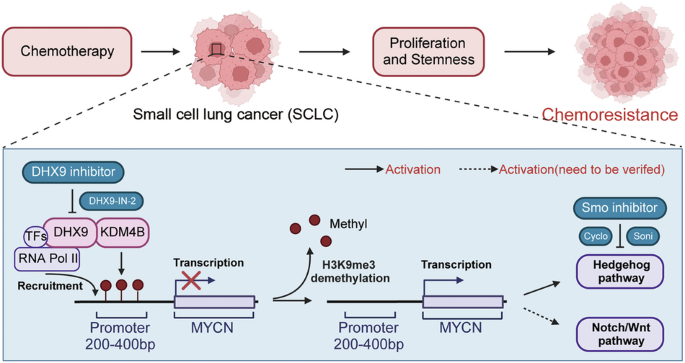
To elucidate the mechanism by which KDM4B contributes to chemoresistance, we performed RNA sequencing on KDM4B-downregulated and negative-control cells. Notably, pathway analysis revealed significant downregulation of both the Hedgehog and NOTCH signaling pathways following KDM4B knockdown (Fig. 4A). A detailed examination revealed that the genes in the pathway, the ligands (DHH), receptors (PTCH1 and PTCH2) and coreceptor GAS1 in the Hedgehog pathway, and the ligands (JAG1), receptors (NOTCH2, NOTCH3, NOTCH4) and effector molecules (HEY1, HES1, HES5) in the NOTCH pathway were downregulated (Fig. 4B). Furthermore, the expression of ligands (WNT5A and WNT5B) in the WNT signaling pathway was also reduced after KDM4B knockdown. Most of these transcriptomic changes were validated by qPCR (Figs. 4C, D and S9), supporting the hypothesis that KDM4B may contribute to chemoresistance through cross-talk among these critical signaling pathways. Despite the significant downregulation of Hedgehog signaling, its precise role in SCLC chemoresistance remains to be fully defined.
Fig. 4: KDM4B regulates the Hedgehog signaling pathway.The alternative text for this image may have been generated using AI.
A Summary of signaling pathways significantly associated with KDM4B, including upregulated and downregulated pathways. B Heatmap showing transcriptomic changes in the Hedgehog and NOTCH pathways after KDM4B knockdown. C, D The results of qPCR show the expression of PTCH1/2 and GLI1 after KDM4B knockdown. E The immunoblotting results show the expression of PTCH1 and GLI1 following KDM4B knockdown. F The results of the clonogenic assays in H69AR/H446DDP and corresponding KDM4B knockdown cells. G The results of the sphere formation assay in H69AR/H446DDP and corresponding KDM4B knockdown cells. ***, p < 0. 001; **, p < 0. 01; *, p < 0. 05.
In the KDM4B-knockdown H69AR and H446DDP cells, immunoblotting revealed that the expression of genes involved in the Hedgehog signaling pathway, including the receptors PTCH1 and PTCH2 and the effector transcription factor GLI1, was significantly downregulated (Fig. 4E). Given that activation of the Hedgehog pathway is known to promote cell proliferation and maintain stemness characteristics, we conducted clonogenic assays and sphere formation experiments to further evaluate the role of KDM4B. The results revealed a significant reduction in both the number of colonies and spheres formed following KDM4B knockdown in H69AR and H446DDP cells compared with those in the control groups (Fig. 4F, G). The above results indicate that KDM4B regulates the Hedgehog signaling pathway and promotes the proliferation and stemness of SCLC cells.
KDM4B promotes chemoresistance via the Hedgehog signaling pathway
We next utilized two SMO inhibitors of the Hedgehog pathway, cyclopamine (Cyclo) and sonidegib (Soni), to investigate whether KDM4B promotes chemoresistance through this pathway. At concentrations of 10 μM for Cyclo and 20 μM for Soni, the survival rates of H69/H69AR and H446/H446DDP cells remained above 90% (Fig. 5A, B). Treatment of H69AR and H446DDP cells with these inhibitors for 24 h effectively inhibited the pathway, as demonstrated by the downregulation of PTCH1, PTCH2, and GLI1 expression, whereas KDM4B expression remained unaffected (Figs. 5C, D and S10).
Fig. 5: KDM4B promotes chemoresistance via the Hedgehog signaling pathway.The alternative text for this image may have been generated using AI.
A, B Inhibition rates of various concentrations of SMO inhibitors on H69/H69AR and H446/H446DDP cells. C, D Effects of SMO inhibitors on the expression of receptors and effectors in the Hedgehog pathway. E Effect of SMO inhibitors on cell proliferation in H69AR and H446DDP cells. F Effects of SMO inhibitors on cell proliferation in rescue experiments using H69 and H446 cells. G Influence of SMO inhibitors on the sphere formation efficiency of H69AR and H446DDP cells. H Effects of SMO inhibitors on sphere formation efficiency in rescue experiments using H69 and H446 cells. I Effect of SMO inhibitors on the chemosensitivity of H69 and H446, as well as corresponding KDM4B-overexpressing cells. IC50, the half-maximal inhibitory concentration. ***, p < 0. 001; **, p < 0. 01; *, p < 0. 05.
We found that treatment with Cyclo or Soni significantly decreased the number of clones formed by H69AR and H446DDP cells (Fig. 5E). In H69 and H446 cells, Cyclo or Soni significantly alleviated the increase in clone number induced by KDM4B overexpression (Fig. 5F). In addition, Cyclo or Soni significantly suppressed the spheroidization rate of H69AR and H446DDP cells (Fig. 5G). In rescue experiments using H69 and H446 cells, Cyclo or Soni effectively mitigated the increase in the spheroidization rate caused by KDM4B overexpression (Fig. 5H). Importantly, in H69 and H446 cells overexpressing KDM4B, Cyclo or Soni significantly attenuated the chemoresistance mediated by KDM4B overexpression (Fig. 5I). These results collectively suggest that KDM4B promotes chemoresistance by activating the Hedgehog signaling pathway, thereby enhancing cell proliferation and stemness. However, whether Hedgehog signaling pathway inhibitors can increase the chemosensitivity of SCLC in vivo remains to be further validated.
KDM4B binds to the MYCN promoter and promotes MYCN expression
To investigate the mechanisms by which KDM4B specifically regulates the Hedgehog signaling pathway, we performed ChIP-seq analysis targeting the KDM4B protein to identify downstream molecules directly regulated by it. Our analysis revealed that KDM4B predominantly binds to intronic regions (44%), followed by intergenic regions (24%) and the 2k-base pair region upstream of gene transcription start sites (17%) (Fig. 6A). By integrating KDM4B binding sites with gene expression data, we identified 8 genes that were potentially upregulated and 11 genes that were potentially downregulated by direct binding to KDM4B (Fig. 6B). We then selected several protein-coding genes for validation and found that knockdown of KDM4B significantly increased SMARCD1 expression and decreased GALNT1, MYCN, TUBD1, and SLC35D1 expression (Fig. 6C, D). Examination of ChIP-seq peaks revealed enrichment of KDM4B at the promoters of MYCN, GALNT1, and SLC35D1, whereas enrichment of gene bodies was detected mainly for TUBD1 and SMARCD1 (Figs. 6E and S11A–C). In support of this, RNA sequencing data showed significant downregulation of MYCN, GALNT1, and SLC35D1 expression following KDM4B knockdown (Fig. S11D).
Fig. 6: KDM4B binds to the MYCN promoter and promotes MYCN expression.The alternative text for this image may have been generated using AI.
A The results of ChIP-seq targeting KDM4B reveal gene regions directly bound by KDM4B. B Venn diagram illustrating the overlap between genes directly bound by KDM4B and those that are differentially expressed following KDM4B knockdown. The results of qPCR confirmed that protein-coding genes were directly bound by KDM4B and differentially expressed after KDM4B knockdown, including genes whose expression increased (C) or decreased (D), after KDM4B knockdown. E Snapshot from the IGV program displaying the KDM4B peaks at the MYCN genomic loci (bottom), from which 3 pairs of specific primers were designed (top). F, G ChIP–PCR assay in H69AR and H446DDP cells demonstrated that a specific antibody against KDM4B, but not isotype IgG, could capture the fragment containing the KDM4B binding site in the MYCN promoter, which was amplified by specific primers using qPCR. H Immunoblot illustrating the relationship between KDM4B and MYCN expression in H69 and H446 cells. I Immunoblot showing the relationship between KDM4B downregulation and MYCN expression in H69AR and H446DDP cells. J Immunoblotting was performed to evaluate the levels of Flag and MYCN after transduction of wild-type or mutant KDM4B in H69 and H446 cells. ***, p < 0.001; **, p < 0.01. *, p < 0.05.
The amplification of genes in the MYC family (including MYC, MYCL, and MYCN) is closely associated with SCLC [42]. Among these genes, MYCN encodes the proto-oncogene N-Myc, and multiple studies have identified its overexpression as a driver of chemoresistance in SCLC [43,44,45]. Analysis of the TU-SCLC and GSE560052 cohorts revealed a significant positive correlation between MYCN and NEUROD1 expression (Fig. S4B, C). Previous work has demonstrated that the KDM4 family promotes the expression of MYCN by regulating H3K9me3 levels and facilitates adrenergic state transition in neuroblastoma [46], which is consistent with our findings that KDM4B transcriptionally regulates MYCN. Based on the ChIP-seq peak of KDM4B at the MYCN promoter, we designed three pairs of primers to verify KDM4B binding and identify the precise binding site (Fig. 6E). In both H69AR and H446DDP cells, ChIP–PCR targeting KDM4B suggested that KDM4B bound 200–400 bp upstream of the MYCN transcription start site (Fig. 6F, G). We further investigated the effect of KDM4B on MYCN protein levels and observed that MYCN expression increased upon KDM4B overexpression in H69 and H446 cells, whereas MYCN protein levels decreased following KDM4B knockdown in H69AR and H446DDP (Fig. 6H, I). Moreover, immunoblot analysis showed that overexpression of wild-type KDM4B (KDM4B-WT), but not the enzymatically inactive mutant KDM4BΔJmjC, significantly upregulated MYCN in both cell lines, indicating that the catalytic activity of the JmjC domain is essential for KDM4B-mediated regulation of MYCN (Fig. 6J).
KDM4B/DHX9 promotes MYCN-driven Hedgehog signaling pathway
KDM4B functions as a histone demethylase, removing methylation marks from H3K9me3 and H3K36me3, thereby modulating chromatin openness and participating in transcriptional regulation alongside other transcriptional cofactors. To elucidate the regulatory mechanism underlying MYCN expression, we performed a DNA pull-down assay using a biotin-labeled MYCN promoter fragment incubated with cellular proteins, followed by streptavidin magnetic bead affinity purification and mass spectrometry identification of MYCN promoter-binding proteins. After structural proteins such as histone H4 and histone H2B, as well as cellular ribosomal components, including 60S and 40S ribosomal proteins, were excluded, the top 10 proteins were selected and sorted by significance (Table 1). Among these, the RNA helicases DDX5 and DHX9 have been previously reported to facilitate gene transcription and can be selectively inhibited by specific compounds. Mass spectrometry identified peptides corresponding to DDX5, DHX9, and KDM4B (Fig. 7A). Subsequent DNA pull-down followed by immunoblotting in H69AR and H446DDP cells confirmed that DDX5, DHX9, and KDM4B physically associate with the MYCN promoter (Fig. 7B). Coimmunoprecipitation experiments targeting KDM4B further revealed that KDM4B interacts specifically with DHX9 but not with DDX5 (Fig. 7C). Analysis of RNA sequencing data revealed a decrease in DHX9 mRNA expression following KDM4B knockdown (Fig. 7D). Immunoblotting confirmed that the DHX9 protein level decreased upon KDM4B knockdown but increased with increasing KDM4B expression (Fig. 7E). DHX9 can be associated with the activation of signaling pathways, such as DHX9 and NF-κB and type I interferon pathways, by promoting transcription. Collectively, these results indicated that KDM4B physically interacts with DHX9 to directly regulate MYCN expression.
Fig. 7: KDM4B/DHX9 promotes MYCN-driven Hedgehog signaling pathway.The alternative text for this image may have been generated using AI.
A The sequences of the DDX5, DHX9 and KDM4B peptides detected in the DNA pull-down products identified the MYCN-binding protein of H69AR. B The KDM4B, DDX5 and DHX9 proteins in the pull-down products of H69AR and H446DDP cells were verified by immunoblotting. C Co-IP and immunoblot experiments were performed to identify the endogenous interactions between DDX5, DHX9, and KDM4B. D KDM4B and DHX9 expression in H69AR and the corresponding KDM4B knockdown cells. E Immunoblot showing the regulatory effect of KDM4B on DHX9 expression. F MYCN, PTCH1 and GLI1 expression in H69AR and H446DDP cells after 24 h of treatment with DHX9 inhibitor. G The expression of MYCN, PTCH1 and GLI1 in H69 and H446 cells after 24 h of treatment with DHX9 inhibitor in the rescue experiment. H Representative IHC staining of DHX9 in SCLC tissues. The statistical graph is on the right side of the images. I Spearman correlation analysis results for KDM4B and DHX9. ***, p < 0.001; **, p < 0.01.
Table 1 Mass spectrometry results of pull-down products from H69AR cells, including KDM4B and the top 10 proteins ranked by significance.
DHX9 is a highly conserved DExD/H-box RNA helicase that is localized to both the nucleus and the cytoplasm and plays pivotal roles in diverse cellular processes, including transcriptional activation, RNA editing, and microRNA biogenesis. To investigate the role of DHX9 in chemoresistance, cell viability assays were performed, and the results demonstrated that DHX9 knockdown significantly increased the sensitivity of H69AR and H446DDP cells to cisplatin and etoposide (Fig. S12). To further elucidate whether the enzymatic activity of DHX9 modulates MYCN expression and Hedgehog pathway signaling, we used DHX9-IN-2, a selective inhibitor of DHX9 enzymatic activity. Treatment with 3 μM DHX9-IN-2 maintained approximately 90% of the viability of H69AR and H446DDP cells after 24 h (Fig. S13A, B). Under these conditions, DHX9 protein levels remained unchanged, whereas MYCN, PTCH1 and GLI1 expression was downregulated (Fig. 7F). Furthermore, KDM4B overexpression in chemosensitive cells increased the expression of DHX9, MYCN, PTCH1 and GLI1, which was partially reversed by DHX9 inhibition (Fig. 7G). These findings indicate that KDM4B regulates MYCN and Hedgehog signaling in cooperation with DHX9, and that inhibiting DHX9 suppresses its transcriptional activation of MYCN. The precise mechanism by which KDM4B upregulates DHX9 remains to be investigated.
In the TU-SCLC cohort, both univariate and multivariate Cox regression analyses revealed that higher DHX9 expression was linked to shorter OS in SCLC patients at both the gene (Fig. S14A, B) and protein levels (Fig. S14C, D). Additionally, DHX9 levels were significantly elevated in chemoresistant SCLC tissues (Fig. 7H) and strongly positively correlated with KDM4B expression (Spearman’s r = 0.93, p = 0.007) (Fig. 7I).
DHX9 inhibitors increase the chemosensitivity of SCLC
Combination therapy not only boosts treatment efficacy but also helps prevent the development of drug resistance that is frequently associated with monotherapy. The results of the combined analysis of a DHX9 inhibitor with cisplatin or etoposide indicated that DHX9-IN-2 may enhance the effects of chemotherapy, particularly with etoposide (H69AR, HSA = 11.99; H446DDP, HSA = 11.96) (Figs. 8A and S15A). Combining 3 μM DHX9-IN-2 significantly reduced the resistance of H69AR cells to cisplatin and etoposide, as well as the resistance of H446DDP cells to these drugs (Figs. 8B and S15B). To further assess the impact of DHX9 inhibition on chemoresistance in vivo, subcutaneous tumor models were established using H69AR cells. The results demonstrated that weekly administration of chemotherapy in combination with the DHX9 inhibitor significantly enhanced tumor suppression compared to chemotherapy alone (Fig.8C–E).
Fig. 8: DHX9 inhibitors increase the chemosensitivity of SCLC.The alternative text for this image may have been generated using AI.
A Inhibitory effects of different concentrations of DHX9-IN-2 combined with cisplatin and etoposide on H69AR cells. B The results of the CCK8 assay showing the IC50 of cisplatin and etoposide in H69AR cells when they are combined with 3 μM DHX9-IN-2. IC50, the half-maximal inhibitory concentration. C Growth curves of tumors derived from H69AR cells and treated with chemotherapy and/or DHX9 inhibitors (n = 5). D Images of subcutaneous tumors derived from H69AR cells after chemotherapy with or without DHX9 inhibitors are shown. E Comparison of tumor weight between the groups treated with chemotherapy with or without DHX9 inhibitors. F, G Bioluminescence imaging signals from mice with orthotopic SCLC tumors were measured on Days 7, 14, 21, and 28 (n = 6). The top panel of F shows the scheme of the therapeutic strategy for the SCLC orthotopic tumor. H Weight curve of the mice. HSA, The Highest Single Agent model; DDP, Cisplatin; VP-16, Etoposide; ***, p < 0. 001; **, p < 0. 01; *, p < 0.05; ns, not significant.
To better recapitulate the natural progression of SCLC, we established orthotopic tumor models by injecting mouse-derived RP cells expressing luciferase into the lungs of C57BL/6 mice. After stable tumor establishment was confirmed via bioluminescence imaging (BLI), the mice were randomized into two treatment groups: those treated with chemotherapy alone or those treated with chemotherapy combined with the DHX9 inhibitor. On Day 21 after treatment, compared with those treated with chemotherapy alone, mice receiving the combination therapy exhibited significantly reduced BLI signal intensity, demonstrating slower tumor progression with the addition of DHX9 inhibition (Fig. 8F, G). Importantly, body weight measurements indicated that compared with chemotherapy alone, the combined treatment did not increase toxicity (Fig. 8H). Collectively, these results indicate that DHX9 inhibitors can increase the sensitivity of SCLC to chemotherapy, suggesting a promising strategy for overcoming chemoresistance.
