


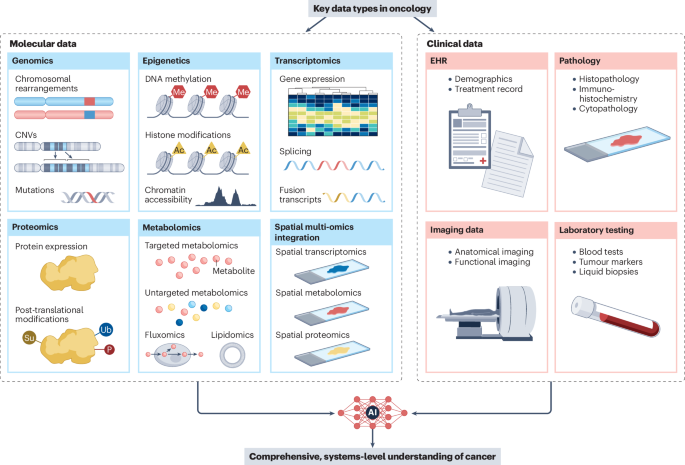
Yang, Z., Guan, F., Bronk, L. & Zhao, L. Multi-omics approaches for biomarker discovery in predicting the response of esophageal cancer to neoadjuvant therapy: a multidimensional perspective. Pharmacol. Ther. 254, 108591 (2024).
Google Scholar
The ICGC/TCGA Pan-Cancer Analysis of Whole Genomes Consortium. Pan-cancer analysis of whole genomes. Nature 578, 82–93 (2020). This consortium paper provides one of the most comprehensive genomic and transcriptomic datasets across multiple cancers, forming a foundational resource for pan-cancer computational analyses.
Google Scholar
Charlotte, J. H. & Jeffrey, M. D. Artificial intelligence and machine learning in clinical medicine. N. Engl. J. Med. 388, 1201–1208 (2023).
Google Scholar
Shi, Z., Lei, J. T., Elizarraras, J. M. & Zhang, B. Mapping the functional network of human cancer through machine learning and pan-cancer proteogenomics. Nat. Cancer 6, 205–222 (2025).
Google Scholar
Zeng, Q. et al. Understanding tumour endothelial cell heterogeneity and function from single-cell omics. Nat. Rev. Cancer 23, 544–564 (2023).
Google Scholar
Gomes, B. & Ashley, E. A. Artificial intelligence in molecular medicine. N. Engl. J. Med. 388, 2456–2465 (2023).
Google Scholar
Lipkova, J. et al. Artificial intelligence for multimodal data integration in oncology. Cancer Cell 40, 1095–1110 (2022). This review offers a foundational synopsis of the strategies, applications and challenges of using AI for multimodal data integration in oncology.
Google Scholar
Binder, A. et al. Morphological and molecular breast cancer profiling through explainable machine learning. Nat. Mach. Intell. 3, 355–366 (2021).
Google Scholar
Zhao, M. et al. Integrated multiomics signatures to optimize the accurate diagnosis of lung cancer. Nat. Commun. 16, 84 (2025). This paper provides a compelling clinical use-case, demonstrating that a multi-omics model integrating radiomics and cell-free DNA fragmentomics improves the diagnostic accuracy for indeterminate pulmonary nodules.
Google Scholar
Alcazer, V. et al. Evaluation of a machine-learning model based on laboratory parameters for the prediction of acute leukaemia subtypes: a multicentre model development and validation study in France. Lancet Digit. Health 6, e323–e333 (2024).
Google Scholar
Wang, T. et al. MOGONET integrates multi-omics data using graph convolutional networks allowing patient classification and biomarker identification. Nat. Commun. 12, 3445 (2021).
Google Scholar
Osipov, A. et al. The Molecular Twin artificial-intelligence platform integrates multi-omic data to predict outcomes for pancreatic adenocarcinoma patients. Nat. Cancer 5, 299–314 (2024). This paper introduces the ‘Molecular Twin’ concept, demonstrating a powerful platform that successfully integrates thousands of multi-omics features to accurately predict survival in pancreatic cancer.
Google Scholar
Tsai, P. C. et al. Histopathology images predict multi-omics aberrations and prognoses in colorectal cancer patients. Nat. Commun. 14, 2102 (2023). A key demonstration of the genotype–phenotype link, this work shows that deep learning on standard histopathology images can predict a wide range of multi-omics aberrations, including gene expression and copy number alterations.
Google Scholar
Boehm, K. M. et al. Multimodal data integration using machine learning improves risk stratification of high-grade serous ovarian cancer. Nat. Cancer 3, 723–733 (2022). This study provides a key example of how fusing histopathological, radiological and clinicogenomic features can improve prognostic accuracy over any single modality alone.
Google Scholar
Niazi, M. K. K., Parwani, A. V. & Gurcan, M. N. Digital pathology and artificial intelligence. Lancet Oncol. 20, e253–e261 (2019).
Google Scholar
Sunami, K. et al. A learning program for treatment recommendations by molecular tumor boards and artificial intelligence. JAMA Oncol. 10, 95–102 (2024).
Google Scholar
Chen, R. J. et al. Pan-cancer integrative histology-genomic analysis via multimodal deep learning. Cancer Cell 40, 865–878.e6 (2022).
Google Scholar
Jee, J. et al. Automated real-world data integration improves cancer outcome prediction. Nature 636, 728–736 (2024). This paper details the creation of a massive, multi-modal real-world dataset (MSK-CHORD) and shows that integrating NLP-derived features from clinical notes improves survival prediction beyond genomics or stage alone.
Google Scholar
Vanguri, R. S. et al. Multimodal integration of radiology, pathology and genomics for prediction of response to PD-(L)1 blockade in patients with non-small cell lung cancer. Nat. Cancer 3, 1151–1164 (2022). This study demonstrated that a model integrating radiology, pathology and genomics can predict immunotherapy response in NSCLC more accurately than established biomarkers like TMB or PDL1.
Google Scholar
Qiu, W. et al. Deep profiling of gene expression across 18 human cancers. Nat. Biomed. Eng. 9, 333–355 (2025).
Google Scholar
Chang, T. G., Park, S., Schaffer, A. A., Jiang, P. & Ruppin, E. Hallmarks of artificial intelligence contributions to precision oncology. Nat. Cancer 6, 417–431 (2025).
Google Scholar
Unger, M. & Kather, J. N. Deep learning in cancer genomics and histopathology. Genome Med. 16, 44 (2024).
Google Scholar
LeCun, Y., Bengio, Y. & Hinton, G. Deep learning. Nature 521, 436–444 (2015).
Google Scholar
Bravo González-Blas, C. et al. Single-cell spatial multi-omics and deep learning dissect enhancer-driven gene regulatory networks in liver zonation. Nat. Cell Biol. 26, 153–167 (2024).
Google Scholar
Wornow, M. et al. Zero-shot clinical trial patient matching with LLMs. NEJM AI 2, AIcs2400360 (2025).
Google Scholar
Andani, S. et al. Histopathology-based protein multiplex generation using deep learning. Nat. Mach. Intell. 7, 1292–1307 (2025).
Google Scholar
Kondepudi, A. et al. Foundation models for fast, label-free detection of glioma infiltration. Nature 637, 439–445 (2025).
Google Scholar
Wang, J. et al. An interpretable artificial intelligence framework for designing synthetic lethality-based anti-cancer combination therapies. J. Adv. Res. 65, 329–343 (2024).
Google Scholar
Su, X. et al. Interpretable identification of cancer genes across biological networks via transformer-powered graph representation learning. Nat. Biomed. Eng. 9, 371–389 (2025). This paper presents a novel approach using a transformer-based model on biological networks to not only predict cancer driver genes with high accuracy but also to provide interpretable insights into their regulatory mechanisms.
Google Scholar
Prelaj, A. et al. Artificial intelligence for predictive biomarker discovery in immuno-oncology: a systematic review. Ann. Oncol. 35, 29–65 (2024).
Google Scholar
Wang, K. et al. A full life cycle biological clock based on routine clinical data and its impact in health and diseases. Nat. Med. 31, 4225–4235 (2025).
Google Scholar
Zhu, J. et al. Cell Decoder: decoding cell identity with multi-scale explainable deep learning. Genome Biol. 26, 359 (2025).
Google Scholar
Zhao, Y. et al. Deep learning using histological images for gene mutation prediction in lung cancer: a multicentre retrospective study. Lancet Oncol. 26, 136–146 (2025). This study demonstrates the clinical potential of predicting key driver gene mutations in lung cancer directly from routine H&E-stained pathology slides with high accuracy across multiple centres.
Google Scholar
Tan, C. L. et al. Prediction of tumor-reactive T cell receptors from scRNA-seq data for personalized T cell therapy. Nat. Biotechnol. 43, 134–142 (2025).
Google Scholar
Rakaee, M. et al. Deep learning model for predicting immunotherapy response in advanced non-small cell lung cancer. JAMA Oncol. 11, 109–118 (2025).
Google Scholar
Ellrott, K. et al. Classification of non-TCGA cancer samples to TCGA molecular subtypes using compact feature sets. Cancer Cell 43, 195–212.e11 (2025).
Google Scholar
Boehm, K. M., Khosravi, P., Vanguri, R., Gao, J. & Shah, S. P. Harnessing multimodal data integration to advance precision oncology. Nat. Rev. Cancer 22, 114–126 (2022).
Google Scholar
Chen, R. J. et al. Algorithmic fairness in artificial intelligence for medicine and healthcare. Nat. Biomed. Eng. 7, 719–742 (2023).
Google Scholar
Nam, J. G. et al. Histopathologic basis for a chest CT deep learning survival prediction model in patients with lung adenocarcinoma. Radiology 305, 441–451 (2022).
Google Scholar
Cai, Z. et al. Synthetic augmentation of cancer cell line multi-omic datasets using unsupervised deep learning. Nat. Commun. 15, 10390 (2024).
Google Scholar
Lotfollahi, M., Yuhan, H., Theis, F. J. & Satija, R. The future of rapid and automated single-cell data analysis using reference mapping. Cell 187, 2343–2358 (2024).
Google Scholar
Wang, H. et al. Scientific discovery in the age of artificial intelligence. Nature 620, 47–60 (2023).
Google Scholar
Figueiredo, M. A. T. & Jain, A. K. Unsupervised learning of finite mixture models. IEEE Trans. Pattern Anal. Mach. Intell. 24, 381–396 (2002).
Google Scholar
Vorontsov, E. et al. A foundation model for clinical-grade computational pathology and rare cancers detection. Nat. Med. 30, 2924–2935 (2024).
Google Scholar
Nguyen, E. et al. Sequence modeling and design from molecular to genome scale with Evo. Science 386, eado9336 (2024).
Google Scholar
Xu, H. et al. A whole-slide foundation model for digital pathology from real-world data. Nature 630, 181–188 (2024).
Google Scholar
Fahrner, L. J., Chen, E., Topol, E. & Rajpurkar, P. The generative era of medical AI. Cell 188, 3648–3660 (2025).
Google Scholar
Krizhevsky, A., Sutskever, I. & Hinton, G. E. ImageNet classification with deep convolutional neural networks. Adv. Neural Inf. Process. Syst. 25, 1097–1105 (2012).
Vaswani, A. et al. Attention is all you need. Adv. Neural Inf. Process. Syst. 30, 5998–6008 (2017).
Song, A. H. et al. Analysis of 3D pathology samples using weakly supervised AI. Cell 187, 2502–2520.e17 (2024).
Google Scholar
Szałata, A. et al. Transformers in single-cell omics: a review and new perspectives. Nat. Methods 21, 1430–1443 (2024).
Google Scholar
Avsec, Ž et al. Effective gene expression prediction from sequence by integrating long-range interactions. Nat. Methods 18, 1196–1203 (2021).
Google Scholar
Li, H. et al. CGMega: explainable graph neural network framework with attention mechanisms for cancer gene module dissection. Nat. Commun. 15, 5997 (2024).
Google Scholar
Ritter, M. et al. Spatially resolved transcriptomics and graph-based deep learning improve accuracy of routine CNS tumor diagnostics. Nat. Cancer 6, 292–306 (2025).
Google Scholar
Goodfellow, I. et al. Generative adversarial networks. Commun. ACM 63, 139–144 (2020).
Google Scholar
Yang, L. et al. Diffusion models: a comprehensive survey of methods and applications. ACM Comput. Surv. 56, 1–39 (2023).
Google Scholar
Wang, J. et al. Self-improving generative foundation model for synthetic medical image generation and clinical applications. Nat. Med. 31, 609–617 (2025).
Google Scholar
Zhao, F., Zhang, C. & Geng, B. Deep multimodal data fusion. ACM Comput. Surv. 56, 1–36 (2024).
Prakash, A., Chitta, K. & Geiger, A. in Proc. IEEE/CVF Conf. Comput. Vision Pattern Recognition 7077–7087 (IEEE, 2021).
Wang, Y. Survey on deep multi-modal data analytics: collaboration, rivalry, and fusion. ACM Trans. Multimed. Comput. Commun. Appl. 17, 1–25 (2021).
Yang, H. et al. A multimodal vision–language model for generalizable annotation-free pathology localization. Nat. Biomed. Eng. https://doi.org/10.1038/s41551-025-01574-7 (2026).
Google Scholar
Gadzicki, K., Khamsehashari, R. & Zetzsche, C. in 2020 IEEE 23rd Int. Conf. Information Fusion (FUSION) 1–6 (IEEE, 2020).
Chaudhary, K., Poirion, O. B., Lu, L. & Garmire, L. X. Deep learning-based multi-omics integration robustly predicts survival in liver cancer. Clin. Cancer Res. 24, 1248–1259 (2018).
Google Scholar
Zhu, J., Huang, C. & De Meo, P. DFMKE: a dual fusion multi-modal knowledge graph embedding framework for entity alignment. Inf. Fusion. 90, 111–119 (2023).
Google Scholar
Wang, M., Bai, S. & Zhang, Y. Single- and multi-modal molecular probes with second near-infrared activatable optical signals for disease diagnosis and theranostics. Chem. Soc. Rev. 54, 7561–7609 (2025).
Google Scholar
Herrmann, M., Probst, P., Hornung, R., Jurinovic, V. & Boulesteix, A. L. Large-scale benchmark study of survival prediction methods using multi-omics data. Brief. Bioinform. 22, bbaa167 (2021).
Google Scholar
Yuan, Y. et al. Assessing the clinical utility of cancer genomic and proteomic data across tumor types. Nat. Biotechnol. 32, 644–652 (2014).
Google Scholar
Cheng, J. et al. Accurate proteome-wide missense variant effect prediction with AlphaMissense. Science 381, eadg7492 (2023).
Google Scholar
Carrillo-Perez, F. et al. Generation of synthetic whole-slide image tiles of tumours from RNA-sequencing data via cascaded diffusion models. Nat. Biomed. Eng. 9, 320–332 (2025). A key generative AI application, this work demonstrates the novel capability of generating realistic histopathology images directly from RNA-sequencing data, offering a powerful solution for data scarcity and modality imputation.
Google Scholar
Howard, F. M. et al. Generative adversarial networks accurately reconstruct pan-cancer histology from pathologic, genomic, and radiographic latent features. Sci. Adv. 10, eadq0856 (2024).
Google Scholar
Lorenzo, G. et al. Patient-specific, mechanistic models of tumor growth incorporating artificial intelligence and big data. Annu. Rev. Biomed. Eng. 26, 529–560 (2024).
Google Scholar
Hu, B. et al. High-resolution spatially resolved proteomics of complex tissues based on microfluidics and transfer learning. Cell 188, 734–748.e22 (2025).
Google Scholar
He, B. et al. Integrating spatial gene expression and breast tumour morphology via deep learning. Nat. Biomed. Eng. 4, 827–834 (2020).
Google Scholar
Anaya, J., Sidhom, J. W., Mahmood, F. & Baras, A. S. Multiple-instance learning of somatic mutations for the classification of tumour type and the prediction of microsatellite status. Nat. Biomed. Eng. 8, 57–67 (2024).
Google Scholar
Coudray, N. et al. Classification and mutation prediction from non-small cell lung cancer histopathology images using deep learning. Nat. Med. 24, 1559–1567 (2018).
Google Scholar
Kather, J. N. et al. Pan-cancer image-based detection of clinically actionable genetic alterations. Nat. Cancer 1, 789–799 (2020).
Google Scholar
Valanarasu, J. M. J. et al. Multimodal AI generates virtual population for tumor microenvironment modeling. Cell 189, 386–400 (2025).
Google Scholar
Song, B. & Liang, R. Integrating artificial intelligence with smartphone-based imaging for cancer detection in vivo. Biosens. Bioelectron. 271, 116982 (2025).
Google Scholar
Shah, S. F. H. et al. Ethical implications of artificial intelligence in skin cancer diagnostics: use-case analyses. Br. J. Dermatol. 192, 520–529 (2025).
Google Scholar
Xu, H. et al. Artificial intelligence-assisted colonoscopy for colorectal cancer screening: a multicenter randomized controlled trial. Clin. Gastroenterol. Hepatol. 21, 337–346.e3 (2023).
Google Scholar
Ahmad, A. et al. Evaluation of a real-time computer-aided polyp detection system during screening colonoscopy: AI-DETECT study. Endoscopy 55, 313–319 (2023).
Google Scholar
Ardila, D. et al. End-to-end lung cancer screening with three-dimensional deep learning on low-dose chest computed tomography. Nat. Med. 25, 954–961 (2019).
Google Scholar
Christiansen, F. et al. International multicenter validation of AI-driven ultrasound detection of ovarian cancer. Nat. Med. 31, 189–196 (2025).
Google Scholar
Eisemann, N. et al. Nationwide real-world implementation of AI for cancer detection in population-based mammography screening. Nat. Med. 31, 917–924 (2025).
Google Scholar
Hamm, C. A. et al. Interactive explainable deep learning model informs prostate cancer diagnosis at MRI. Radiology 307, e222276 (2023).
Google Scholar
Haue, A. D., Hjaltelin, J. X., Holm, P. C., Placido, D. & Brunak, S. R. Artificial intelligence-aided data mining of medical records for cancer detection and screening. Lancet Oncol. 25, e694–e703 (2024).
Google Scholar
Hernström, V. et al. Screening performance and characteristics of breast cancer detected in the Mammography Screening with Artificial Intelligence trial (MASAI): a randomised, controlled, parallel-group, non-inferiority, single-blinded, screening accuracy study. Lancet Digit. Health 7, e175–e183 (2025).
Google Scholar
Jones, O. T. et al. Artificial intelligence and machine learning algorithms for early detection of skin cancer in community and primary care settings: a systematic review. Lancet Digit. Health 4, e466–e476 (2022).
Google Scholar
Lu, M. Y. et al. AI-based pathology predicts origins for cancers of unknown primary. Nature 594, 106–110 (2021). This work demonstrates a powerful clinical application of AI in pathology, showing that a deep learning model can accurately predict the tissue of origin for metastatic tumours, a key challenge in managing cancer of unknown primary.
Google Scholar
Lång, K. et al. Artificial intelligence-supported screen reading versus standard double reading in the Mammography Screening with Artificial Intelligence trial (MASAI): a clinical safety analysis of a randomised, controlled, non-inferiority, single-blinded, screening accuracy study. Lancet Oncol. 24, 936–944 (2023).
Google Scholar
Karsenti, D. et al. Effect of real-time computer-aided detection of colorectal adenoma in routine colonoscopy (COLO-GENIUS): a single-centre randomised controlled trial. Lancet Gastroenterol. Hepatol. 8, 726–734 (2023).
Google Scholar
Ortiz, O. et al. An artificial intelligence-assisted system versus white light endoscopy alone for adenoma detection in individuals with Lynch syndrome (TIMELY): an international, multicentre, randomised controlled trial. Lancet Gastroenterol. Hepatol. 9, 802–810 (2024).
Google Scholar
Yuan, X. L. et al. Effect of an artificial intelligence-assisted system on endoscopic diagnosis of superficial oesophageal squamous cell carcinoma and precancerous lesions: a multicentre, tandem, double-blind, randomised controlled trial. Lancet Gastroenterol. Hepatol. 9, 34–44 (2024).
Google Scholar
Steyaert, S. et al. Multimodal data fusion for cancer biomarker discovery with deep learning. Nat. Mach. Intell. 5, 351–362 (2023).
Google Scholar
Zhu, G. et al. A deep-learning model for quantifying circulating tumour DNA from the density distribution of DNA-fragment lengths. Nat. Biomed. Eng. 9, 307–319 (2025).
Google Scholar
Cohen, J. D. et al. Detection and localization of surgically resectable cancers with a multi-analyte blood test. Science 359, 926–930 (2018).
Google Scholar
Liu, M. C., Oxnard, G. R., Klein, E. A., Swanton, C. & Seiden, M. V. Sensitive and specific multi-cancer detection and localization using methylation signatures in cell-free DNA. Ann. Oncol. 31, 745–759 (2020).
Google Scholar
Yang, M. et al. Enhancing the differential diagnosis of small pulmonary nodules: a comprehensive model integrating plasma methylation, protein biomarkers, and LDCT imaging features. J. Transl. Med. 22, 984 (2024).
Google Scholar
Guerra, C. E., Sharma, P. V. & Castillo, B. S. Multi-cancer early detection: the new frontier in cancer early detection. Annu. Rev. Med. 75, 67–81 (2024).
Google Scholar
Schrag, D. et al. Blood-based tests for multicancer early detection (PATHFINDER): a prospective cohort study. Lancet 402, 1251–1260 (2023).
Google Scholar
Bai, L. et al. Cancer biomarkers discovered using pan-cancer plasma proteomic profiling. Nat. Biomed. Eng. 10, 16–38 (2026).
Google Scholar
Malara, N. et al. Multicancer screening test based on the detection of circulating non haematological proliferating atypical cells. Mol. Cancer 23, 32 (2024).
Google Scholar
Zeune, L. L. et al. Deep learning of circulating tumour cells. Nat. Mach. Intell. 2, 124–133 (2020).
Google Scholar
Foroutan, F. et al. Computer aided detection and diagnosis of polyps in adult patients undergoing colonoscopy: a living clinical practice guideline. BMJ 388, e082656 (2025).
Google Scholar
Djinbachian, R. et al. Autonomous artificial intelligence vs artificial intelligence-assisted human optical diagnosis of colorectal polyps: a randomized controlled trial. Gastroenterology 167, 392–399 e392 (2024).
Google Scholar
Ebigbo, A., Messmann, H. & Lee, S. H. Artificial intelligence applications in image-based diagnosis of early esophageal and gastric neoplasms. Gastroenterology 169, 396–415.e2 (2025).
Google Scholar
Ding, W. et al. Contrast-enhanced ultrasound-based AI model for multi-classification of focal liver lesions. J. Hepatol. 83, 426–439 (2025).
Google Scholar
Lam, S. et al. Current and future perspectives on computed tomography screening for lung cancer: a roadmap from 2023 to 2027 from the International Association for the Study of Lung Cancer. J. Thorac. Oncol. 19, 36–51 (2024).
Google Scholar
Lam, S. et al. The International Association for the Study of Lung Cancer Early Lung Imaging Confederation Open-source Deep Learning and Quantitative Measurement Initiative. J. Thorac. Oncol. 19, 94–105 (2024).
Google Scholar
Darmofal, M. et al. Deep-Learning model for tumor-type prediction using targeted clinical genomic sequencing data. Cancer Discov. 14, 1064–1081 (2024).
Google Scholar
Chen, L. et al. Machine learning predicts oxaliplatin benefit in early colon cancer. J. Clin. Oncol. 42, 1520–1530 (2024).
Google Scholar
Adeoye, J. & Su, Y. X. Leveraging artificial intelligence for perioperative cancer risk assessment of oral potentially malignant disorders. Int. J. Surg. 110, 1677–1686 (2024).
Google Scholar
Chen, Z. et al. Predicting gastric cancer response to anti-HER2 therapy or anti-HER2 combined immunotherapy based on multi-modal data. Signal. Transduct. Target. Ther. 9, 222 (2024).
Google Scholar
Yang, Z. et al. A foundation model for generalizable cancer diagnosis and survival prediction from histopathological images. Nat. Commun. 16, 2366 (2025).
Google Scholar
Mikhael, P. G. et al. Sybil: a validated deep learning model to predict future lung cancer risk from a single low-dose chest computed tomography. J. Clin. Oncol. 41, 2191–2200 (2023).
Google Scholar
Yala, A. et al. Multi-institutional validation of a mammography-based breast cancer risk model. J. Clin. Oncol. 40, 1732–1740 (2022).
Google Scholar
Eriksson, M., Czene, K., Vachon, C., Conant, E. F. & Hall, P. Long-term performance of an image-based short-term risk model for breast cancer. J. Clin. Oncol. 41, 2536–2545 (2023).
Google Scholar
Huang, K. et al. A foundation model for clinician-centered drug repurposing. Nat. Med. 30, 3601–3613 (2024).
Google Scholar
Lapi, S. E. et al. Recent advances and impending challenges for the radiopharmaceutical sciences in oncology. Lancet Oncol. 25, e236–e249 (2024).
Google Scholar
Moon, I. et al. Machine learning for genetics-based classification and treatment response prediction in cancer of unknown primary. Nat. Med. 29, 2057–2067 (2023).
Google Scholar
Ogier du Terrail, J. et al. Federated learning for predicting histological response to neoadjuvant chemotherapy in triple-negative breast cancer. Nat. Med. 29, 135–146 (2023). This study provides a crucial proof-of-concept for federated learning, showing how multiple institutions can collaboratively train a powerful predictive model without sharing sensitive patient data.
Google Scholar
Sammut, S.-J. et al. Multi-omic machine learning predictor of breast cancer therapy response. Nature 601, 623–629 (2022).
Google Scholar
Bao, X. et al. A multiomics analysis-assisted deep learning model identifies a macrophage-oriented module as a potential therapeutic target in colorectal cancer. Cell Rep. Med. 5, 101399 (2024).
Google Scholar
Loupy, A. et al. Reshaping transplantation with AI, emerging technologies and xenotransplantation. Nat. Med. 31, 2161–2173 (2025).
Google Scholar
Fraunhoffer, N. et al. Development and validation of AI-assisted transcriptomic signatures to personalize adjuvant chemotherapy in patients with pancreatic ductal adenocarcinoma. Ann. Oncol. 35, 780–791 (2024).
Google Scholar
Zhang, K. et al. Artificial intelligence in drug development. Nat. Med. 31, 45–59 (2025).
Google Scholar
Park, S. et al. A deep learning model of tumor cell architecture elucidates response and resistance to CDK4/6 inhibitors. Nat. Cancer 5, 996–1009 (2024).
Google Scholar
Keyl, J. et al. Decoding pan-cancer treatment outcomes using multimodal real-world data and explainable artificial intelligence. Nat. Cancer 6, 307–322 (2025).
Google Scholar
L’Imperio, V. et al. Pathologist validation of a machine learning-derived feature for colon cancer risk stratification. JAMA Netw. Open 6, e2254891 (2023).
Google Scholar
Heckenbach, I. et al. Deep learning assessment of senescence-associated nuclear morphologies in mammary tissue from healthy female donors to predict future risk of breast cancer: a retrospective cohort study. Lancet Digit. Health 6, e681–e690 (2024).
Google Scholar
Spratt, D. E. et al. Artificial intelligence predictive model for hormone therapy use in prostate cancer. NEJM Evid. 2, EVIDoa2300023 (2023).
Google Scholar
Esteva, A. et al. Prostate cancer therapy personalization via multi-modal deep learning on randomized phase III clinical trials. NPJ Digit. Med. 5, 71 (2022).
Google Scholar
Foersch, S. et al. Multistain deep learning for prediction of prognosis and therapy response in colorectal cancer. Nat. Med. 29, 430–439 (2023).
Google Scholar
Amgad, M. et al. A population-level digital histologic biomarker for enhanced prognosis of invasive breast cancer. Nat. Med. 30, 85–97 (2024). This study presents a population-level, deep learning-based biomarker from H&E slides that consistently outperforms pathologists in predicting breast cancer survival, highlighting the power of AI to capture prognostic stromal and immune features.
Google Scholar
Wulczyn, E. et al. Interpretable survival prediction for colorectal cancer using deep learning. NPJ Digit. Med. 4, 71 (2021).
Google Scholar
Mataraso, S. J. et al. A machine learning approach to leveraging electronic health records for enhanced omics analysis. Nat. Mach. Intell. 7, 293–306 (2025).
Google Scholar
Volinsky-Fremond, S. et al. Prediction of recurrence risk in endometrial cancer with multimodal deep learning. Nat. Med. 30, 1962–1973 (2024). This study demonstrates that a multi-modal deep learning model (HECTOR), integrating histology and clinical stage, outperforms the current molecular-based gold standard for predicting distant recurrence in endometrial cancer.
Google Scholar
Kehl, K. L. et al. Shareable artificial intelligence to extract cancer outcomes from electronic health records for precision oncology research. Nat. Commun. 15, 9787 (2024).
Google Scholar
Gale, D. et al. Residual ctDNA after treatment predicts early relapse in patients with early-stage non-small cell lung cancer. Ann. Oncol. 33, 500–510 (2022).
Google Scholar
Pantel, K. & Alix-Panabières, C. Minimal residual disease as a target for liquid biopsy in patients with solid tumours. Nat. Rev. Clin. Oncol. 22, 65–77 (2025).
Google Scholar
Bruhm, D. C. et al. Genomic and fragmentomic landscapes of cell-free DNA for early cancer detection. Nat. Rev. Cancer 25, 341–358 (2025).
Google Scholar
Abbosh, C. et al. Tracking early lung cancer metastatic dissemination in TRACERx using ctDNA. Nature 616, 553–562 (2023).
Google Scholar
Wang, Y. et al. PRIME: an interpretable artificial intelligence model based on liquid biopsy improves prediction of progression risk in non-small cell lung cancer. Mil. Med. Res. 12, 94 (2026).
Google Scholar
Loeffler, C. M. L. et al. HIBRID: histology-based risk-stratification with deep learning and ctDNA in colorectal cancer. Nat. Commun. 16, 7561 (2025).
Google Scholar
Thangaraj, P. M., Benson, S. H., Oikonomou, E. K., Asselbergs, F. W. & Khera, R. Cardiovascular care with digital twin technology in the era of generative artificial intelligence. Eur. Heart J. 45, 4808–4821 (2024).
Google Scholar
Zhang, K. et al. Concepts and applications of digital twins in healthcare and medicine. Patterns 5, 101028 (2024).
Google Scholar
Asghar, U. S. & Chung, C. Application of digital twins for personalized oncology. Nat. Rev. Cancer 25, 823–825 (2025).
Google Scholar
Sadée, C. et al. Medical digital twins: enabling precision medicine and medical artificial intelligence. Lancet Digit. Health 7, 100864 (2025).
Google Scholar
Reicher, L. et al. Deep phenotyping of health-disease continuum in the Human Phenotype Project. Nat. Med. 31, 3191–3203 (2025).
Google Scholar
National Academies of Sciences, Engineering & Medicine. Foundational Research Gaps and Future Directions for Digital Twins (The National Academies Press, 2024).
McCoy, M. Digital twins in oncology: where we are and where we hope to go. BMJ Oncol. 4, e000893 (2025).
Google Scholar
Gilbertson, R. J. et al. The virtual child. Cancer Discov. 14, 663–668 (2024).
Google Scholar
Laubenbacher, R., Mehrad, B., Shmulevich, I. & Trayanova, N. Digital twins in medicine. Nat. Comput. Sci. 4, 184–191 (2024).
Google Scholar
Asciak, L. et al. Digital twin assisted surgery, concept, opportunities, and challenges. NPJ Digit. Med. 8, 32 (2025).
Google Scholar
Ector, C. et al. Time-of-day effects of cancer drugs revealed by high-throughput deep phenotyping. Nat. Commun. 15, 7205 (2024).
Google Scholar
Foy, B. H. et al. Haematological setpoints are a stable and patient-specific deep phenotype. Nature 637, 430–438 (2025).
Google Scholar
Görtz, M. et al. Digital twins for personalized treatment in uro-oncology in the era of artificial intelligence. Nat. Rev. Urol. 23, 29–39 (2025).
Google Scholar
Tushar, F. I. et al. Virtual lung screening trial (VLST): an in silico study inspired by the national lung screening trial for lung cancer detection. Med. Image Anal. 103, 103576 (2025).
Google Scholar
Sarrami-Foroushani, A. et al. In-silico trial of intracranial flow diverters replicates and expands insights from conventional clinical trials. Nat. Commun. 12, 3861 (2021).
Google Scholar
Scibilia, K. R. et al. Mathematical oncology: how modeling is transforming clinical decision-making. Cancer Res. 85, 4866–4879 (2025).
Google Scholar
Demir, S. et al. Mechanistic models position ceritinib as a nuclear integrity disrupting therapy in pediatric liver tumors. J. Exp. Clin. Cancer Res. 44, 268 (2025).
Google Scholar
DeGrave, A. J., Cai, Z. R., Janizek, J. D., Daneshjou, R. & Lee, S. I. Auditing the inference processes of medical-image classifiers by leveraging generative AI and the expertise of physicians. Nat. Biomed. Eng. 9, 294–306 (2025).
Google Scholar
Rong, Y. et al. Towards human-centered explainable AI: a survey of user studies for model explanations. IEEE Trans. Pattern Anal. Mach. Intell. 46, 2104–2122 (2024).
Google Scholar
Chen, D. et al. Physician and artificial intelligence chatbot responses to cancer questions from social media. JAMA Oncol. 10, 956–960 (2024).
Google Scholar
Benfatto, S. et al. Explainable artificial intelligence of DNA methylation-based brain tumor diagnostics. Nat. Commun. 16, 1787 (2025). This work pioneers the concept of a ‘biologically informed’ neural network, which integrates known biological pathways into the model architecture to improve prediction and enable the discovery of novel molecular drivers of treatment resistance.
Google Scholar
Ghassemi, M., Oakden-Rayner, L. & Beam, A. L. The false hope of current approaches to explainable artificial intelligence in health care. Lancet Digit. Health 3, e745–e750 (2021).
Google Scholar
Feuerriegel, S. et al. Causal machine learning for predicting treatment outcomes. Nat. Med. 30, 958–968 (2024).
Google Scholar
Elmarakeby, H. A. et al. Biologically informed deep neural network for prostate cancer discovery. Nature 598, 348–352 (2021).
Google Scholar
Novakovsky, G., Dexter, N., Libbrecht, M. W., Wasserman, W. W. & Mostafavi, S. Obtaining genetics insights from deep learning via explainable artificial intelligence. Nat. Rev. Genet. 24, 125–137 (2023).
Google Scholar
Chen, H., Gomez, C., Huang, C. M. & Unberath, M. Explainable medical imaging AI needs human-centered design: guidelines and evidence from a systematic review. NPJ Digit. Med. 5, 156 (2022).
Google Scholar
Kurian, M., Adashek, J. J. & West, H. J. Cancer care in the era of artificial intelligence. JAMA Oncol. 10, 683 (2024).
Google Scholar
Acosta, J. N., Falcone, G. J., Rajpurkar, P. & Topol, E. J. Multimodal biomedical AI. Nat. Med. 28, 1773–1784 (2022).
Google Scholar
Alderman, J. E. et al. Tackling algorithmic bias and promoting transparency in health datasets: the STANDING together consensus recommendations. Lancet Digit. Health 7, e64–e88 (2025).
Google Scholar
Fiske, A. et al. Weighing the benefits and risks of collecting race and ethnicity data in clinical settings for medical artificial intelligence. Lancet Digit. Health 7, e286–e294 (2025).
Google Scholar
Giddings, R. et al. Factors influencing clinician and patient interaction with machine learning-based risk prediction models: a systematic review. Lancet Digit. Health 6, e131–e144 (2024).
Google Scholar
Gazzarata, R. et al. HL7 Fast Healthcare Interoperability Resources (HL7 FHIR) in digital healthcare ecosystems for chronic disease management: scoping review. Int. J. Med. Inf. 189, 105507 (2024).
Google Scholar
Vokinger, K. N. & Gasser, U. Regulating AI in medicine in the United States and Europe. Nat. Mach. Intell. 3, 738–739 (2021).
Google Scholar
Qian, X. et al. A multimodal machine learning model for the stratification of breast cancer risk. Nat. Biomed. Eng. 9, 356–370 (2025).
Google Scholar
Kehayias, C. E. et al. A prospectively deployed deep learning-enabled automated quality assurance tool for oncological palliative spine radiation therapy. Lancet Digit. Health 7, e13–e22 (2025).
Google Scholar
Moons, K. G. M. et al. PROBAST+AI: an updated quality, risk of bias, and applicability assessment tool for prediction models using regression or artificial intelligence methods. BMJ 388, e082505 (2025).
Google Scholar
