


Loss of SCAP accelerates KRAS/TP53-induced pancreatic tumor formation
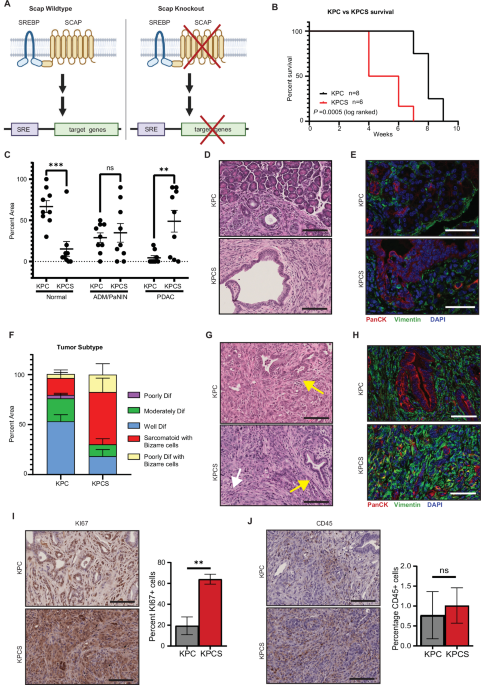
To directly test the consequence of Scap deletion on pancreatic tumorigenesis, we crossed Scapf/f (floxed, but lacking Cre recombinase, resulting in normal Scap expression) and Scapwt/wt mice to the well-characterized LSL-KrasG12D;Trp53f/f;Pdx1-Cre model of pancreatic ductal adenocarcinoma (PDAC) [8], generating KPC versus KPCS mice (Fig. 1A, Supplementary Fig S1A). The Pdx1 promoter used to activate Cre in this model becomes active at embryonic day 8.5–9.0 in the definitive endoderm for the pancreatic bud, precursor to exocrine, endocrine, and ductal cell populations [25]. In KPC mice, signs of ill health mandating euthanasia typically occur at ~8-10 weeks of age [8]. In this study, similar results were obtained, with overall survival (OS) at ~8–9 weeks (Fig. 1A). Strikingly, in the KPCS genotype, disease progression was accelerated, with OS reduced to ~4–6 weeks (p = 0.0005); all mice with this genotype died of aggressive pancreatic tumors (Fig. 1B). Interestingly, we also observed a correlation between low SCAP expression and reduced survival in human PDAC, based on KM plots analysis of public data [26] (Supplementary Fig S1B).
Fig. 1: Loss of Scap accelerates and promotes loss of differentiation of KRAS/TP53 pancreatic tumors.
A Graphical description of Scap knockout model. Created in BioRender. Lilly, A. (2026) https://BioRender.com/k5xvfzb. B Survival curve of KPC (n = 8) vs KPCS (n = 6) mice. C. Percent area of pancreata from 4-week-old KPC (n = 9) or KPCS (n = 9) mice that are normal, precancerous (ADM/PaNIN), or pancreatic cancer (PDAC). Approximately equal number males and females were analyzed per genotypes D Representative 20x H&E images of pancreata from 4-week-old KPC (n = 9) and KPCS (n = 9) mice. Scale bar 100 µm. E Representative ×40 immunofluorescence images of pancreata from 4-week-old KPC (n = 5) and KPCS (n = 5) mice stained for pan-cytokeratin (red) and vimentin (green). Scale bar 50 µm. 5 fields of view per mouse. F Relative area of the pancreatic tumors consisting of differentially differentiated tumor in KPC (n = 5) vs KPCS (n = 5) mice from the survival cohort. G Representative 20x H&E images of ScapΔpanc and Scapf/f pancreata from KPC (vs KPCS mice in the survival cohort. The yellow arrows point to representative lesions with classical PDAC. The white arrow points to a representative lesion of sarcomatoid PDAC. Scale bar 100 µm. H Representative 40x immunofluorescence images of pancreata from the survival study cohort (n = 5) and KPCS (n = 5) mice stained for pan-cytokeratin (red) and vimentin (green). Scale bar 50 µm. 5 fields of view per mouse. Representative 20x images for markers of (I) proliferation (Ki67) and J leukocyte infiltration (CD45) in KPC versus KPCS mice from the survival cohort, with quantitation. Scale bar 100 µm. *p ≤ 0.05; **p ≤ 0.01; ***p ≤ 0.001, ****p ≤ 0.0001, in all panels. Student’s t test used for all statistical analysis.
Comparison of the pancreata of 4-week-old KPC and KPCS mice (Fig. 1C, D and Supplementary Fig S1C) revealed extensive areas of tumor tissue mass in KPCS mice, with almost no normal tissue identified, in contrast to little detected formation of tumors in KPC mice. Based on quantification of the overall cohort, 34.8% of the observed pancreatic area in KPCS mice was composed of tissue with acinar-to-ductal metaplasia (ADM) or pancreatic intraepithelial neoplasias (PanINs), and 48.9% overt PDAC (compared to 28.9% ADM/PanIN and 4.4% PDAC for KPC mice) (Fig C, D, Supplementary Fig S1C). At 4 weeks, immunofluorescence staining of KPCS pancreata revealed a large increase in vimentin-positive tissue (Fig. 1E and Supplementary Fig S1D).
Similar histopathological assessment performed on KPC and KPCS from the survival study indicated that KPCS tumors were largely sarcomatoid or poorly differentiated compared to the well to moderately differentiated KPC tumors (Fig. 1F, G and Supplementary Fig S1E, F). Additionally, a number of KPCS tumors contained bizarre cells (enlarged, often multinucleated cells associated with sarcomatoid carcinomas [27, 28]). Three of the six KPCS mice in the survival study also had areas of cystic tissue (Supplementary Fig S1G); this was not observed in KPC mice. In these specimens, vimentin staining of mesenchymal tissue was much higher in the KPCS tissues (Fig. 1H). KPCS tumors also stained more strongly for Ki67, indicating increased proliferation (Fig. 1I). In contrast, we did not observe a significant difference in staining pattern of the leukocyte marker CD45 between KPC and KPCS pancreatic tumors (Fig. 1J).
Single nuclei transcriptomic analysis of KPC versus KPCS tumors
To gain insight into underlying changes in cellularity and signaling induced by loss of SCAP, KPC and KPCS pancreata were collected at times corresponding to significant tumor burden (4 weeks for KPCS tumors, and 7 weeks for KPC tumors) and used for isolation of single nuclei (Fig. 2, Supplementary Fig S2A–D). For comparison, the pancreas from a 4-week-old KPC mouse was also collected for single nuclei; however, at 4 weeks of age, the sample consisted primarily of acinar cells, with no emergence of a transformed population at this time point (Supplementary Fig S2E). Because of this significant difference in cellularity between age matched KPC and KPCS pancreata, we did not continue downstream analysis involving the 4-week-old KPC mouse data. A gross comparison of cellularity following single nuclei transcriptomic analysis (Fig. 2A, B) indicated a markedly different profile between the two genotypes. Although possessing a substantial burden of tumor (epithelial) cells, KPC tumor-bearing pancreata retained extensive numbers of acinar cells, with limited populations of immune cells or fibroblasts. In contrast, the KPCS pancreata were predominantly composed of epithelial (tumor) cells, with substantial enlargement of the fibroblast and immune compartments; almost no acinar cells were detected. When comparing the subtypes of immune populations between KPC and KPCS samples, KPC samples predominantly contained macrophages, with a very minor population of dendritic cells; results similar to those previously described for this genotype in another study [29] (Supplementary Fig S2F–H). Conversely KPCS samples contained a much more diverse population, with macrophages accompanied by an expanded pool of dendritic cells and abundant lymphocytes, including both T and B cells.
Fig. 2: Single nuclei sequencing of KPCS and KPC pancreatic tumors.
A UMAP of annotated clusters in 4-week-old KPCS (n = 2) and 7-week-old KPC (n = 2) single nuclei-RNA seq pancreatic samples. B Stacked bar graph of the average percentage of cells in each cluster per genotype/time point. C Dot plot showing average expression of Scap, Srebf1/2, and their downstream regulated genes in indicated cell clusters. D GSEA analysis of upregulated and downregulated Hallmark genesets in the 4-week-old KPCS fibroblast cluster compared to 7-week-old KPC, using fgsea. E IPA analysis predicting upregulated and downregulated signaling pathways responsible for altered gene expression in the 4-week-old KPCS fibroblast cluster compared to 7-week-old KPC. F A UMAP projection of KPC (left) and KPCS (right) epithelial cells. Point color – from blue (early pseudotime, most epithelial-like, expressing genes Cdh1, Epcam, Krt8, Krt18) through yellow (EMT) to red (late pseudotime, most fibroblastic, expressing genes Vim, Fn1, Snai1, Twist1)—reflecting Monocle 3-inferred differentiation progression, showing KPC and KPCS epithelial cells have similar patterns of differentiation. G A violin plot showing the quantification of the pseudotime distribution of KPC and KPCS clusters. H A UMAP projection of pseudotime values split into three equally populated bins (Early, Middle, and Late) using quantile-based tertile cuts. I GSEA analysis of upregulated and downregulated Hallmark genesets in the 4-week-old KPCS compared to 7-week-old KPC epithelial cluster, using fgsea. J IPA analysis predicting upregulated and downregulated signaling pathways responsible for altered gene expression in the 4-week-old KPCS compared to 7-week-old KPC epithelial cluster. K Bar chart of percentage of cells in KPC and KPCS samples by pseudotime stage. L. A UMAP projection of KPC (left) and KPCS (right) fibroblasts. Point color—from blue (early pseudotime, most myCAF-like, expressing genes Vim, Des, Acta2) through yellow (intermediate) to red (late pseudotime, most iCAF-like, expressing genes Pdgfra, Cxcl12, Il6)—reflects Monocle 3-inferred differentiation progression, showing an increase of KPCS fibroblasts expressing an iCAF phenotype compared to KPC. M A violin plot showing the quantification of the pseudotime distribution of KPC and KPCS clusters. N A UMAP projection of pseudotime values split into three equally populated bins (Early, Middle, and Late) using quantile-based tertile cuts. O Bar chart of percentage of cells in KPC and KPCS samples by pseudotime stage. **p ≤ 0.01, ***p ≤ 0.001, in all panels. A Chi-square test was used for quantification of percentage of cells by pseudotime stage.
Examination of the expression of SCAP/SREP and other lipid-relevant transcripts in these key populations (Fig. 2C) indicated elevated expression of Srebf2 in the KPCS setting, and a striking elevation of Acaca (ACC1), a key dependency in PDAC characterized by KRAS pathway activation [30]. Gene set enrichment analysis (GSEA) and Ingenuity Pathway Analysis (IPA, [31]) were performed on differentially expressed genes (DEGs) separately on the epithelial/tumor (Fig. 2D, E), and fibroblast (Fig. 2F, G) compartments. GSEA analysis identified significant upregulation of signatures of mitotic spindle and UV response in both KPCS epithelial cells and fibroblasts, suggestive of rapidly proliferating cells, and less pronounced reduction in MYC transcriptional targets and oxidative phosphorylation in KPCS fibroblasts (Supp Table S3). Intriguingly, IPA analysis identified many common elements in the signatures of KPCS epithelial cells and fibroblasts, in comparison to matching KPC populations (Supplementary Table S4). The KPCS populations strongly downregulated MLXIPL/ChREBP and SPEN, and upregulated LARP1, and RICTOR. MLKIPL is a glucose-regulated MYC-superfamily member that activates an overlapping series of lipogenic targets with SREBPs [32]; SPEN, a transcriptional co-repressor that has been identified as a tumor suppressor in some cancers [33]. LARP1 [34] and RICTOR [35] both function as positive regulators of mTOR signaling, associated with rapid cellular growth.
Although there was an increase in sarcomatoid tumors in KPCS mice, pseudotime analysis indicated few differences in differentiation trajectory between KPC and KPCS, KPCS epithelial clusters have undergone more EMT than KPC epithelial cells (Fig. 2H–K). We also performed pseudotime characterization of the cancer associated fibroblasts (CAFs) comparing markers indicative of functional myofibroblastic CAFs (Vim, Des, Acta2) and/or inflammatory CAFs (Pdgfra, Cxcl12, Il6) within the fibroblast clusters. This analysis revealed little difference between CAF functionality in KPCS tumors compared to KPC tumors (Fig. 2K–O).
Deletion of Scap in the pancreatic primordia disrupts pancreatic development
To gain insight into the very distinct phenotypes of KPC versus KPCS tumors, we analyzed the consequences of Scap loss in the absence of PDAC oncogenic driver lesions, crossing Scapf/f mice to Pdx1-Cre mice to create Pdx1-Cre;Scapf/f mice (subsequently designated as ScapΔpanc) (Supplementary Fig S3A). ScapΔpanc mice are born at normal Mendelian ratios (Supplementary Table S5). Although of lower weight than control mice at 2 weeks of age, this difference became insignificant by 1 month of age (Fig. 3A). In young mice (2–4 weeks), ScapΔpanc pancreata were significantly smaller than those of control mice, although this difference also became less significant as mice age and was not observed in 6-month-old mice (Fig. 3B). In some ScapΔpanc animals, pancreatic cysts were observed (Supplementary Fig S3B).
Fig. 3: Altered pancreatic growth and cellularity in ScapΔpanc mice.
A Weight of ScapΔpanc and Scapf/f mice ± SEM at ages indicated. Analysis is based on n = 10 mice per genotype per age group, equal numbers male and female. B Weight of ScapΔpanc and Scapf/f pancreata ± SEM from from mice in (A). C Representative 20x H&E images of ScapΔpanc and Scapf/f pancreata described in (B). Scale bar 100 µm. D Pancreatic atrophy ± SEM at ages indicated. E Quantitation of acinar-to-ductal metaplasia (ADM) ± SEM in 2-week-old H&E stained ScapΔpanc and Scapf/f pancreata. F Representative 40x image of ADM in 1-month-old ScapΔpanc pancreata compared to Scapf/f. Arrows indicate cells expressing both acinar (a-amylase, red)) and ductal (CK19, green)) markers. DAPI, blue. Scale bar 50 µm. 5 fields of view per mouse. G Left, Representative Western blot, and right, related quantitation of carboxypeptidase A (CPA) and α-amylase in AR42J cells treated with 50 nM siRNA targeting Scap or a scrambled control for 72 h (n = 7 independent experiments). H Representative Western blot of PARP in AR42J cells treated with 50 nM siRNA targeting Scap or a scrambled control for 72 h (n = 7 independent experiments). *p ≤ 0.05; **p ≤ 0.01; ***p ≤ 0.001, ****p ≤ 0.0001, in all panels. Student’s t test used for all statistical analysis.
In contrast to these limited quantitative differences, histopathological analyses indicated clear differences in pancreatic development already significant in two-week-old mice, and magnified in older mice (Fig. 3C, D, and S3C, D). Severe pancreatic atrophy was observed in ScapΔpanc mice, characterized by an extensive loss of acinar tissue. By 1 month of age, the exocrine compartment was largely replaced by mature adipose tissue, leaving only residual ductal structures and scattered islets of Langerhans. In several areas, ductal dilation was noted, with some ducts appearing ectatic or irregular in shape. The remaining pancreatic architecture was markedly disrupted, with minimal to no identifiable acinar cell remnants. Despite the extensive atrophy, the endocrine component (islets) appeared relatively preserved, although in some cases slightly reduced or displaced within the adipose-rich tissue. These findings suggest chronic and advanced degenerative changes, potentially resulting from long-standing injury, metabolic stress, genetic modification, or other underpinnings in the experimental model.
Comparison of the rates of proliferation and apoptosis in the pancreata of 2 week old mice (Supplementary Fig S3E, F) indicated almost no detectable apoptosis (based on caspase 3 cleavage), and no significant proliferation (Ki67) differences between the Scapf/f and ScapΔpanc genotypes. Rather, suggestive of a differentiation defect, numerous areas of ADM were observed in ScapΔpanc pancreata (Fig. 3E, F), as immunofluorescence analysis with markers for acinar cells (α-amylase) or ductal cells (cytokeratin 19, CK19) confirmed reduced areas containing α-amylase+ acinar cells, increased areas with CK19+ ductal cells, and appearance of structures staining for both acinar and ductal markers. To determine if the observed loss of acinar cells represented a cell-intrinsic effect of SCAP loss, we knocked down SCAP using siRNA in the rat acinar cell line AR42J. Knockdown of SCAP (Fig S3G) reduced expression of the acinar markers carboxypeptidase A (CPA) and α-amylase (Fig. 3G), but did not induce apoptosis as indicated by the lack of cleaved PARP (Fig. 3H). Together, these data suggested loss of SCAP predisposed acinar cells to ADM.
Scap
Δpanc mice develop features of chronic pancreatitis
The striking loss of acinar cells observed in mice is a typical feature of chronic pancreatitis, a pathological state associated with fibrosis, immune cell infiltration, and accumulation of adipocytes [36, 37]. Based on staining with Masson’s trichrome, we observed a significant, progressive accumulation of fibrous collagen in pancreatic tissue from ScapΔpanc mice, versus little accumulation in controls, with this particularly notable in 1 month old mice (Fig. 4A). Similar results were obtained based on immunohistochemical staining with vimentin (Supplementary Fig S4A). We also observed extensive infiltration of CD45+ lymphocytes and F4/80+ macrophages into pancreatic tissue of 1 month old ScapΔpanc mice (Fig. 4B, C). Accumulation of CD45+ lymphocytes was maintained 3-month-old and 6-month-old ScapΔpanc mice; levels of F4/80+ macrophages were attenuated as ScapΔpanc mice age (Fig. 4C).
Fig. 4: Loss of pancreatic Scap promotes fibrosis, immune infiltration, and fatty replacement.
A Representative Masson’s trichrome staining in ScapΔpanc and Scapf/f pancreata from mice at ages indicated. Equal numbers of male and female mice were analyzed per genotype. Representative 20x images (B) of staining for markers for leukocytes (CD45, B) and macrophages (F4/80, C) in ScapΔpanc and Scapf/f pancreata from 1 month old, 3 months old, and 6 months old mice, and quantification of these results, ± SEM. Scale bar 100 µm. D Representative 20x perilipin-1 immunohistochemistry staining of ScapΔpanc and Scapf/f pancreata from mice at ages indicated. Analysis based on 5–6 mice per genotype, equal number males and females. Scale bar 100 µm. E Mean concentration of triglycerides ± SEM (pmol/mg) in ScapΔpanc pancreata compared to Scapf/f pancreata in 2-week-old mice. Analysis of 10 samples per genotype, equal numbers of males and females. Data has been normalized to known, spiked-in lipid controls, allowing the results to be converted to pmol of lipid/mg tissue. See also Supplementary Table S6. *p ≤ 0.05; **p ≤ 0.01; ****p ≤ 0.0001, in all panels. Student’s t test used for all statistical analysis.
The fatty tissue within the ScapΔpanc pancreas stained intensely for perilipins-1 and -2 (Fig. 4D, Supplementary Fig S4B), proteins required for lipid droplet formation that are typically found in adipocytes, and elevated in MASLD [38]. Lipidomic analysis of ScapΔpanc versus Scapf/f pancreatic tissue at 2 weeks of age (Fig. 4E, Supplementary Fig S4C, Supplementary Table S6) demonstrated significant increase in triglycerides, a storage form of excess lipids often observed in pancreatitis [39], in the ScapΔpanc cohort compared to the Scapf/f samples. Taken in sum, these data indicated that constitutive absence of SCAP in pancreatic primordia triggered rapid onset of chronic pancreatitis.
Lineage tracing indicates mesenchymal origin of adipocytes
The observations of acinar loss and replacement with adipose tissue accompanied by higher levels of storage lipids were surprising, as loss of SCAP-SREBP signaling would be expected to decrease rather than increase lipid production. To gain insight into the changes in cellularity, we crossed Scapf/f versus ScapΔpanc mice to Ai9 mice, which strongly express the fluorescent protein tdTomato following Cre-dependent recombination [12]. In Pdx1-CreAi9 mice (designated wtTom) mice, the bulk of pancreatic tissue, including acinar, ductal, and endocrine tissue is uniformly tdTomato + . Notably, in Pdx1-Cre;Scapf/f;Ai9 mice (designated ScapΔpanc-Tom), while the residual acinar, ductal, and endocrine tissue is tdTomato + , the adipose cells are not (Fig. 5A). Of pancreas-resident cell types, the Pdx1 promoter is only inactive in cells of mesenchymal origin (e.g. fibroblasts, stellate cells, and adipocytes) and immune cells [40,41,42]. These results suggested that in mice with SCAP deficiency in exocrine and endocrine tissue, there is compensatory expansion of mesenchymal cells that subsequently differentiate into adipocytes.
Fig. 5: Altered cellularity and signaling in ScapΔpanc and Scapf/f pancreata.
A Representative 40x images of immunofluorescence staining for Perilipin-1 (green) in ScapΔpanc-Tom (n = 5) and WtTom (n = 4) pancreata from 1-month-old mice. Scale bar 50 µm. B UMAP of annotated clusters in 0.5-month-old ScapΔpanc and Scapf/f samples. C Stacked bar graph of the percentage of cells in each cluster per sample. D Dot plot showing average expression of Scap, Srebf1/2, and their downstream regulated genes in selected clusters, comparing ScapΔpanc and Scapf/f samples. E GSEA analysis of upregulated and downregulated Hallmark genesets in the ScapΔpanc fibroblastic cell 2 cluster compared to Scapf/f. F Violin plots of gene expression associated with fibroblastic cell activation in the fibroblastic cell 2 cluster, comparing ScapΔpanc and Scapf/f samples. G Ingenuity pathway analysis (IPA) upstream regulator analysis of predicted upregulated and downregulated signaling pathways in the ScapΔpanc fibroblastic cell 2 cluster compared to Scapf/f. H A UMAP projection of ScapΔpanc (left) and Scapf/f (right) pancreatic fibroblastic cells 1 and fibroblastic 2. Point color–from blue (early pseudotime, least differentiated, expressing genes Vim, Cd44, Vcam1, Pdgfra) through yellow (intermediate) to red (late pseudotime, most differentiated, expressing genes Col1a1, Fn1, Acta2, Col6a1)—reflects Monocle 3-inferred differentiation progression, showing that Scapf/f cells advance to a later state while ScapΔpanc cells remain in earlier differentiation stages. I A violin plot showing the quantification of the pseudotime distribution of ScapΔpanc and Scapf/f clusters. J A UMAP projection of pseudotime values split into three equally populated bins (Early, Middle, and Late) using quantile-based tertile cuts. K Bar chart of percentage of cells in ScapΔpanc and Scapf/f samples by pseudotime stage. **p ≤ 0.01, ***p ≤ 0.001, in all panels. Chi-square test used for quantification of percentage of cells by pseudotime stage.
Single cell RNA sequencing identifies early reciprocal signaling changes in exocrine versus mesenchymal cell populations
To test this idea, and evaluate contributing mechanisms, we performed single cell sequencing on 2-week-old ScapΔpanc and Scapf/f mice. At two weeks of age, a time when relatively limited morphological differences were apparent, the overall cellular composition of the pancreas was similar between the two genotypes (Fig. 5B, Supplementary Fig S5A–C). However, a loss of acinar cell populations was already evident, as were losses in overall exocrine cells (representing immature acinar cells, ductal cells, and exocrine precursor cells) (Fig. 5C). In contrast, levels of immune cells were elevated in the ScapΔpanc sample. When investigating the immune populations, the ScapΔpanc sample has elevated levels of B cells and lymphocytes compared to Scapf/f(Supplementary Fig S5D–G). Interestingly, B cell accumulation has been linked to pancreatic inflammation [43] and has previously been reported to inhibit pancreatic epithelial regeneration in the context of chronic pancreatitis [44].
We compared the expression of genes relevant to SCAP signaling in cells of distinct lineages in ScapΔpanc and Scapf/f pancreata (Fig. 5D, Supplementary Fig. S5B, C, Supplementary Table S7). As expected, levels of SCAP itself were greatly reduced or undetectable in acinar and exocrine cells from ScapΔpanc mice (Fig. 5D, Supplementary Fig S5B), whereas little difference was seen in the fibroblastic 1 cluster (with an expression profile most similar to local resident fibroblasts, defined based on intermediate expression of collagen genes, Fn1, Pdgfra, Fbn1, Fndc1, and S100a11) or the fibroblastic 2 cluster (with an expression profile similar to stellate cells: Acta2+Pdgfralow). Similar results were obtained for Srebf1 expression in all analyzed cell populations (Fig. 5D, Supplementary Fig S5B). For SREBP2, while significant reduction in expression was observed in acinar and exocrine clusters from ScapΔpanc pancreata, the degree of reduction was much less in ductal and endocrine cells than was observed for Srebf1. Notably, Srebf2 expression was significantly elevated in ScapΔpanc fibroblastic 1 and fibroblastic 2 clusters. SREBPs direct the transcription of genes including Fasn, Acaca/b, Scd1, Elovl6, Hmgcr, and Hmgcr1/2, required for lipid production and uptake. For these genes, we observed a pattern similar to Srebf2, with reduced expression in acinar and exocrine cells. In contrast, expression of these genes was elevated in ScapΔpanc fibroblastic cells (Fig. 5D).
We performed GSEA on DEGs in discrete ScapΔpanc versus Scapf/f cell clusters. While no statistically significant changes were identified in fibroblastic 1 cells, ScapΔpanc fibroblastic 2 cells had elevated expression of Hallmark gene sets for fatty acid metabolism (including Acaa1, Acaa2, and Acat1), as well as for mTORC1 and MYC, DNA repair, IFNγ, and oxidative phosphorylation, associated with proliferation and inflammation (Fig. 5E, Supplementary Table S3). Notably, increased fatty acid metabolism and fatty acid oxidation have been previously reported to increase in activated stellate cells [45,46,47]. Additional fibroblastic markers such as Acta2 and Fn1 were also elevated in ScapΔpanc cells compared to Scapf/f (Fig. 5F). IPA identified a complex pattern of transcriptional changes in ScapΔpanc fibroblastic 2 cells, including significant upregulation of KRAS and MYC-dependent transcription and downregulation of TP53-dependent transcription, among others (Fig. 5G). To assess if fibroblastic differentiation is affected by the loss of Scap in pancreatic exocrine and endocrine tissue, we performed pseudotime analysis on the combined fibroblastic 1 and fibroblastic 2 clusters (the combined set referred to as fibroblastic). This indicated that the ScapΔpanc fibroblastic cells are restricted to an earlier pseudotime stage expressing more mesenchymal progenitor markers (Vim, Cd44, Vcam1, Pdgfra) while Scapf/f fibroblastic cells are found primarily in the middle to late stage associated with more differentiated fibroblastic markers (Col1a1, Fn1, Acta2, Col6a1) (Fig. 5H, K).
Given the observation of ADM and potential defect in differentiation of acinar cells in ScapΔpanc pancreata, we separately analyzed signaling in acinar versus the broader exocrine compartment. In the acinar cluster, GSEA analysis indicated the significant decrease in genesets including TGFβ signaling and EMT, TNFα signaling, and angiogenesis/hypoxia, in ScapΔpanc versus Scapf/f samples (Fig. 6A). IPA upstream regulator analysis separately indicated the strongest downregulation of TGFβ1-dependent transcription in ScapΔpanc acinar cells, also finding downregulation of TP53-, and AGT-transcription (Fig. 6B); concomitant with elevated KRAS and HRAS transcription (Fig. 6B). Intriguingly, AGT, encoding angiotensin, controls the renin-angiotensin system that regulates blood pressure and vascular function, but has also been linked to regulation of adipogenesis and cross-regulation with SREBP1 [48, 49]. Further, analysis using EnrichR [18] of significantly upregulated genes in the ScapΔpanc acinar cluster (Fig. 6C) identified significant overlap with genes elevated in exocrine pancreatic insufficiency and pancreatic steatorrhea, a condition characterized by excess amounts of fat; as well as syndromes related to metabolic disfunction such as cholesterol ester storage disease and disease of metabolism (Fig. 6C). GSEA analysis of the exocrine cluster was similar to that of acinar cells, with a significant decrease in TGFβ signaling, EMT, TNFα signaling, and angiogenesis/hypoxia in ScapΔpanc versus Scapf/f samples (Fig. 6D). Additionally, the exocrine ScapΔpanc cluster had a decrease cholesterol homeostasis, consistent with the loss of SCAP/SREBP signaling. IPA analysis also yielded results similar to the acinar cluster (Fig. 6E), with some additions; the pancreatic tumor suppressor MRTFB [50] was significantly downregulated, while PEAR1, a promoter of fibroblast activation and fibrosis [51], was strongly elevated.
Fig. 6: Altered signaling in ScapΔpanc and Scapf/f acinar and exocrine cells shows developmental impact of Scap loss.
A GSEA analysis of upregulated and downregulated Hallmark genesets in the ScapΔpanc compared to Scapf/f acinar cluster. B IPA upstream regulator analysis of predicted upregulated and downregulated signaling pathways in the ScapΔpanc acinar cluster compared to Scapf/f. C Enrichr analysis of Jensen DISEASES genesets associated with genes overexpressed in ScapΔpanc versus Scapf/f acinar cells. D GSEA analysis of upregulated and downregulated Hallmark genesets in the ScapΔpanc compared to Scapf/f exocrine cluster. E IPA analysis of predicted upregulated and downregulated signaling pathways associated with observed gene expression changes in the ScapΔpanc versus Scapf/f exocrine cluster. F A UMAP projection of ScapΔpanc (left) and Scapf/f (right) pancreatic exocrine and acinar cells. Point color—from blue (early pseudotime, least differentiated, expressing genes Pdx1, Hnf1b, Sox9, Ptf1a) through yellow (intermediate) to red (late pseudotime, most differentiated, expressing genes Amy2a, Cpa1, Prss1, Krt19)—reflects Monocle 3-inferred differentiation progression, showing that ScapΔpanc cells are restricted to the middle differentiation stages while Scapf/f cells had both earlier and later differentiation states. G A violin plot showing the quantification of the pseudotime distribution of ScapΔpanc and Scapf/f clusters. H A UMAP projection of pseudotime values split into three equally populated bins (Early, Middle, and Late) using quantile-based tertile cuts. I Bar chart of percentage of cells in ScapΔpanc and Scapf/f samples by pseudotime stage. J Graphical abstract describing how the loss of Scap impacts the pancreas. Created in BioRender. Lilly, A. (2026) https://BioRender.com/511uib5. ***p ≤ 0.001, in all panels. Chi-square test used for quantification of percentage of cells by pseudotime stage.
Using pseudotime analysis to compare cell differentiation pathways, we investigated if the loss of SCAP impacts the trajectory of differentiation of specific pancreatic populations. We first verified the expression profiles of acinar (Cela2a, Cpa1, Cpa2, Pnliprp1, Try4) and ductal (Sox9, Krt19, Muc1) markers in ScapΔpanc and Scapf/f samples (Supplementary Fig S6A, B). These UMAPs show the majority of clusters express acinar markers, with a small cluster expressing ductal markers, and clusters expressing both acinar and ductal markers. The expression of Scap, Srebf1/2, and SCAP/SREBP signaling targets (Ldlr, Acaca, Fasn) was uniformly decreased in ScapΔpanc versus Scapf/f samples (Supplementary Fig S6C). Using pseudotime, we observed that ScapΔpanc cells stalled at the middle pseudotime stage compared to Scapf/f (Fig. 6F, G), indicating a delay in progression toward a terminally differentiated acinar states. When comparing the trajectory-based clustering between Scapf/f and ScapΔpanc, we observed an intermediate subpopulation almost exclusively composed of ScapΔpanc cells at mid-pseudotime (p < 0.001; Fig. 6H, I), consistent with incomplete acinar differentiation.
To further investigate how SCAP loss stalls acinar cell terminal differentiation, we looked at the expression of acinar differentiation markers, genes associated with pancreatic steatosis, and genes associated with pancreatic cancer (Supplementary Fig S7). Although the very small numbers of ScapΔpanc acinar cells at early stages of differentiation limited conclusions, expression of two genes essential for acinar cell differentiation and maintenance, PTF1a and NR5A22, appeared moderately reduced in ScapΔpanc cells compared to Scapf/f cells, as was expression of the tumor suppressor TRP53. Finally, a similar phenotype of global acinar replacement by adipose tissue has previously been observed in other studies involving induced loss or gain of genes in the pancreatic exocrine/endocrine primordia, as reviewed in [37]. Studies using the Pdx1 promoter to eliminate genes including cMYC [52], IKKa [53], JAG1 [54], KIF3A [55], or PROX1 [56], or a Ptf1 promoter to overexpress TGFBR1 in acinar cells [57] in each case identified progressive acinar loss and replacement with adipose cells, in some cases accompanied by ADM and fibrosis. However, in ScapΔpanc cells, expression of mRNA for MYC, JAG1 and other genes was relatively unaffected.
