


Cell culture
BV-2 (referred as BV2) mouse microglia cell line (RRID: CVCL_0182; gift of G. Brown, University of Cambridge) [11, 19, 50], HMC3 human microglia cell line (RRID: CVCL_II76; also known as CHME3, obtained from originator M. Tardieu, Paris-Sub University) [51], GL261 mouse GB, IDH1 wildtype, cell line expressing the enhanced green fluorescent protein (GFP) (referred as GFP-GL261) (RRID: CVCL_Y003; gift of R. Glass, Max Delbrück Center) [11, 26] and C6 rat glioma, IDH1 wildtype, cell line (RRID: CVCL_0194; gift of O. Hermanson, Karolinska Institutet) and C8-D1A mouse astrocytic cell line (RRID: CRL-2541; purchased from ATCC, CRL-2541™) were cultivated in DMEM + glutamax medium (Gibco) supplemented with 10% FBS (fetal bovine serum) and 1% P/S (Penicillin/Streptomycin). MN9D mouse dopaminergic neuronal cell line (RRID: CVCL_M067; obtained from the originator Alfred Heller, University of Chicago) was cultivated in DMEM/F12 glutamax medium (Gibco) supplemented with 10% FBS and 1% P/S. U-87MG ATCC (referred to as U87-MG) human GB, IDH1 wildtype, cell line (RRID: CVCL_0022; purchased from ATCC, HTB-14™) was cultivated in MEM medium supplemented with 10% FBS and 1% P/S. All cell lines were grown in an incubator at 37°C and 5% CO2 and regularly tested with Venor GeM mycoplasma detection kit (Minerva Biolabs).
For segregated coculture experiments, microglial cells were first seeded in 5% FBS medium on coverslips in 12-well plates, while glioblastoma neuronal and astrocytic cells were seeded in 94 mm diameter Petri dishes. Thereafter, 24 h after seeding, the cocultures were initiated by placing the coverslips with microglial cells into cell strainers in the petri dishes containing the glioblastoma cells. Microglial cells were then harvested at given time-points.
Glial cell extraction and following microglia isolation
Glial cells were isolated from the brains of male C57BL/6J mice (Charles River, Sulzfeld, Germany, stock #000664) on postnatal day 14. All the experimental procedures were carried out according to the European and Swedish animal welfare regulations approved by the northern Stockholm ethical committee (application no. 13676-2020) (n = 10 per preparation). Animals were deeply anesthetized with sodium pentobarbital (ABCUR AB, Sweden), and transcardially perfused with ice-cold 1 × phosphate-buffered saline without Ca2+ and Mg2+ (PBS; pH 7.4; GIBCO/Life Technologies #10010056). Brains were collected, the cerebella and olfactory bulbs were removed, and cerebra were placed into 50 mL tubes containing 1 × PBS and kept on ice. Briefly, dissected cerebra were transferred to Petri dishes and finely minced using scalpels. The tissue was then enzymatically digested in 2.5 mL of an enzyme solution consisting of 0.01% papain (0.1%; Roche #000000010108014001), 0.1% dispase II (Sigma-Aldrich #D4693), 0.05% DNase I (Roche # 000000010104159001), and 12.4 mM MgSO₄ (Sigma-Aldrich #M7506) made in 1× Hank’s-buffered salt solution (HBSS) without Ca2+ and Mg2+ (GIBCO/Life Technologies #14175095). Samples were incubated at 37 °C for 10 min, after which the enzymatic activities were stopped with 20% cold heat-inactivated fetal bovine serum (FBS; GIBCO/Life Technologies #10500064). Tissue homogenization was achieved by gentle trituration using a pipette until a uniform suspension was obtained. Cell suspensions were filtered through a 70 μm strainer, diluted with 20% FBS in HBSS, and centrifuged at 500 × g for 5 min at 4 °C. After washing with 1× HBSS, cells were resuspended in 20% percoll solution (percoll plus, GE Healthcare, #GE17-0891-02); 10× phenol red HBSS (Gibco/Life Technologies #14060040) and 1× HBSS, and overlaid with an equal volume of 1× HBSS, and overlaid carefully with 1× HBSS, and centrifuged at 500 × g for 20 min at 4 °C without brake to remove the myelin. Following removal of the supernatant, cells were washed in 1× HBSS and centrifuged again at 500 × g for 5 min at 4 °C. The final pellet was resuspended in complete culture medium consisting of DMEM/F12 with Glutamax culture medium (Gibco/Life Technologies #31331028) and 10% heat-inactivated FBS, supplemented with 10 ng/mL recombinant mouse M-CSF (R&D Systems 416-ML-010). Cells were plated in a T75 flask and grown at 37 °C in 5% CO2. The culture media were replaced every 2–3 days.
Gene silencing by transfection of small interfering RNAs pools
For transient gene expression silencing by siRNAs, non-targeting control, Dnmt1, Dnmt3a and Dnmt3b ON-TARGET plus SMARTpools siRNAs, whose sequences can be found in the Supplementary Table 1, were obtained from Dharmacon. Transfection of BV2 cells was carried out with Lipofectamine 3000 (Invitrogen).
Primary microglia were transfected with siRNA using the Glial-Mag transfection reagent and magnetic plate system (OZ Biosciences) according to the manufacturer’s protocol with minor modifications. The procedure was performed in a 24-well low evaporation plate, with reagent volumes adjusted accordingly. For each well, 0,6 μL of siRNA (20 μM stock concentration) was diluted in 90 μL DMEM/F12 without serum or antibiotics and 0,5 μL of Glial-Mag reagent was mixed gently. The mixture was incubated at room temperature for 20 min to allow complex formation. Meanwhile, the culture medium in each well was replaced with 330 μL fresh DMEM/F12 without serum or antibiotics. Following incubation, the siRNA–Glial-Mag complex was added dropwise to each well along with 4 μL of Glial-Boost (100×), as recommended in the kit protocol. The culture plates were then placed on the magnetic plate inside a humidified incubator at 37 °C with 5% CO2 for 30 min to facilitate magnetic-assisted transfection. After removing the magnetic plate, cells were incubated for an additional 3 h under the same conditions. Subsequently, the medium was replaced with complete culture medium (DMEM/F12 supplemented with 10% FBS and 1% P/S), and cells were allowed to recover for 24 h prior to the transwell migration assay.
Dnmt3a gene silencing by short hairpin RNA lentiviral infection
For stable gene expression silencing of Dnmt3a by shRNA, MISSION® shRNA for Dnmt3a in pLKO-PURO vector in lentiviral particles, and an empty pLKO-PURO vector used as a control, were purchased from Sigma Aldrich. Two clones (Clone IDs: TRCN0000039034 with target sequence: CCAGATGTTCTTTGCCAATAA, and TRCN0000039035 with target sequence: GCAGACCAACATCGAATCCAT) were tested for lentiviral infection at different Multiplicity of Infection (MOI 1, MOI 2 and MOI 5) of the BV2 cells overnight in the presence of polybrene (Sigma-Aldrich). The MOI of 2 was selected as the best ratio of infection. Two days post-infection, cells that incorporated the shRNA were selected using fresh medium containing 5 µg/ml of Puromycin (Sigma-Aldrich) and shRNA knockdown efficiency was monitored by immunoblot analysis (as described below) after the first 3 cell passages and at regular intervals when running experimental work.
Cell death
The cell apoptosis was detected using an Annexin V-FITC/PI apoptosis kit (Fisher #10267392) according to the manufacturer´s protocol. At the indicated time and conditions, the media and cells digested with TrypLE Express Enzyme (1X) (Fisher #10718463) were collected and washed with PBS. In the segregated coculture experiments, tumor cells and microglia cells were pooled together, and CD11b staining (Brilliant Violet 421, Biolegend #101236) was performed to distinguish both populations. Subsequently, cells were incubated in 100 μL Annexin binding buffer with Annexin-V- FITC (5 μL) and Propidium Iodide (0,5 μL) for 15 min at room temperature. The apoptosis rate was analysed using a FCM flow cytometer (BDFACS Canto II, Biomedicum Flow Cytometry Core Facility, Karolinska Institute) according to the instructions.
Immunoblotting
Total protein extracts were made directly in Laemmli buffer by scraping the cells. For immunoblot analysis, protein extracts were resolved on 8% SDS–polyacrylamide gel electrophoresis and then blotted onto 0.45 µm pore-size nitrocellulose membranes. Membranes were blocked with 0.1% Tween/5% milk in PBS and incubated with the indicated primary antibodies, overnight at 4 °C, followed by incubation with the appropriate horseradish peroxidase secondary antibody (Pierce, 1:10,000) for 1 h at room temperature 20–25 °C. An immunoblot with anti-β-actin antibodies was used for standardization of protein loading. Details about antibodies used in this study can be found in Supplementary Table 2. Bands were visualized by enhanced chemiluminescence (ECL-Plus, Pierce) following the manufacturer’s protocol. Alternatively, the membranes were incubated with the appropriate secondary antibody, RDye® 680RD Goat anti-Rabbit or RDye® 800CW Goat anti-Mouse IgG (1:5000; LI-COR Bioscience, Lincoln, NE, USA) for 1 h at room temperature and visualized using an Odyssey CLx infrared imaging system (LI-COR Bioscience). All targeted proteins of interest were normalized to the selected housekeeping gene, the intensity of the bands was verified within the same linear range, and quantification was performed using the ImageJ software. The uncropped immunoblots can be found in Supplementary Data S4.
DNA extraction
DNA extraction was performed using the QIAamp DNA Mini Kit (Qiagen). DNA concentration was quantified using a NanoDrop® spectrophotometer (Thermo Fisher Scientific).
DNA methylation analysis
Whole-genome DNA methylation analysis was performed using the Illumina® Infinium HumanMethylation450 BeadChip array. Experiments were performed according to protocol at the Bioinformatics and Expression Analysis (BEA) Core facility at Novum, Karolinska Institutet.
Dot blot
500 µg of DNA in 0.1 M NaOH (or positive 5mC DNA used as control, Diagenode) were denaturated 5 min at 99˚C. The samples were then neutralized with 0.1 volume of 6.6 M ammonium acetate and spotted on a Hybond-N+ membrane (Amersham). To assess DNA loading, the membrane was stained with methylene blue (0.04% in 0.5 M sodium acetate, pH 5.2) for 5 minutes at room temperature, followed by rinsing with distilled water. Images were acquired prior to immunodetection. The membrane was air-dried before cross-linking for 2 h at 80 °C. The membrane was then blocked in 10% milk, 1% BSA diluted in PBS-tween (0.1%) for 1 h at room temperature before the overnight incubation at 4 °C with the primary antibody directed against 5-methylcytosine (Diagenode) diluted 1/250 in blocking solution. After three washes in PBS-tween, the appropriate horseradish peroxidase secondary antibody (Pierce, 1:10,000) was incubated for 1 h at room temperature. Spots were visualized by enhanced chemiluminescence (ECL-Plus, Pierce) following the manufacturer’s protocol. Densitometry was done using the ImageJ software.
RNA isolation, cDNA synthesis, and qPCR
Total RNA was extracted using the RNeasy Mini Kit (Qiagen). RNA concentrations were quantified using a NanoDrop® spectrophotometer (Thermo Fisher Scientific). BV2 microglia cDNA was synthesized from 1 µg RNA using Oligo dT, dNTPs, and Superscript III Reverse Transcriptase (Invitrogen). Primary microglia cDNA was synthesized from 100 ng RNA using Oligo dT, dNTPs, and Superscript IV Reverse Transcriptase (Invitrogen). qPCR was run on StepOne plus (Applied Biosystems) using the SYBR™ Green master mix (Life Technologies) and primers listed in Supplementary Table 3. Actb gene expression in each sample was used for normalization. Results were calculated using the ΔCt method and represented as a fold over control (microglia cells from monoculture condition).
RNA sequencing
Total RNA was subjected to quality control with Agilent Tapestation according to the manufacturer’s instructions. 200 ng of Total RNA was subjected to Illumina sequencing, and libraries were prepared with the Illumina TruSeq Stranded mRNA kit, which includes cDNA synthesis, ligation of adapters and amplification of indexed libraries. The yield and quality of the amplified libraries were analysed using Qubit by Thermo Fisher and the Agilent Tapestation. The indexed cDNA libraries were normalized and combined, and the pools were sequenced on the Illumina HiSeq 2000, generating 50 bp single-end reads. Basecalling and demultiplexing were performed using BCL2 software with default settings, generating Fastq files for further downstream mapping and analysis.
Transcriptome data computational analysis
In vivo glioma-induced microglia—A publicly available dataset comparing glioblastoma-associated microglia at 7 days versus 28 days in vivo (GSE246154) was used as the source dataset; genes were selected based on FDR < 0.05 and Fold Change ≥ 1.5. Volcano plot was generated using the online bioinformatics tool VolcaNoseR (https://huygens.science.uva.nl/). The dataset was further analyzed in comparison to the microglial sensome and TGF-β-related gene sets using the Morpheus online tool (https://software.broadinstitute.org/morpheus).
In vitro glioma-induced microglia—DEGs between glioma cocultured and monocultured BV2 microglia were analyzed using Volcano plots depicting the up- and down-regulated genes using VolcanoNoseR. All DEGs with a statistically significant p-value (p < 0.05), regardless of Fold Change, were included for further analysis (Supplementary Data S1). Gene ontology (GO) enrichment for Biological Processes (BP) was performed separately for up- and down-regulated genes across different comparison groups and time points, using the bioinformatics tool Metascape (https://metascape.org) [52]. The top 10 up- and down-regulated GO BP terms are displayed in the main figures; a list of all terms is available in Supplementary Data S2. KEGG pathway analysis for both up- and down-regulated genes was also conducted via Metascape (Supplementary Data S3), and the results were visualized using the SRplot online bioinformatics tool (https://www.bioinformatics.com.cn/srplot) [53]. The in vitro datasets were compared against the microglial sensome and TGF-β gene sets using the Morpheus online tool.
Chromatin immunoprecipitation (ChIP) and ChIP sequencing
DNMT3A ChIP experiments were done using the HighCell# ChIP kit from Diagenode (kch-mahigh-G48) according to the manufacturer´s instructions. Briefly, after cell cross-linking in 1% formaldehyde and cell lysis, chromatin shearing was done with a Bioruptor® Pico sonicator (Diagenode). Then, each chromatin immunoprecipitation was done using 6.3 μg of antibody. Purified DNA and 1% input were then analyzed by qPCR (primers listed in supplementary Table 2). Data interpretation from qPCR was done by calculating the percentage of input and then normalizing to the control condition.
DNMT3A ChIP-seq experiments were done using the iDeal ChIP-seq kit from Diagenode according to the manufacturer´s instructions. Purified DNA was sent for library preparation and sequencing at the Bioinformatics and Expression Analysis core facility (BEA, Novum, Karolinska Institute).
ChIP DNA was subjected to quality control with Agilent Tapestation according to the manufacturer’s instructions. To construct libraries suitable for Illumina sequencing, the NEB Ultra DNA kit was used. 10 ng of chipped DNA was used as input. The protocol includes ligation of adapters and amplification of indexed libraries and purification with AMpure magnetic beads. The yield and quality of the amplified libraries were analyzed using Qubit by Thermo Fisher and the Agilent Tapestation. The indexed DNA libraries were normalized and combined, and the pools were sequenced on the Illumina HiSeq 2000 for a 50-cycle sequencing run, generating 50 bp single-end reads. Basecalling and demultiplexing were performed using CASAVA software with default settings, generating Fastq files for further downstream mapping and analysis.
Transwell migration assay
Eight μm-pore-width transparent PET membrane inserts (Transwell, Corning) were used to measure cell migration capability using a transwell system. For the C6 glioma cells migration assay, C6 cells were seeded on top of the insert, and BV2 microglia were seeded in the lower compartment. For the BV2 microglia migration assay, BV2 cells were seeded in the insert in 5% FBS medium, and 10% FBS medium was placed in the bottom as an attractant. Once the experiment was finalized (after 24 h migration for C6 cells and 4 h migration for BV2 cells), the membranes from the inserts were washed with PBS and carefully cut out with a blade. The membranes were mounted with ProLong Gold antifade reagent with DAPI (Life Technologies), and the nuclei of the migrated cells were counted under fluorescent microscopy.
Phagocytosis assay
pHrodo™ Green Zymozan BioParticles™ Conjugate for Phagocytosis kit (Invitrogen, P35365) was used to assess microglial phagocytosis capability following the manufacturer’s protocol. Cells treated with Cytochalasin D (Calbiochem, #250255), a phagocytosis inhibitor, were used as a control.
Syngeneic transplant glioma mouse model
C57/BL6/J mice (Charles River) were housed in a 12 h light/12 h dark cycle with access to food and water ad libitum.
Intrastriatal GL261 GB cells and BV2 microglia injections—Postnatal day 16–17 male pups were anesthetized with isoflurane (5% for induction and 1.5% for maintenance). An incision was made on the scalp, and the skin flaps were retracted to expose the skull. Animals received an intrastriatal injection of either GL261 GB cells alone (35,000 cells) or a mix of GL261 GB cells and BV2 shDnmt3a microglia or BV2 shControl microglia (35000 + 15000 cells respectively) resuspended in 1 μl of the culture medium in the left hemisphere using the following coordinates relative to bregma anterior/posterior: +0.7 mm, lateral: ± 2.5 mm, ventral: −3 mm, using a 5 μl ILS microsyringe. The injection was performed over 1 min and the syringe remained in the injection site for 5 min to reduce backflow and was slowly retracted over 1 min thereafter. The skin was sutured, and animals were allowed to recover before they were returned to their dams. Animals were sacrificed 2 weeks after transplantation. The experiment was performed on 4 animals per condition and repeated twice (n = 8 animals per condition final).
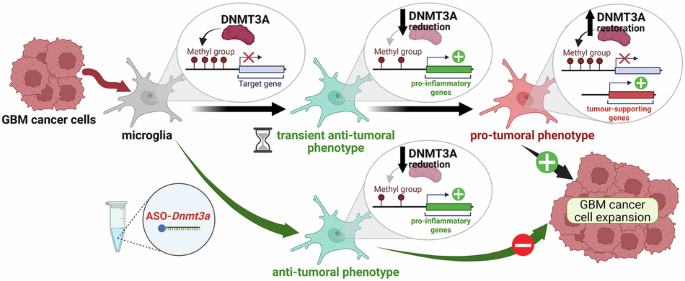
Antisense oligonucleotide and cortical GL261 GB cells injections—ASOs were designed as 5-10-5 MOE gapmers, with mixed phosphorothiate/phosphodiester backbone, to target mouse Dnmt3a or no target (Control ASO). ASO sequences were as follows: Control ASO: CCTATAGGACTATCCAGGAA; mouse-specific Dnmt3a ASOs: TTTCCATATTTTTATCCATA (ASO-1), ACCTACATTTTAGCACAGCT (ASO-2). Six-week-old mice were anesthetized with isoflurane (5% for induction and 2% for maintenance) using a mouse mask coupled to a stereotaxic apparatus. Mice were also injected subcutaneously (s.c.) with 5 mg/kg Rimadyl (Carprofen) and 0.1 mg/kg buprenorphine (Temgesic) 15 min prior to surgery for systemic anesthesia and analgesia. The fur on top of the head was removed using a shaver, and the skin was disinfected with ethanol. A 2 mm incision was then made on the scalp following lidocaine administration (4 mg/kg). ASOs (Dnmt3a-ASO-2, or ASO-Control) or PBS were injected intracerebroventricularly (icv) using the following stereotaxic coordinates: 0.3 mm anterior to bregma (AP), 1.0 mm lateral to bregma (ML), and 3 mm deep (measured from when the orifice of the needle has passed the skull) (DV) using a Hamilton 10 μl syringe (#80030 1701 RN) and a (22 s/51/2)S needle (#7758-03 RN) without drilling the skull. The volume (10 μl) and speed (0.1 μl/sec) of the injection were controlled by an automatic microinjection pump. The syringe remained in the injection site for 3 min to reduce backflow and was slowly retracted thereafter. After the surgery, 2–3 stitches (Ethilon monofilament 5.0) were applied to suture the wound. Eye gel drops (Viscotears 2 mg /ml, # 541760) were used to hydrate the eyes throughout the surgery. Mice (n = 12/group) were allowed to recover in a separate cage on a heating pad (35.5 °C) and monitored until they were fully awake and active. They were also given analgesics for post-operative pain relief (Carprofen 5 mg/kg) 24 h later.
Two weeks after the first injections, mice were again anesthetized with isoflurane and administered Rimadyl and buprenorphine s.c. as before. A small craniotomy of 2 mm was performed on the skull using a drill at 1 mm anterior to bregma, 1.5 mm lateral from bregma, and 2.5 mm deep (measured from when the orifice of the needle has passed the hole). A suspension of GL261 GB cells in PBS (50,000 GL261 tumor cells in 3 µl) was injected in all animals using a 10 µl Hamilton syringe (#80030 1701 RN) and a (26/30/4)S needle (#7804-03 RN) at a speed of 1.5 µl/ min. The syringe remained in the injection site for 3 min to reduce backflow and was slowly retracted thereafter. The skin wound was sutured, and the animals were allowed to recover in a separate cage on a heating pad and monitored until they were fully awake and active. They were given analgesics for post- operative pain relief (Carprofen 5 mg/kg, s.c., 24 h later). Animals were sacrificed 2 weeks after cell transplantation.
Brain tissue extraction, fixation, and sectioning—Animals were deeply anesthetized with an overdose of sodium pentobarbital and transcardially perfused with 0.9% sodium chloride, followed by fixation with 4% paraformaldehyde in 0.1 M phosphate buffer (pH 7.4). Brains were then transferred to 30% sucrose in 0.1 M phosphate buffer and left until they sank. 25-μm-thick horizontal free-floating sections were prepared using a sliding microtome (Leica SM2010R) and stored in cryoprotection solution at 4 °C (25% glycerol, 25% ethylene glycol in 0.1 M phosphate buffer) for further histological analysis.
Microglia morphology analysis
CellProfiler (version 4.2.8; Broad Institute Inc.) was used for morphological analysis of microglia. The pipeline used AIF1 IHC (10x magnification) as input and consisted of the identification of objects using adaptive threshold detection (Otsu method, 100 pixels adaptive window). The objects detected were then filtered by morphological features such as area (between 50 and 1000 square microns) and maximum Feret diameter (>5 microns). Object area and solidity (defined as the ratio between the area of the convex hull including the entire object of interest and the object’s actual area) were used for further analyses. Solidity ranges between 0 and 1, and low values (due to high convex hull area, but relatively small area of actual object) indicate ramified structures. Input images were obtained from 4 independent experiments (1 image/animal and experiment). The measurements of microglia from all images per experiment were pooled before statistical analyses (one-way ANOVA followed by Dunnett’s post-hoc test for comparisons against controls as the reference group).
RNAscope in situ hybridization
RNA in situ hybridization was performed for Dnmt3a and P2ry12 mRNAs. After sacrificing the mice, the brains were immediately frozen on dry ice for 5 min and then embedded in cryo-embedding medium (OCT compound, Sakura Finetek). After equilibrating at –20 °C for 2 h in a cryostat (CryoStar NX70, ThermoScientific), the brains were sectioned into 10 μm slices and mounted onto SuperFrost Plus adhesion slide (Epredia). The slices were dried at -20°C for 1 h and then stored in zip-lock bags at –80 °C until needed. The RNAscope Multiplex Fluorescent Reagent Kit (Advanced Cell Diagnostics) for in situ hybridization assay was used to detect the mRNAs of interest. The slides were fixed by immersion into pre-chilled 4% PFA for 1 h at 4 °C. After rinsing the slides twice with 1X PBS to remove the fixative, the sections were dehydrated in 50%, 70%, 100%, and 100% ethanol each for 5 min at room temperature. RNAscope hydrogen peroxide was added to each slice for 10 min at room temperature, and then washed off with distilled water, followed by protease IV for 10 min at room temperature, and then washed with PBS. Dnmt3a (GenBank accession number NM_153743.4; target nt region, 3757–4994) and P2ry12 (GenBank accession number NM_027571.3; target nt region, 739-1854) probes were pre-warmed for 10 min at 40 °C. The probes targeting RNAs contain different 20 ZZ oligonucleotide probes: Dnmt3a-C1 probe, P2ry12-C3 probe. To hybridize with target RNAs, the probes were mixed and added to the slides for 2 h at 40 °C in a HybEZ oven. The signals were then amplified by AMP1, AMP 2, and AMP 3 hybridization for 30 min at 40 °C, followed by HRP-C1 for 15 min at 40 °C and incubation with OpalTM 570 for 30 min at 40 °C for Dnmt3a detection. The slides were then blocked with HRP blocker before adding HRP-C3 and OpalTM 690 for detecting P2ry12. DAPI was used for 30 s at room temperature before mounting the slides with Prolong Gold Antifade Mountant. Pictures were taken using a Zeiss LSM900-Airy confocal microscope and analysed with OMERO.insight and ImageJ software.
Immunohistochemistry
The mice brain free-floating sections were washed in PBS and followed by antigen retrieval treatment using Target retrieval Solution (Dako) by incubation at 80 °C for 30 min and let to rest at room temperature for 30 min. After PBS washes, the sections were permeabilized 15 min in PBS-Triton 1% and then blocked for 1 h at room temperature in 3% serum/0.3% PBS-Triton under gentle shaking. The sections were then incubated with the primary antibodies diluted (as described in supplementary Table 1) in blocking solution overnight at 4 °C. The next day, the sections were washed three times in PBS, followed by incubation in secondary antibody diluted in blocking solution for 2 h at room temperature under gentle shaking. The sections were then washed in PBS, incubated in Hoechst 33342 solution (1:1000 in PBS, Molecular Probes/Life Technologies #H3570) for 10 min at room temperature. After a final PBS wash, the sections were mounted onto SuperFrost Plus adhesion slides (Epredia), let them dry before adding Mounting medium (Prolong Gold Antifade Mounting medium, Invitrogen) and covered with a coverslip. Pictures were taken using a Zeiss LSM800-Airy confocal microscope.
For anti-DNMT3A and AIF1/IBA1 staining, the free-floating mice brain sections were washed several times with 1× Tris-buffered saline (TBS) to remove the cryoprotectant solution. For DNMT3A staining, an intermediate antigen retrieval step was required before blocking. To this end, the brain sections were incubated in sodium citrate solution (NaCl, 10 mM, pH 6.0) for 30 min at 80 °C, allowed to recover for 10 min at room temperature, and then rinsed several times in TBS to remove the excess of NaCi.
Then the sections were subsequently incubated in a blocking solution containing 5% donkey serum (Jackson ImmunoResearch Laboratories, West Grove, PA) and 0.1% Triton X-100, for 1 h at room temperature. Incubation with the primary antibodies ensued for 48 h at 4 °C. The sections were then rinsed with TBS and incubated with the appropriate secondary antibodies for 1 h at room temperature. Hoechst 33342 was added for nuclear counterstaining. Finally, the sections were mounted onto microscope slides using ProLong Gold anti-fade reagent (Molecular Probes/Life Technologies) as mounting media, coverslipped, and allowed to dry at room temperature. Image acquisition was carried out using a Zeiss LSM700 confocal laser scanning microscope equipped with ZEN Zeiss software.
Tumor volume calculation
Assessment of tumor size and microglial occupancy outcome was blindly analyzed by an experimenter independent from the one who performed animal surgeries. Using a preestablished inclusion criterion, animals presenting a tumor size below 1 mm3 were excluded from the analysis. Volumes in mm3 were calculated in coronal sections using the Zeiss software from the GFP-positive and Iba1-positive areas according to the Cavalieri principle using the following algorithm: V = ΣA × P × T, where V = total volume, ΣA = the sum of area measurements, P = the inverse of the sampling fraction, and T = the section thickness. IBA1 intensity (Arbitrary Unit) using the Zeiss software within the calculated tumor volume was used as a proxy for microglia occupancy within each tumor.
Statistical analyses and reproducibility
All statistical analyses were conducted using Prism 8/10 (GraphPad Software). Results were tested for statistical significance using one-way ANOVA followed by Dunnett’s post-hoc test for multiple comparisons. If two conditions were to be compared, a two-tailed paired or unpaired Student’s t test was used. Results are presented as the mean ± s.e.m. Differences were considered statistically significant if P values were less than 0.05. (*P < 0.05, **P < 0.01, and ***P < 0.001). The number of biological replicates is described in the relevant figure legends.
All in vivo experimental studies are guided by the 3 R principle, EU Directive 2010/63/EU. The investigators were blinded to the conditions of the experiments during data collection and quantification. No statistical methods were used to predetermine sample sizes, but these are consistent with previous publications [10, 11, 19, 32]. Animals were randomly assigned to the different experimental groups. For morphological analyses, sample IDs were randomized using an Excel-generated randomized numerical ID.
