


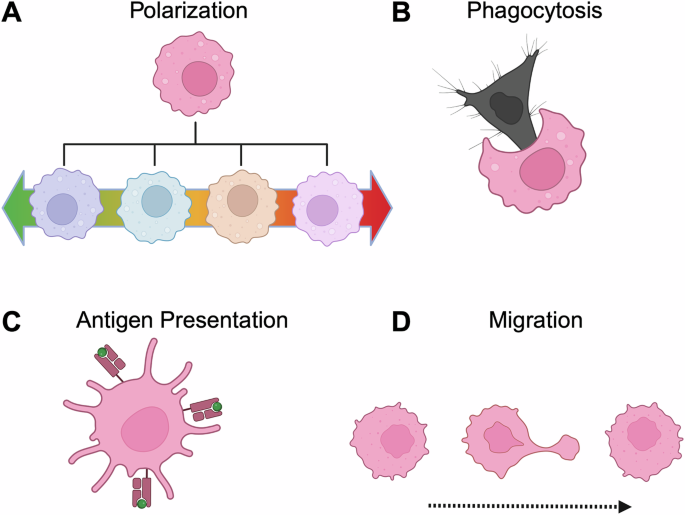
Park, M. D., Silvin, A., Ginhoux, F. & Merad, M. Macrophages in health and disease. Cell 185, 4259–4279 (2022).
Google Scholar
Italiani, P. & Boraschi, D. From monocytes to M1/M2 macrophages: phenotypical vs. functional differentiation. Front. Immunol. 5, 514 (2014).
Google Scholar
Guilliams, M., Mildner, A. & Yona, S. Developmental and functional heterogeneity of monocytes. Immunity 49, 595–613 (2018).
Google Scholar
Sommerfeld, S. D. et al. Interleukin-36gamma-producing macrophages drive IL-17-mediated fibrosis. Sci. Immunol. 4, https://doi.org/10.1126/sciimmunol.aax4783 (2019).
Martin, K. E. & Garcia, A. J. Macrophage phenotypes in tissue repair and the foreign body response: Implications for biomaterial-based regenerative medicine strategies. Acta Biomater. 133, 4–16 (2021).
Google Scholar
Qian, B. Z. & Pollard, J. W. Macrophage diversity enhances tumor progression and metastasis. Cell 141, 39–51 (2010).
Google Scholar
Quail, D. F. & Joyce, J. A. Microenvironmental regulation of tumor progression and metastasis. Nat. Med 19, 1423–1437 (2013).
Google Scholar
Kersten, K. et al. Spatiotemporal co-dependency between macrophages and exhausted CD8(+) T cells in cancer. Cancer Cell 40, 624–638.e629 (2022).
Google Scholar
Tylek, T., Wong, J., Vaughan, A. E. & Spiller, K. L. Biomaterial-mediated intracellular control of macrophages for cell therapy in pro-inflammatory and pro-fibrotic conditions. Biomaterials 308, 122545 (2024).
Google Scholar
Meli, V. S. et al. Biophysical regulation of macrophages in health and disease. J. Leukoc. Biol. 106, 283–299 (2019).
Google Scholar
Butenko, S. et al. Hydrogel crosslinking modulates macrophages, fibroblasts, and their communication, during wound healing. Nat. Commun. 15, 6820 (2024).
Google Scholar
Chung, L., Maestas, D. R. Jr, Housseau, F. & Elisseeff, J. H. Key players in the immune response to biomaterial scaffolds for regenerative medicine. Adv. Drug Deliv. Rev. 114, 184–192 (2017).
Google Scholar
Witherel, C. E., Abebayehu, D., Barker, T. H. & Spiller, K. L. Macrophage and fibroblast interactions in biomaterial-mediated fibrosis. Adv. Health. Mater. 8, e1801451 (2019).
Google Scholar
Zarif, J. C. et al. Mannose receptor-positive macrophage infiltration correlates with prostate cancer onset and metastatic castration-resistant disease. Eur. Urol. Oncol. 2, 429–436 (2019).
Google Scholar
Jaynes, J. M. et al. Mannose receptor (CD206) activation in tumor-associated macrophages enhances adaptive and innate antitumor immune responses. Sci. Transl. Med. 12, https://doi.org/10.1126/scitranslmed.aax6337 (2020).
Ma, R. Y., Black, A. & Qian, B. Z. Macrophage diversity in cancer revisited in the era of single-cell omics. Trends Immunol. 43, 546–563 (2022).
Google Scholar
Strizova, Z. et al. M1/M2 macrophages and their overlaps – myth or reality? Clin. Sci. (Lond.) 137, 1067–1093 (2023).
Google Scholar
Adebowale, K. G., Guerriero, J L. & Mitragotri, S. Dynamics of macrophage tumor infiltration. Appl. Phys. Rev. 10, https://doi.org/10.1063/5.0160924 (2023).
Guerriero, J. L. Macrophages: the road less traveled, changing anticancer therapy. Trends Mol. Med 24, 472–489 (2018).
Google Scholar
Mulder, K. et al. Cross-tissue single-cell landscape of human monocytes and macrophages in health and disease. Immunity 54, 1883–1900.e1885 (2021).
Google Scholar
Ray, A. et al. Targeting CD206+ macrophages disrupts the establishment of a key antitumor immune axis. J. Exp. Med. 222, https://doi.org/10.1084/jem.20240957 (2025).
Cavnar, M. J. et al. Tumor-associated macrophage infiltration in colorectal cancer liver metastases is associated with better outcome. Ann. Surg. Oncol. 24, 1835–1842 (2017).
Google Scholar
Zhong, C. et al. PSGL-1 is a phagocytosis checkpoint that enables tumor escape from macrophage clearance. Sci. Immunol. 10, eadn4302 (2025).
Google Scholar
Matusiak, M. et al. Spatially segregated macrophage populations predict distinct outcomes in colon cancer. Cancer Discov. 14, 1418–1439 (2024).
Google Scholar
Liu, M. et al. Spatially-resolved transcriptomics reveal macrophage heterogeneity and prognostic significance in diffuse large B-cell lymphoma. Nat. Commun. 15, 2113 (2024).
Google Scholar
Enfield, K. S. S. et al. Spatial architecture of myeloid and T cells orchestrates immune evasion and clinical outcome in lung cancer. Cancer Discov. 14, 1018–1047 (2024).
Google Scholar
Paterson, N. & Lammermann, T. Macrophage network dynamics depend on haptokinesis for optimal local surveillance. Elife 11, https://doi.org/10.7554/eLife.75354 (2022).
Mantovani, A., Allavena, P., Marchesi, F. & Garlanda, C. Macrophages as tools and targets in cancer therapy. Nat. Rev. Drug Discov. 21, 799–820 (2022).
Google Scholar
Toledo, B. et al. Deciphering the performance of macrophages in tumour microenvironment: a call for precision immunotherapy. J. Hematol. Oncol. 17, 44 (2024).
Google Scholar
Kloosterman, D. J. & Akkari, L. Macrophages at the interface of the co-evolving cancer ecosystem. Cell 186, 1627–1651 (2023).
Google Scholar
Cockram, T. O. J., Dundee, J. M., Popescu, A. S. & Brown, G. C. The phagocytic code regulating phagocytosis of mammalian cells. Front. Immunol. 12, 629979 (2021).
Google Scholar
Dolasia, K., Bisht, M. K., Pradhan, G., Udgata, A. & Mukhopadhyay, S. TLRs/NLRs: shaping the landscape of host immunity. Int Rev. Immunol. 37, 3–19 (2018).
Google Scholar
Kelley, S. M. & Ravichandran, K. S. Putting the brakes on phagocytosis: “don’t-eat-me” signaling in physiology and disease. Embo Rep. 22, e52564 (2021).
Google Scholar
Ding, X. et al. Engineering macrophages via nanotechnology and genetic manipulation for cancer therapy. Front. Oncol. 11, 786913 (2021).
Google Scholar
Du, H. et al. Tuning immunity through tissue mechanotransduction. Nat. Rev. Immunol. 23, 174–188 (2023).
Google Scholar
Zhang, X. et al. Unraveling the mechanobiology of immune cells. Curr. Opin. Biotechnol. 66, 236–245 (2020).
Google Scholar
Liu, Z. et al. Viscoelastic synthetic antigen-presenting cells for augmenting the potency of cancer therapies. Nat. Biomed. Eng. 8, 1615–1633 (2024).
Google Scholar
Adu-Berchie, K. et al. Generation of functionally distinct T-cell populations by altering the viscoelasticity of their extracellular matrix. Nat. Biomed. Eng. 7, 1374–1391 (2023).
Google Scholar
Vining, K. H. et al. Mechanical checkpoint regulates monocyte differentiation in fibrotic niches. Nat. Mater. 21, 939–950 (2022).
Google Scholar
Alraies, Z. et al. Cell shape sensing licenses dendritic cells for homeostatic migration to lymph nodes. Nat. Immunol. 25, 1193–1206 (2024).
Google Scholar
Settle, A. H. et al. beta2 integrins impose a mechanical checkpoint on macrophage phagocytosis. Nat. Commun. 15, 8182 (2024).
Google Scholar
Tello-Lafoz, M. et al. Cytotoxic lymphocytes target characteristic biophysical vulnerabilities in cancer. Immunity 54, 1037–1054.e1037 (2021).
Google Scholar
Basu, R. et al. Cytotoxic T cells use mechanical force to potentiate target cell killing. Cell 165, 100–110 (2016).
Google Scholar
Huse, M. Mechanical forces in the immune system. Nat. Rev. Immunol. 17, 679–690 (2017).
Google Scholar
Lei, K. et al. Cancer-cell stiffening via cholesterol depletion enhances adoptive T-cell immunotherapy. Nat. Biomed. Eng. 5, 1411–1425 (2021).
Google Scholar
Zhu, C., Chen, W., Lou, J., Rittase, W. & Li, K. Mechanosensing through immunoreceptors. Nat. Immunol. 20, 1269–1278 (2019).
Google Scholar
Li, K. et al. Mechanical force regulates ligand binding and function of PD-1. Nat. Commun. 15, 8339 (2024).
Google Scholar
Choi, H. K. et al. Mechanotransduction governs CD40 function and underlies X-linked Hyper IgM syndrome. Preprint at https://doi.org/10.1101/2023.07.23.550231 (2023).
Zhong, Z. et al. Human immune organoids to decode B cell response in healthy donors and patients with lymphoma. Nat. Mater. 24, 297–311 (2025).
Google Scholar
Assen, F. P. et al. Multitier mechanics control stromal adaptations in the swelling lymph node. Nat. Immunol. 23, 1246–1255 (2022).
Google Scholar
Horsnell, H. L. et al. Lymph node homeostasis and adaptation to immune challenge resolved by fibroblast network mechanics. Nat. Immunol. 23, 1169–1182 (2022).
Google Scholar
Narain, R., Muncie-Vasic, J. M. & Weaver, V. M. Forcing the code: tension modulates signaling to drive morphogenesis and malignancy. Genes Dev. 39, 163–181 (2025).
Google Scholar
Tharp, K. M. et al. Tumor-associated macrophages restrict CD8(+) T cell function through collagen deposition and metabolic reprogramming of the breast cancer microenvironment. Nat. Cancer 5, 1045–1062 (2024).
Google Scholar
Jeffreys, N., Brockman, J. M., Zhai, Y., Ingber, D. E. & Mooney, D. J. Mechanical forces amplify TCR mechanotransduction in T cell activation and function. Appl. Phys. Rev. 11, 011304 (2024).
Google Scholar
Ma, S. et al. A role of PIEZO1 in iron metabolism in mice and humans. Cell 184, 969–982.e913 (2021).
Google Scholar
Reis-Rodrigues, P. et al. Migrating immune cells globally coordinate protrusive forces. Nat. Immunol. 26, 1258–1266 (2025).
Google Scholar
Fritzsche, M. & Kruse, K. Mechanical force matters in early T cell activation. Proc. Natl. Acad. Sci. USA 121, e2404748121 (2024).
Google Scholar
Dustin, M. L. & Kam, L. C. Tapping out a mechanical code for T cell triggering. J. Cell Biol. 213, 501–503 (2016).
Google Scholar
Zhang, J. et al. Osr2 functions as a biomechanical checkpoint to aggravate CD8(+) T cell exhaustion in tumor. Cell 187, 3409–3426.e3424 (2024).
Google Scholar
Meizlish, M. L. et al. Mechanosensing regulates tissue repair program in macrophages. Sci. Adv. 10, eadk6906 (2024).
Google Scholar
Lewis, J. S. et al. The effect of cyclic mechanical strain on activation of dendritic cells cultured on adhesive substrates. Biomaterials 34, 9063–9070 (2013).
Google Scholar
Golo, M., Newman, P. L. H., Kempe, D. & Biro, M. Mechanoimmunology in the solid tumor microenvironment. Biochem Soc. Trans. 52, 1489–1502 (2024).
Google Scholar
Jain, N., Lord, J. M. & Vogel, V. Mechanoimmunology: Are inflammatory epigenetic states of macrophages tuned by biophysical factors? APL Bioeng. 6, 031502 (2022).
Google Scholar
Zhao, L., Gui, Y. & Deng, X. Focus on mechano-immunology: new direction in cancer treatment. Int J. Surg. 111, 2590–2602 (2025).
Google Scholar
Wang, Z. et al. Gut mechanoimmunology: shaping immune response through physical cues. Phys. Life Rev. 50, 13–26 (2024).
Google Scholar
Pageon, S. V., Govendir, M. A., Kempe, D. & Biro, M. Mechanoimmunology: molecular-scale forces govern immune cell functions. Mol. Biol. Cell 29, 1919–1926 (2018).
Google Scholar
He, Y. et al. Nanoscale acoustic oscillator for mechanoimmunology: NAOMI. Sci. Adv. 11, eadx3851 (2025).
Google Scholar
Mukhopadhyay, M. Immunomechanics. Nat. Methods 20, 35 (2023).
Google Scholar
Janssen, E., van den Dries, K., Ventre, M. & Cambi, A. Mechanobiology of myeloid cells. Curr. Opin. Cell Biol. 86, 102311 (2024).
Google Scholar
Lee, M., Du, H., Winer, D. A., Clemente-Casares, X. & Tsai, S. Mechanosensing in macrophages and dendritic cells in steady-state and disease. Front. Cell Dev. Biol. 10, 1044729 (2022).
Google Scholar
Hong, J. et al. A TCR mechanotransduction signaling loop induces negative selection in the thymus. Nat. Immunol. 19, 1379–1390 (2018).
Google Scholar
Comrie, W. A., Babich, A. & Burkhardt, J. K. F-actin flow drives affinity maturation and spatial organization of LFA-1 at the immunological synapse. J. Cell Biol. 208, 475–491 (2015).
Google Scholar
Luo, B. H., Carman, C. V. & Springer, T. A. Structural basis of integrin regulation and signaling. Annu. Rev. Immunol. 25, 619–647 (2007).
Google Scholar
Choi, H. K. & Zhu, C. Catch bonds in immunology. Annu. Rev. Immunol. 43, 641–666 (2025).
Google Scholar
Ezzo, M. et al. Acute contact with profibrotic macrophages mechanically activates fibroblasts via alphavbeta3 integrin-mediated engagement of Piezo1. Sci. Adv. 10, eadp4726 (2024).
Google Scholar
Atcha, H. et al. Mechanically activated ion channel Piezo1 modulates macrophage polarization and stiffness sensing. Nat. Commun. 12, 3256 (2021).
Google Scholar
Sreejit, G., Fleetwood, A. J., Murphy, A. J. & Nagareddy, P. R. Origins and diversity of macrophages in health and disease. Clin. Transl. Immunol. 9, e1222 (2020).
Google Scholar
Ni, Y. et al. Macrophages modulate stiffness-related foreign body responses through plasma membrane deformation. Proc. Natl. Acad. Sci. USA 120, e2213837120 (2023).
Google Scholar
Ranade, S. S., Syeda, R. & Patapoutian, A. Mechanically activated ion channels. Neuron 87, 1162–1179 (2015).
Google Scholar
Yang, S. et al. Membrane curvature governs the distribution of Piezo1 in live cells. Nat. Commun. 13, 7467 (2022).
Google Scholar
Wang, J. et al. Piezo1: structural pharmacology and mechanotransduction mechanisms. Trends Pharm. Sci. 46, 752–770 (2025).
Google Scholar
Solis, A. G. et al. Mechanosensation of cyclical force by PIEZO1 is essential for innate immunity. Nature 573, 69–74 (2019).
Google Scholar
Wang, Y. et al. Stiffness sensing via Piezo1 enhances macrophage efferocytosis and promotes the resolution of liver fibrosis. Sci. Adv. 10, eadj3289 (2024).
Google Scholar
Lee, J. et al. Determining the Young’s modulus of the bacterial cell envelope. ACS Biomater. Sci. Eng. 10, 2956–2966 (2024).
Google Scholar
Islamzada, E. et al. Red blood cells with reduced deformability are selectively cleared from circulation in a mouse model. Blood Adv. 9, 2988–2996 (2025).
Google Scholar
Sosale, N. G. et al. Cell rigidity and shape override CD47’s “self”-signaling in phagocytosis by hyperactivating myosin-II. Blood 125, 542–552 (2015).
Google Scholar
Liu, Z. et al. Cancer cells display increased migration and deformability in pace with metastatic progression. Faseb J. 34, 9307–9315 (2020).
Google Scholar
Joshi, H. et al. Mechanosensitivity of macrophage polarization: comparing small molecule leukadherin-1 to substrate stiffness. Front. Immunol. 16, 1420325 (2025).
Google Scholar
Meli, V. S. et al. YAP-mediated mechanotransduction tunes the macrophage inflammatory response. Sci. Adv. 6, https://doi.org/10.1126/sciadv.abb8471 (2020).
Sridharan, R., Cavanagh, B., Cameron, A. R., Kelly, D. J. & O’Brien, F. J. Material stiffness influences the polarization state, function and migration mode of macrophages. Acta Biomater. 89, 47–59 (2019).
Google Scholar
Mei, F. et al. Matrix stiffness regulates macrophage polarisation via the Piezo1-YAP signalling axis. Cell Prolif. 57, e13640 (2024).
Google Scholar
Adlerz, K. M., Aranda-Espinoza, H. & Hayenga, H. N. Substrate elasticity regulates the behavior of human monocyte-derived macrophages. Eur. Biophys. 45, 301–309 (2016).
Google Scholar
Neupane, A. S. et al. Patrolling alveolar macrophages conceal bacteria from the immune system to maintain homeostasis. Cell 183, 110–125.e111 (2020).
Google Scholar
Hu, J. et al. Microglial Piezo1 senses Abeta fibril stiffness to restrict Alzheimer’s disease. Neuron 111, 15–29.e18 (2023).
Google Scholar
Dooling, L. J. et al. Cooperative phagocytosis of solid tumours by macrophages triggers durable anti-tumour responses. Nat. Biomed. Eng. 7, 1081–1096 (2023).
Google Scholar
Morva, A., Arroyo, A. B., Andreeva, L., Tapia-Abellan, A. & Luengo-Gil, G. Unleashing the power of CAR-M therapy in solid tumors: a comprehensive review. Front. Immunol. 16, 1615760 (2025).
Google Scholar
Chao, M. P., Weissman, I. L. & Majeti, R. The CD47-SIRPalpha pathway in cancer immune evasion and potential therapeutic implications. Curr. Opin. Immunol. 24, 225–232 (2012).
Google Scholar
Tang, Z. et al. CD47 masks pro-phagocytic ligands in cis on tumor cells to suppress antitumor immunity. Nat. Immunol. 24, 2032–2041 (2023).
Google Scholar
Zhang, H. et al. Silencing of SIRPalpha enhances the antitumor efficacy of CAR-M in solid tumors. Cell Mol. Immunol. 21, 1335–1349 (2024).
Google Scholar
Liu, Y. et al. Emerging phagocytosis checkpoints in cancer immunotherapy. Signal Transduct. Target Ther. 8, 104 (2023).
Google Scholar
Yang, H., Xun, Y. & You, H. The landscape overview of CD47-based immunotherapy for hematological malignancies. Biomark. Res. 11, 15 (2023).
Google Scholar
Jiang, C. et al. Targeting the CD47/SIRPalpha pathway in malignancies: recent progress, difficulties and future perspectives. Front. Oncol. 14, 1378647 (2024).
Google Scholar
ClinicalTrials.gov. CD47 Clinical Trials. https://clinicaltrials.gov/search?cond=cd47 (2025).
Muntjewerff, E. M., Meesters, L. D. & van den Bogaart, G. Antigen cross-presentation by macrophages. Front. Immunol. 11, 1276 (2020).
Google Scholar
Arnold, C. E., Gordon, P., Barker, R. N. & Wilson, H. M. The activation status of human macrophages presenting antigen determines the efficiency of Th17 responses. Immunobiology 220, 10–19 (2015).
Google Scholar
Silva, M. et al. A particulate saponin/TLR agonist vaccine adjuvant alters lymph flow and modulates adaptive immunity. Sci. Immunol. 6, eabf1152 (2021).
Google Scholar
Liu, H. et al. Structure-based programming of lymph-node targeting in molecular vaccines. Nature 507, 519–522 (2014).
Google Scholar
Irvine, D. J., Aung, A. & Silva, M. Controlling timing and location in vaccines. Adv. Drug Deliv. Rev. 158, 91–115 (2020).
Google Scholar
Dash, S. P., Gupta, S. & Sarangi, P. P. Monocytes and macrophages: origin, homing, differentiation, and functionality during inflammation. Heliyon 10, e29686 (2024).
Google Scholar
Hoffmann, E. J. & Ponik, S. M. Biomechanical contributions to macrophage activation in the tumor microenvironment. Front. Oncol. 10, 787 (2020).
Google Scholar
McNally, A. K. & Anderson, J. M. Beta1 and beta2 integrins mediate adhesion during macrophage fusion and multinucleated foreign body giant cell formation. Am. J. Pathol. 160, 621–630 (2002).
Google Scholar
Gui, P. et al. The protease-dependent mesenchymal migration of tumor-associated macrophages as a target in cancer immunotherapy. Cancer Immunol. Res 6, 1337–1351 (2018).
Google Scholar
Friedl, P. & Wolf, K. Plasticity of cell migration: a multiscale tuning model. J. Cell Biol. 188, 11–19 (2010).
Google Scholar
Friedl, P. & Wolf, K. Proteolytic and non-proteolytic migration of tumour cells and leucocytes. Biochem. Soc. Symp. 277–285. https://doi.org/10.1042/bss0700277 (2003).
Travnickova, J. et al. Macrophage morphological plasticity and migration is Rac signalling and MMP9 dependant. Sci. Rep. 11, 10123 (2021).
Google Scholar
Sanz-Moreno, V. Tumour invasion: a new twist on Rac-driven mesenchymal migration. Curr. Biol. 22, R449–R451 (2012).
Google Scholar
Friedl, P. & Weigelin, B. Interstitial leukocyte migration and immune function. Nat. Immunol. 9, 960–969 (2008).
Google Scholar
Adebowale, K. et al. Monocytes use protrusive forces to generate migration paths in viscoelastic collagen-based extracellular matrices. Proc. Natl. Acad. Sci. USA 122, e2309772122 (2025).
Google Scholar
Argyle, D. & Kitamura, T. Targeting macrophage-recruiting chemokines as a novel therapeutic strategy to prevent the progression of solid tumors. Front. Immunol. 9, 2629 (2018).
Google Scholar
Sica, A. & Mantovani, A. Macrophage plasticity and polarization: in vivo veritas. J. Clin. Invest. 122, 787–795 (2012).
Google Scholar
Son, B., Lee, W., Kim, H., Shin, H. & Park, H. H. Targeted therapy of cancer stem cells: inhibition of mTOR in pre-clinical and clinical research. Cell Death Dis. 15, 696 (2024).
Google Scholar
Panwar, V. et al. Multifaceted role of mTOR (mammalian target of rapamycin) signaling pathway in human health and disease. Signal Transduct. Target Ther. 8, 375 (2023).
Google Scholar
Lee, H. W., Choi, H. J., Ha, S. J., Lee, K. T. & Kwon, Y. G. Recruitment of monocytes/macrophages in different tumor microenvironments. Biochim. Biophys. Acta 1835, 170–179 (2013).
Google Scholar
Du, W. et al. High-motility pro-tumorigenic monocytes drive macrophage enrichment in the tumor microenvironment. Preprint at https://doi.org/10.1101/2024.07.16.603739 (2024).
Khurana, A. et al. Visualization of macrophage recruitment in head and neck carcinoma model using fluorine-19 magnetic resonance imaging. Magn. Reson Med 79, 1972–1980 (2018).
Google Scholar
Yang, H. et al. Magnetic Resonance Imaging of Macrophage Response to Radiation Therapy. Cancers 15, https://doi.org/10.3390/cancers15245874 (2023).
Sugimoto, M. A., Sousa, L. P., Pinho, V., Perretti, M. & Teixeira, M. M. Resolution of inflammation: What Controls Its Onset? Front. Immunol. 7, 160 (2016).
Google Scholar
Serhan, C. N. & Savill, J. Resolution of inflammation: the beginning programs the end. Nat. Immunol. 6, 1191–1197 (2005).
Google Scholar
Zaveri, T. D., Lewis, J. S., Dolgova, N. V., Clare-Salzler, M. J. & Keselowsky, B. G. Integrin-directed modulation of macrophage responses to biomaterials. Biomaterials 35, 3504–3515 (2014).
Google Scholar
Zaveri, T. D. et al. Macrophage integrins modulate response to ultra-high molecular weight polyethylene particles and direct particle-induced osteolysis. Biomaterials 115, 128–140 (2017).
Google Scholar
Haskill, S., Yurochko, A. D. & Isaacs, K. L. Regulation of macrophage infiltration and activation in sites of chronic inflammation. Ann. N. Y Acad. Sci. 664, 93–102 (1992).
Google Scholar
McCarthy, J. B., Vachhani, B. V., Wahl, S. M., Finbloom, D. S. & Feldman, G. M. Human monocyte binding to fibronectin enhances IFN-gamma-induced early signaling events. J. Immunol. 159, 2424–2430 (1997).
Google Scholar
Schmid, M. C. et al. Integrin CD11b activation drives anti-tumor innate immunity. Nat. Commun. 9, 5379 (2018).
Google Scholar
Atcha, H. et al. Crosstalk between CD11b and Piezo1 mediates macrophage responses to mechanical cues. Front. Immunol. 12, 689397 (2021).
Google Scholar
Yao, M. et al. Force- and cell state-dependent recruitment of Piezo1 drives focal adhesion dynamics and calcium entry. Sci. Adv. 8, eabo1461 (2022).
Google Scholar
Lei, M. et al. Cell-cell and cell-matrix adhesion regulated by Piezo1 is critical for stiffness-dependent DRG neuron aggregation. Cell Rep. 42, 113522 (2023).
Google Scholar
Wang, Y. et al. Macrophage-derived extracellular vesicles: diverse mediators of pathology and therapeutics in multiple diseases. Cell Death Dis. 11, 924 (2020).
Google Scholar
Kumar, M. A. et al. Extracellular vesicles as tools and targets in therapy for diseases. Signal Transduct. Target Ther. 9, 27 (2024).
Google Scholar
Cianciaruso, C. et al. Molecular profiling and functional analysis of macrophage-derived tumor extracellular vesicles. Cell Rep. 27, 3062–3080.e3011 (2019).
Google Scholar
Zhou, J. et al. Exosomes released from tumor-associated macrophages transfer miRNAs that induce a Treg/Th17 cell imbalance in epithelial ovarian cancer. Cancer Immunol. Res. 6, 1578–1592 (2018).
Google Scholar
Prestwich, R. J. et al. The immune system-is it relevant to cancer development, progression and treatment? Clin. Oncol. 20, 101–112 (2008).
Google Scholar
Virchow, R. Cellular pathology. As based upon physiological and pathological histology. Lecture XVI-Atheromatous affection of arteries. 1858. Nutr. Rev. 47, 23–25 (1989).
Google Scholar
Zhang, Y. & Zhang, Z. The history and advances in cancer immunotherapy: understanding the characteristics of tumor-infiltrating immune cells and their therapeutic implications. Cell Mol. Immunol. 17, 807–821 (2020).
Google Scholar
Coley, W. B. I. I. Contribution to the Knowledge of Sarcoma. Ann. Surg. 14, 199–220 (1891).
Google Scholar
McCarthy, E. F. The toxins of William B. Coley and the treatment of bone and soft-tissue sarcomas. Iowa Orthop. J. 26, 154–158 (2006).
Google Scholar
Idos, G. E. et al. The prognostic implications of tumor infiltrating lymphocytes in colorectal cancer: a systematic review and meta-analysis. Sci. Rep. 10, 3360 (2020).
Google Scholar
Bida, M., Miya, T. V., Hull, R. & Dlamini, Z. Tumor-infiltrating lymphocytes in melanoma: from prognostic assessment to therapeutic applications. Front. Immunol. 15, 1497522 (2024).
Google Scholar
Ozcan, D. et al. Prognostic value of tumor-infiltrating lymphocytes in irradiated node-positive breast cancer patients. Breast 83, 104525 (2025).
Google Scholar
Du, M., Cai, Y. M., Yin, Y. L., Xiao, L. & Ji, Y. Evaluating tumor-infiltrating lymphocytes in hepatocellular carcinoma using hematoxylin and eosin-stained tumor sections. World J. Clin. Cases 10, 856–869 (2022).
Google Scholar
Fidler, I. J. Therapy of cancer metastasis by systemic activation of macrophages. Adv. Pharm. 30, 271–326 (1994).
Google Scholar
Fidler, I. J. & Kleinerman, E. S. Therapy of cancer metastasis by systemic activation of macrophages: from the bench to the clinic. Res Immunol. 144, 284–287 (1993).
Google Scholar
Gentles, A. J. et al. The prognostic landscape of genes and infiltrating immune cells across human cancers. Nat. Med. 21, 938–945 (2015).
Google Scholar
Canella, A. & Rajappa, P. Therapeutic utility of engineered myeloid cells in the tumor microenvironment. Cancer Gene Ther. 30, 964–972 (2023).
Google Scholar
Clevenger, A. J., Jha, A., Moore, E. & Raghavan, S. A. Manipulating immune activity of macrophages: a materials and mechanics perspective. Trends Biotechnol. 43, 131–144 (2025).
Google Scholar
Noy, R. & Pollard, J. W. Tumor-associated macrophages: from mechanisms to therapy. Immunity 41, 49–61 (2014).
Google Scholar
Pittet, M. J., Michielin, O. & Migliorini, D. Clinical relevance of tumour-associated macrophages. Nat. Rev. Clin. Oncol. 19, 402–421 (2022).
Google Scholar
Hochstadt, J., Martinez Pacheco, S. & Casanova-Acebes, M. Embracing diversity: macrophage complexity in cancer. Trends Cancer 11, 351–364 (2025).
Google Scholar
Brownlie, D. et al. Metastasis-associated macrophages constrain antitumor capability of natural killer cells in the metastatic site at least partially by membrane bound transforming growth factor beta. J. Immunother. Cancer 9, https://doi.org/10.1136/jitc-2020-001740 (2021).
Timperi, E. et al. Lipid-associated macrophages are induced by cancer-associated fibroblasts and mediate immune suppression in breast cancer. Cancer Res. 82, 3291–3306 (2022).
Google Scholar
Guzman, G., Reed, M. R., Bielamowicz, K., Koss, B. & Rodriguez, A. CAR-T therapies in solid tumors: opportunities and challenges. Curr. Oncol. Rep. 25, 479–489 (2023).
Google Scholar
Peng, L., Sferruzza, G., Yang, L., Zhou, L. & Chen, S. CAR-T and CAR-NK as cellular cancer immunotherapy for solid tumors. Cell Mol. Immunol. 21, 1089–1108 (2024).
Google Scholar
Yan, T., Zhu, L. & Chen, J. Current advances and challenges in CAR T-Cell therapy for solid tumors: tumor-associated antigens and the tumor microenvironment. Exp. Hematol. Oncol. 12, 14 (2023).
Google Scholar
Anderson, N. R., Minutolo, N. G., Gill, S. & Klichinsky, M. Macrophage-based approaches for cancer immunotherapy. Cancer Res. 81, 1201–1208 (2021).
Google Scholar
Lu, J. et al. CAR Macrophages: a promising novel immunotherapy for solid tumors and beyond. Biomark. Res. 12, 86 (2024).
Google Scholar
Klichinsky, M. et al. Human chimeric antigen receptor macrophages for cancer immunotherapy. Nat. Biotechnol. 38, 947–953 (2020).
Google Scholar
Sunseri, N., O’Brien, M., Bhardwaj, N. & Landau, N. R. Human immunodeficiency virus type 1 modified to package Simian immunodeficiency virus Vpx efficiently infects macrophages and dendritic cells. J. Virol. 85, 6263–6274 (2011).
Google Scholar
Bobadilla, S., Sunseri, N. & Landau, N. R. Efficient transduction of myeloid cells by an HIV-1-derived lentiviral vector that packages the Vpx accessory protein. Gene Ther. 20, 514–520 (2013).
Google Scholar
Reiss, K. A. et al. CAR-macrophage therapy for HER2-overexpressing advanced solid tumors: a phase 1 trial. Nat. Med. 31, 1171–1182 (2025).
Google Scholar
Chen, Y. et al. CAR-macrophage: a new immunotherapy candidate against solid tumors. Biomed. Pharmacother. 139, 111605 (2021).
Google Scholar
Morrissey, M. A. et al. Chimeric antigen receptors that trigger phagocytosis. Elife 7, https://doi.org/10.7554/eLife.36688 (2018).
Schlam, D. et al. Phosphoinositide 3-kinase enables phagocytosis of large particles by terminating actin assembly through Rac/Cdc42 GTPase-activating proteins. Nat. Commun. 6, 8623 (2015).
Google Scholar
Dooling, L. J. et al. Clustered macrophages cooperate to eliminate tumors via coordinated intrudopodia. Proc. Natl. Acad. Sci. USA 122, e2425452122 (2025).
Google Scholar
Chen, S. et al. CAR macrophages with built-In CD47 blocker combat tumor antigen heterogeneity and activate T cells via cross-presentation. Nat. Commun. 16, 4069 (2025).
Google Scholar
Polak, R. et al. Liposome-loaded cell backpacks. Adv. Health. Mater. 4, 2832–2841 (2015).
Google Scholar
Xu, L., Zolotarskaya, O. Y., Yeudall, W. A. & Yang, H. Click hybridization of immune cells and polyamidoamine dendrimers. Adv. Health. Mater. 3, 1430–1438 (2014).
Google Scholar
Ayer, M. & Klok, H. A. Cell-mediated delivery of synthetic nano- and microparticles. J. Control Release 259, 92–104 (2017).
Google Scholar
Shields, C. W. T. et al. Cellular backpacks for macrophage immunotherapy. Sci. Adv. 6, eaaz6579 (2020).
Google Scholar
Zhao, Z. et al. Engineering of living cells with polyphenol-functionalized biologically active nanocomplexes. Adv. Mater. 32, e2003492 (2020).
Google Scholar
Kwan, M. M. C. et al. Particle Shape Modulates the Function of Adoptive Macrophage Transfers. Adv. Healthc. Mater. e01348, https://doi.org/10.1002/adhm.202501348 (2025).
Rodell, C. B. et al. TLR7/8-agonist-loaded nanoparticles promote the polarization of tumour-associated macrophages to enhance cancer immunotherapy. Nat. Biomed. Eng. 2, 578–588 (2018).
Google Scholar
Griffin, K. V., Saunders, M. N., Lyssiotis, C. A. & Shea, L. D. Engineering immunity using metabolically active polymeric nanoparticles. Trends Biotechnol. 43, 1371–1384 (2025).
Google Scholar
Bender, E. C., Sircar, A. J., Taubenfeld, E. K. & Suggs, L. J. Modulating lipid-polymer nanoparticles’ physicochemical properties to alter macrophage uptake. ACS Biomater. Sci. Eng. 10, 2911–2924 (2024).
Google Scholar
Kraynak, C. A., Yan, D. J. & Suggs, L. J. Modulating inflammatory macrophages with an apoptotic body-inspired nanoparticle. Acta Biomater. 108, 250–260 (2020).
Google Scholar
Li, S. et al. Nanomedicine engulfed by macrophages for targeted tumor therapy. Int. J. Nanomed. 11, 4107–4124 (2016).
Google Scholar
Nguyen, V. D. et al. Macrophage-mediated delivery of multifunctional nanotherapeutics for synergistic chemo-photothermal therapy of solid tumors. ACS Appl. Mater. Interfaces 12, 10130–10141 (2020).
Google Scholar
Ramesh, A., Kumar, S., Nandi, D. & Kulkarni, A. CSF1R- and SHP2-inhibitor-loaded nanoparticles enhance cytotoxic activity and phagocytosis in tumor-associated macrophages. Adv. Mater. 31, e1904364 (2019).
Google Scholar
Wesolowski, R. et al. Phase Ib study of the combination of pexidartinib (PLX3397), a CSF-1R inhibitor, and paclitaxel in patients with advanced solid tumors. Ther. Adv. Med Oncol. 11, 1758835919854238 (2019).
Google Scholar
Mitchell, M. J. & King, M. R. Leukocytes as carriers for targeted cancer drug delivery. Expert Opin. Drug Deliv. 12, 375–392 (2015).
Google Scholar
Wang, L. L. et al. Preclinical characterization of macrophage-adhering gadolinium micropatches for MRI contrast after traumatic brain injury in pigs. Sci. Transl. Med. 16, eadk5413 (2024).
Google Scholar
Lin, F., Luo, H., Wang, J., Li, Q. & Zha, L. Macrophage-derived extracellular vesicles as new players in chronic non-communicable diseases. Front. Immunol. 15, 1479330 (2024).
Google Scholar
Zou, Y., Zhou, Y., Li, G., Dong, Y. & Hu, S. Clinical applications of extracellular vesicles: recent advances and emerging trends. Front. Bioeng. Biotechnol. 13, 1671963 (2025).
Google Scholar
Anfray, C., Ummarino, A., Andon, F. T. & Allavena, P. Current strategies to target tumor-associated-macrophages to improve anti-tumor immune responses. Cells 9, https://doi.org/10.3390/cells9010046 (2019).
Sun, M. et al. Adoptive cell therapy with macrophage-drug conjugates facilitates cytotoxic drug transfer and immune activation in glioblastoma models. Sci. Transl. Med. 17, eadr4058 (2025).
Google Scholar
Huang, W. et al. Clinical pharmacology perspectives for adoptive cell therapies in oncology. Clin. Pharm. Ther. 112, 968–981 (2022).
Google Scholar
Li, R., Grosskopf, A. K., Joslyn, L. R., Stefanich, E. G. & Shivva, V. Cellular kinetics and biodistribution of adoptive T cell therapies: from biological principles to effects on patient outcomes. AAPS J. 27, 55 (2025).
Google Scholar
Veerasubramanian, P. K. et al. A Src-H3 acetylation signaling axis integrates macrophage mechanosensation with inflammatory response. Biomaterials 279, 121236 (2021).
Google Scholar
Jain, N., Moeller, J. & Vogel, V. Mechanobiology of macrophages: how physical factors coregulate macrophage plasticity and phagocytosis. Annu Rev. Biomed. Eng. 21, 267–297 (2019).
Google Scholar
Sapudom, J. et al. 3D in vitro M2 macrophage model to mimic modulation of tissue repair. NPJ Regen. Med 6, 83 (2021).
Google Scholar
Burchett, A., Siri, S., Li, J., Lu, X. & Datta, M. Novel 3-D macrophage spheroid model reveals reciprocal regulation of immunomechanical stress and mechano-immunological response. Cell Mol. Bioeng. 17, 329–344 (2024).
Google Scholar
Burchett, A., Chen, H., Najera, J., Howard, S. & Datta, M. Chronic compression drives macrophages toward a pathological pro-tumor state. Preprint at https://doi.org/10.1101/2025.05.13.653793 (2025).
Liu, Y. & Segura, T. Biomaterials-mediated regulation of macrophage cell fate. Front. Bioeng. Biotechnol. 8, 609297 (2020).
Google Scholar
Graf, J. et al. Macrophage variance: investigating how macrophage origin influences responses to soluble and physical cues with immortalized vs. primary cells in 2D and 3D culture. Front. Biomater. Sci. 3, https://doi.org/10.3389/fbiom.2024.1399448 (2024).
Guillot, A. & Tacke, F. Liver macrophages revisited: The expanding universe of versatile responses in a spatiotemporal context. Hepatol. Commun. 8, https://doi.org/10.1097/HC9.0000000000000491 (2024).
Stark, C. J S. E. N, M. T. -Omics approaches to study and model cell-cell interactions in engineered tissues. Front. Chem. Eng. 7, https://doi.org/10.3389/fceng.2025.1629455.
Ma, C. et al. Bioengineered immunocompetent preclinical trial-on-chip tool enables screening of CAR T cell therapy for leukaemia. Nat. Biomed. Eng. https://doi.org/10.1038/s41551-025-01428-2 (2025).
Knight, H. R. et al. Bioengineering approaches to trained immunity: Physiologic targets and therapeutic strategies. Elife 14, https://doi.org/10.7554/eLife.106339 (2025).
Xiang, Y. et al. Multifaceted cancer alleviation by cowpea mosaic virus in a bioprinted ovarian cancer peritoneal spheroid model. Biomaterials 311, 122663 (2024).
Google Scholar
Tang, M. et al. Integration of 3D bioprinting and multi-algorithm machine learning identified glioma susceptibilities and microenvironment characteristics. Cell Discov. 10, 39 (2024).
Google Scholar
Staros, R. et al. Perspectives for 3D-bioprinting in modeling of tumor immune evasion. Cancers 14, https://doi.org/10.3390/cancers14133126 (2022).
Wang, X., Luo, Y., Ma, Y., Wang, P. & Yao, R. Converging bioprinting and organoids to better recapitulate the tumor microenvironment. Trends Biotechnol. 42, 648–663 (2024).
Google Scholar
Jung, M., Ghamrawi, S., Du, E. Y., Gooding, J. J. & Kavallaris, M. Advances in 3D bioprinting for cancer biology and precision medicine: from matrix design to application. Adv. Health. Mater. 11, e2200690 (2022).
Google Scholar
Li, Y. C, H.; Cui, H. Precision Spatial Control of Tumor-Stroma Interactions in Cancer Models via 3D Bioprinting for Advanced Research and Therapy. Adv. Funct. Mater. https://doi.org/10.1002/adfm.202503391 (2025).
Datta, P., Dey, M., Ataie, Z., Unutmaz, D. & Ozbolat, I. T. 3D bioprinting for reconstituting the cancer microenvironment. NPJ Precis Oncol. 4, 18 (2020).
Google Scholar
Zhang, Z., Chen, X., Gao, S., Fang, X. & Ren, S. 3D bioprinted tumor model: a prompt and convenient platform for overcoming immunotherapy resistance by recapitulating the tumor microenvironment. Cell Oncol. 47, 1113–1126 (2024).
Google Scholar
Visalakshan, R. M. et al. Opportunities and challenges to engineer 3D models of tumor-adaptive immune interactions. Front. Immunol. 14, 1162905 (2023).
Google Scholar
Mu, P. et al. Newly developed 3D in vitro models to study tumor-immune interaction. J. Exp. Clin. Cancer Res. 42, 81 (2023).
Google Scholar
Ahmed, T. Biomaterial-based in vitro 3D modeling of glioblastoma multiforme. Cancer Pathog. Ther. 1, 177–194 (2023).
Google Scholar
Huang, M. S. C, F.; Roth, J. G., Heilshorn, S. C. Organoid bioprinting: from cells to functional tissues. Nat. Rev. Bioeng. https://doi.org/10.1038/s44222-024-00268-0 (2024).
Zhang, D., Huerta-Lopez, C. & Heilshorn, S. C. Organoid bioprinting to pattern the matrix microenvironment. Curr. Opin. Biomed. Eng. 35, https://doi.org/10.1016/j.cobme.2025.100607 (2025).
Hanif, F., Muzaffar, K., Perveen, K., Malhi, S. M. & Simjee Sh, U. Glioblastoma multiforme: a review of its epidemiology and pathogenesis through clinical presentation and treatment. Asian Pac. J. Cancer Prev. 18, 3–9 (2017).
Google Scholar
Pierini, S. et al. Chimeric antigen receptor macrophages (CAR-M) sensitize HER2+ solid tumors to PD1 blockade in pre-clinical models. Nat. Commun. 16, 706 (2025).
Google Scholar
Bhatia, D., Dolcetti, R. & Mazzieri, R. Are monocytes a preferable option to develop myeloid cell-based therapies for solid tumors? J. Exp. Clin. Cancer Res 44, 98 (2025).
Google Scholar
Billingsley, M. M. et al. In vivo mRNA CAR T cell engineering via targeted ionizable lipid nanoparticles with extrahepatic tropism. Small 20, e2304378 (2024).
Google Scholar
Yang, S. et al. Advances in engineered macrophages: a new frontier in cancer immunotherapy. Cell Death Dis. 15, 238 (2024).
Google Scholar
Na, Y. R., Kim, S. W. & Seok, S. H. A new era of macrophage-based cell therapy. Exp. Mol. Med. 55, 1945–1954 (2023).
Google Scholar
