


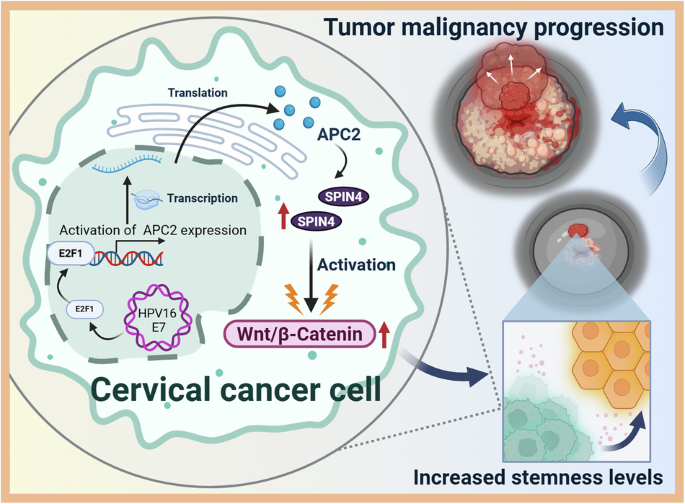
Burd EM. Human papillomavirus and cervical cancer. Clin Microbiol Rev. 2003;16:1–17.
Perkins RB, Wentzensen N, Guido RS, Schiffman M. Cervical cancer screening: a review. Jama. 2023;330:547–58.
Tewari KS, Sill MW, Long HJ 3rd, Penson RT, Huang H, Ramondetta LM, et al. Improved survival with bevacizumab in advanced cervical cancer. N Engl J Med. 2014;370:734–43.
Doorbar J, Egawa N, Griffin H, Kranjec C, Murakami I. Human papillomavirus molecular biology and disease association. Rev Med Virol. 2015;25:2–23.
Moscicki AB, Schiffman M, Burchell A, Albero G, Giuliano AR, Goodman MT, et al. Updating the natural history of human papillomavirus and anogenital cancers. Vaccine. 2012;30:F24–33.
Yang S, Chen T, Huang L, Xu S, Cao Z, Zhang S, et al. High-risk human papillomavirus E7 maintains stemness via APH1B in cervical cancer stem-cell like cells. Cancer Manag Res. 2019;11:9541–52.
Yang M, Ma Y, Cao Z, Zhan H, Jin Y, Huang X, et al. HPV16 E7 enhances cell stemness via RTKN 2-mediated activation of the NF-κB pathway in cervical cancer. Biochem Genet. 2025. https://doi.org/10.1007/s10528-025-11144-w. (Online ahead of print).
Nassar D, Blanpain C. Cancer stem cells: basic concepts and therapeutic implications. Annu Rev Pathol. 2016;11:47–76.
Yao T, Lu R, Zhang Y, Zhang Y, Zhao C, Lin R, et al. Cervical cancer stem cells. Cell Prolif. 2015;48:611–25.
Cao HZ, Liu XF, Yang WT, Chen Q, Zheng PS. LGR5 promotes cancer stem cell traits and chemoresistance in cervical cancer. Cell Death Dis. 2017;8:e3039.
Zhang Y, An J, Liu M, Li N, Wang W, Yao H, et al. Efficient isolation, culture, purification, and stem cell expression profiles of primary tumor cells derived from uterine cervical squamous cell carcinoma. Am J Reprod Immunol. 2020;84:e13251.
Kim N, Park W, Cho WK, Bae DS, Kim BG, Lee JW, et al. Significance of serum CA125 level in surgically resected cervical adenocarcinoma with adverse features. J Gynecol Oncol. 2021;32:e72.
Nusse R, Clevers H. Wnt/β-catenin signaling, disease, and emerging therapeutic modalities. Cell. 2017;169:985–99.
Luo J, Wang P, Wang R, Wang J, Liu M, Xiong S, et al. The Notch pathway promotes the cancer stem cell characteristics of CD90+ cells in hepatocellular carcinoma. Oncotarget. 2016;7:9525–37.
Zhu R, Gires O, Zhu L, Liu J, Li J, Yang H, et al. TSPAN8 promotes cancer cell stemness via activation of Sonic Hedgehog signaling. Nat Commun. 2019;10:2863.
Iluta S, Nistor M, Buruiana S, Dima D. Notch and hedgehog signaling unveiled: crosstalk, roles, and breakthroughs in cancer stem cell research. Life. 2025;15:228.
Drost J, van Jaarsveld RH, Ponsioen B, Zimberlin C, van Boxtel R, Buijs A, et al. Sequential cancer mutations in cultured human intestinal stem cells. Nature. 2015;521:43–7.
Bourguignon LY, Wong G, Earle C, Chen L. Hyaluronan-CD44v3 interaction with Oct4-Sox2-Nanog promotes miR-302 expression leading to self-renewal, clonal formation, and cisplatin resistance in cancer stem cells from head and neck squamous cell carcinoma. J Biol Chem. 2012;287:32800–24.
Kulasingam V, Diamandis EP. Strategies for discovering novel cancer biomarkers through utilization of emerging technologies. Nat Clin Pract Oncol. 2008;5:588–99.
Wu SF, Qian WY, Zhang JW, Yang YB, Liu Y, Dong Y, et al. Network motifs in the transcriptional regulation network of cervical carcinoma cells respond to EGF. Arch Gynecol Obstet. 2013;287:771–7.
Xiao Y, Yin J, Liu P, Zhang X, Lin Y, Guo J. Triptolide-induced cuproptosis is a novel antitumor strategy for the treatment of cervical cancer. Cell Mol Biol Lett. 2024;29:113.
Katoh M, Katoh M. WNT signaling and cancer stemness. Essays Biochem. 2022;66:319–31.
Dunys J, Kawarai T, Sevalle J, Dolcini V, George-Hyslop PS, Da Costa CA, et al. p53-dependent Aph-1 and Pen-2 anti-apoptotic phenotype requires the integrity of the gamma-secretase complex but is independent of its activity. J Biol Chem. 2007;282:10516–25.
Zhao J, Yang S, Cui X, Wang Q, Yang E, Tong F, et al. A novel compound EPIC-0412 reverses temozolomide resistance via inhibiting DNA repair/MGMT in glioblastoma. Neuro Oncol. 2023;25:857–70.
Ghamlouch H, Boyle EM, Blaney P, Wang Y, Choi J, Williams L, et al. Insights into high-risk multiple myeloma from an analysis of the role of PHF19 in cancer. J Exp Clin Cancer Res CR. 2021;40:380.
Zhou Q, Wang C, Zhu Y, Wu Q, Jiang Y, Huang Y, et al. Key genes and pathways controlled by E2F1 in human castration-resistant prostate cancer cells. Onco Targets Ther. 2019;12:8961–76.
Cheng LH, Hsu CC, Tsai HW, Liao WY, Yang PM, Liao TY, et al. ASPM activates hedgehog and Wnt signaling to promote small cell lung cancer stemness and progression. Cancer Res. 2023;83:830–44.
Nara M, Teshima K, Watanabe A, Ito M, Iwamoto K, Kitabayashi A, et al. Bortezomib reduces the tumorigenicity of multiple myeloma via downregulation of upregulated targets in clonogenic side population cells. PLoS ONE. 2013;8:e56954.
Zhang W, Ruan X, Li Y, Zhi J, Hu L, Hou X, et al. KDM1A promotes thyroid cancer progression and maintains stemness through the Wnt/β-catenin signaling pathway. Theranostics. 2022;12:1500–17.
Young MA, Daly CS, Taylor E, James R, Clarke AR, Reed KR. Subtle deregulation of the Wnt-signaling pathway through loss of Apc2 reduces the fitness of intestinal stem cells. Stem Cells. 2018;36:114–22.
Tian S, Zhang L, Li Y, Cao D, Quan S, Guo Y, et al. Human papillomavirus E7 oncoprotein promotes proliferation and migration through the transcription factor E2F1 in cervical cancer cells. Anti Cancer Agents Med Chem. 2021;21:1689–96.
Sun H, Ma H, Zhang H, Ji M. Up-regulation of MELK by E2F1 promotes the proliferation in cervical cancer cells. Int J Biol Sci. 2021;17:3875–88.
Zhang Y, Wang N, Ding M, Yang Y, Wang Z, Huang L, et al. CD40 accelerates the antigen-specific stem-like memory CD8(+) T cells formation and human papilloma virus (HPV)-positive tumor eradication. Front Immunol. 2020;11:1012.
Vishnoi K, Mahata S, Tyagi A, Pandey A, Verma G, Jadli M, et al. Cross-talk between human papillomavirus oncoproteins and hedgehog signaling synergistically promotes stemness in cervical cancer cells. Sci Rep. 2016;6:34377.
Xi R, Pan S, Chen X, Hui B, Zhang L, Fu S, et al. HPV16 E6-E7 induces cancer stem-like cells phenotypes in esophageal squamous cell carcinoma through the activation of PI3K/Akt signaling pathway in vitro and in vivo. Oncotarget. 2016;7:57050–65.
Bhattacharjee R, Das SS, Biswal SS, Nath A, Das D, Basu A, et al. Mechanistic role of HPV-associated early proteins in cervical cancer: molecular pathways and targeted therapeutic strategies. Crit Rev Oncol/Hematol. 2022;174:103675.
Wang JCK, Baddock HT, Mafi A, Foe IT, Bratkowski M, Lin TY, et al. Structure of the p53 degradation complex from HPV16. Nat Commun. 2024;15:1842.
Martinez-Zapien D, Ruiz FX, Poirson J, Mitschler A, Ramirez J, Forster A, et al. Structure of the E6/E6AP/p53 complex required for HPV-mediated degradation of p53. Nature. 2016;529:541–5.
Bergot AS, Ford N, Leggatt GR, Wells JW, Frazer IH, Grimbaldeston MA. HPV16-E7 expression in squamous epithelium creates a local immune suppressive environment via CCL2- and CCL5- mediated recruitment of mast cells. PLoS Pathog. 2014;10:e1004466.
Mirabello L, Yeager M, Yu K, Clifford GM, Xiao Y, Zhu B, et al. HPV16 E7 genetic conservation is critical to carcinogenesis. Cell. 2017;170:1164–74.e6.
Liu H, Xu J, Yang Y, Wang X, Wu E, Majerciak V, et al. Oncogenic HPV promotes the expression of the long noncoding RNA lnc-FANCI-2 through E7 and YY1. Proc Natl Acad Sci USA. 2021;118:e2014195118.
Xu A, Yang X, Zhao J, Kong S, Tang Q, Li X, et al. KAT8 facilitates the proliferation of cancer cells through enhancing E7 function in HPV-associated cervical cancer. Acta Biochim Biophys Sinica. 2025;57:1517–28.
Liu J, Xiao Q, Xiao J, Niu C, Li Y, Zhang X, et al. Wnt/β-catenin signalling: function, biological mechanisms, and therapeutic opportunities. Signal Transduct Target Ther. 2022;7:3.
Sun Y, Wang L, Xu X, Han P, Wu J, Tian X, et al. FOXO4 inhibits the migration and metastasis of colorectal cancer by regulating the APC2/β-catenin axis. Front Cell Dev Biol. 2021;9:659731.
Xu G, Zhang Z, Zhang L, Chen Y, Li N, Lv Y, et al. miR-4326 promotes lung cancer cell proliferation through targeting tumor suppressor APC2. Mol Cell Biochem. 2018;443:151–7.
Ying X, Li-ya Q, Feng Z, Yin W, Ji-hong L. MiR-939 promotes the proliferation of human ovarian cancer cells by repressing APC2 expression. Biomed Pharmacother. 2015;71:64–9.
Gammons MV, Renko M, Johnson CM, Rutherford TJ, Bienz M. Wnt signalosome assembly by DEP domain swapping of dishevelled. Mol Cell. 2016;64:92–104.
Mosimann C, Hausmann G, Basler K. Parafibromin/Hyrax activates Wnt/Wg target gene transcription by direct association with beta-catenin/Armadillo. Cell. 2006;125:327–41.
Kunttas-Tatli E, Roberts DM, McCartney BM. Self-association of the APC tumor suppressor is required for the assembly, stability, and activity of the Wnt signaling destruction complex. Mol Biol Cell. 2014;25:3424–36.
van Es JH, Kirkpatrick C, van de Wetering M, Molenaar M, Miles A, Kuipers J, et al. Identification of APC2, a homologue of the adenomatous polyposis coli tumour suppressor. Curr Biol. 1999;9:105–8.
Daly CS, Shaw P, Ordonez LD, Williams GT, Quist J, Grigoriadis A, et al. Functional redundancy between Apc and Apc2 regulates tissue homeostasis and prevents tumorigenesis in murine mammary epithelium. Oncogene. 2017;36:1793–803.
Saito-Diaz K, Benchabane H, Tiwari A, Tian A, Li B, Thompson JJ, et al. APC inhibits ligand-independent Wnt signaling by the clathrin endocytic pathway. Dev cell. 2018;44:566–81.e8.
Ranasinghe V, McMillan N. Novel therapeutic strategies for targeting E6 and E7 oncoproteins in cervical cancer. Crit Rev Oncol/Hematol. 2025;211:104721.
Shoaib M, Tariq A, Liu Y, Yang M, Qu L, Yang L, et al. Recent update on the development of HPV16 inhibitors for cervical cancer. Crit Rev Oncol/Hematol. 2025;210:104703.
Lui JC, Wagner J, Zhou E, Dong L, Barnes KM, Jee YH, et al. Loss-of-function variant in SPIN4 causes an X-linked overgrowth syndrome. JCI insight. 2023;8:e167074.
Chang SL, Chan TC, Chen TJ, Yang CC, Tsai HH, Yeh CF, et al. High SPIN4 expression is linked to advanced nodal status and inferior prognosis in nasopharyngeal carcinoma patients. Life. 2021;11:912.
Zhang X, Thielert M, Li H, Cravatt BF. SPIN4 is a principal endogenous substrate of the E3 ubiquitin ligase DCAF16. Biochemistry. 2021;60:637–42.
Li Y, Wang W, Xu D, Liang H, Yu H, Zhou Y, et al. PIWIL2/PDK1 axis promotes the progression of cervical epithelial lesions via metabolic reprogramming to maintain tumor-initiating cell stemness. Adv Sci. 2024;11:e2410756.
Xu M, Huseinovic A, Jaspers A, Yuan L, Steenbergen RDM. Downregulation of miR-193a/b-3p during HPV-induced cervical carcinogenesis contributes to anchorage-independent growth through PI3K-AKT pathway regulators. J Med Virol. 2023;95:e28589.
