


Background
Advances in the care of patients with prostate cancer across the disease spectrum have resulted in substantial survival gains over recent decades. However, global disparities in prostate cancer survival, stage at diagnosis, and access to timely diagnosis and treatment remain among the greatest across all malignancies. We aimed to quantify country-level health system correlates of the prostate cancer mortality-to-incidence ratio (MIR).
Methods
We applied interpretable machine learning using CatBoost with SHAP (SHapley Additive exPlanations) to all 185 countries with prostate cancer MIR estimates in GLOBOCAN 2022. National age-standardized MIR estimates were linked to 11 health system indicators from the World Health Organization Global Health Observatory, World Bank World Development Indicators, United Nations agencies, and the Directory of Radiotherapy Centres. Model performance was evaluated using repeated leave-one-country-out cross-validation with bootstrap-based uncertainty estimation. CatBoost handled missing predictor values natively, allowing inclusion of all countries without imputation.
Results
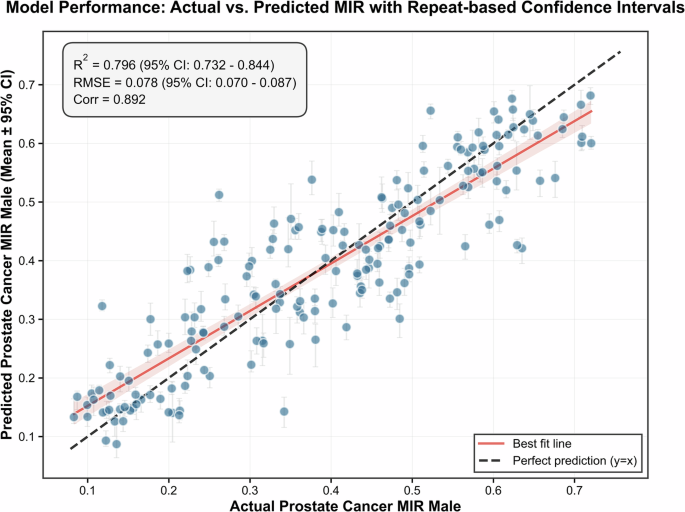
The model demonstrated strong predictive performance for prostate cancer MIR (R² = 0.80, RMSE = 0.078, MAE = 0.060, Pearson correlation = 0.89). The health system features most strongly associated with lower MIR were gross domestic product per capita, the universal health coverage (UHC) service coverage index, and radiotherapy infrastructure. Country-level SHAP decompositions demonstrated heterogeneous feature contributions across settings, identifying context-specific priorities. Greater radiotherapy capacity and more comprehensive UHC were consistently associated with lower MIR, whereas higher aggregate health expenditure alone showed weaker associations with improved outcomes.
Conclusions
Interpretable machine learning identified radiotherapy infrastructure, universal health coverage, and national wealth as the health system features most consistently associated with lower prostate cancer mortality-to-incidence ratios across countries. These findings suggest that targeted investment in treatment capacity and service coverage may have greater relevance to prostate cancer outcomes than increases in aggregate health spending alone. Although ecological and hypothesis-generating, this framework may inform future health systems research, prospective evaluation, and global prostate cancer control.
