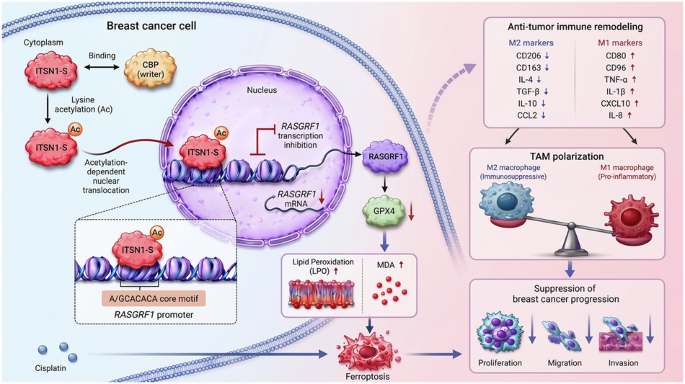
Breast cancer remains the most prevalent malignancy among women worldwide, yet robust molecular biomarkers are still lacking to advance precision oncology. Integrative analyses of our single-cell RNA sequencing (scRNA-seq) and mRNA microarray datasets identified endocytic protein, the short isoform of intersectin 1 (ITSN1-S), as a previously uncharacterized tumor suppressor, with its nuclear accumulation positively correlating with clinical prognosis in breast cancer. Mechanistically, CREB-binding protein (CBP)‑mediated acetylation facilitated nuclear translocation of ITSN1-S, enabling it to function as a non-canonical transcriptional repressor. Via directly binding to A/GCACACA core motif within RASGRF1 promoter, nuclear ITSN1-S transcriptionally repressed RASGRF1. Functionally, this transcriptional repression inhibited breast cancer malignant progression and downregulated GPX4, thereby sensitizing breast cancer cells to cisplatin-induced ferroptosis. Further functional assays demonstrated that ITSN1-S-RASGRF1 axis-triggered tumor ferroptosis remodeled tumor immune microenvironment by driving tumor-associated macrophage (TAM) polarization towards anti-tumor M1 phenotype both in vitro and in vivo. Consistently, combined nuclear ITSN1-S and RASGRF1 expression status served as an independent prognostic factor for breast cancer patients. Collectively, this study advanced mechanistic insights into non-canonical transcriptional regulation driven by post-translationally modified endocytic proteins and offered promising prognostic biomarkers and druggable targets to reverse cisplatin resistance for breast cancer treatment.
Trending
- Jersey minister looking again at patient travel costs to UK
- Acetylation-driven non-canonical transcriptional repressor ITSN1-S targets RASGRF1-GPX4 axis to induce breast cancer ferroptosis and anti-tumor immune remodeling
- Same mutagenic insult, different destinies: genetic background directs cancer evolution
- VIKTORIA-1 and Gedatolisib in HR+/HER2− mBC
- Managing Zongertinib Toxicities and Supporting Adherence
- Early Clinical Data Show KRAS Inhibitors Can Work in Cholangiocarcinoma
- Bridging therapy response and type as determinants of cilta-cel outcomes in relapsed/refractory multiple myeloma
- What Drove the SBRT Quality-of-Life Advantage in Pancreatic Cancer?


Friday, October 2
Acetylation-driven non-canonical transcriptional repressor ITSN1-S targets RASGRF1-GPX4 axis to induce breast cancer ferroptosis and anti-tumor immune remodeling
 By NewsCancer