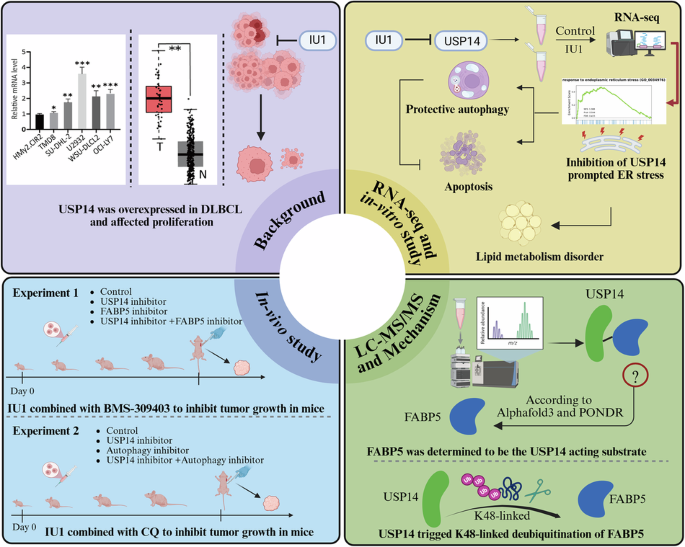
Proteasome inhibitors have transformed cancer therapy in certain settings. However, their overall effectiveness is often limited as residual proteasome function is retained through the overexpression of ubiquitin-specific protease 14 (USP14), a proteasome-associated deubiquitinase that processes ubiquitinated substrates prior to proteasome-mediated degradation. USP14 is closely associated with the progression of multiple malignancies, making USP14 an attractive therapeutic target in cancer treatment. Our study reveals that USP14 is abnormally overexpressed in diffuse large B-cell lymphoma (DLBCL) and significantly affects disease prognosis. Mechanistic investigations indicate that inhibiting USP14, either pharmacologically with the USP14 inhibitor IU1 or through targeted short hairpin RNA, is associated with endoplasmic reticulum (ER) stress in DLBCL cells, which may lead to apoptosis and disrupt lipid metabolism. Importantly, this process is concurrently accompanied by a pro-survival autophagic reaction limiting the overall effectiveness of USP14 inhibition. Inhibiting this reaction enhances the apoptotic effect induced by USP14 inhibition. Further investigations reveal that USP14 also functions through a proteasome-independent role by deubiquitinating and stabilizing the fatty acid-binding protein 5 (FABP5). Restoration of FABP5 expression suppressed ER stress in DLBCL cells, along with downstream lipid metabolism disorders and apoptotic autophagy. Consistently, FABP5 is upregulated in DLBCL, and co-targeting of USP14 and FABP5 exhibited remarkable synergistic effects, offering a novel therapeutic approach for DLBCL.
Trending
- Middlesbrough FC Foundation cancer fitness group ‘saved me’
- CAR signaling instructs divergent metabolic reprogramming and functional fates in αβ and γδ T cells
- Prognostic impact of need for re-induction based on day-14 residual disease and age-adapted consolidation strategy in acute myeloid leukemia
- Integrating Talazoparib Plus Enzalutamide Into HRR-Mutated mHSPC Care
- When Single-Fraction SRS Still Makes Sense for Resected Brain Metastases
- Lirafugratinib Approval Adds a Third FGFR2 Inhibitor in Cholangiocarcinoma
- BCMA/GPRC5D CAR T-Cell Therapy Shows Early Efficacy in R/R Multiple Myeloma
- Genetics and treatment history influence clonal hematopoiesis risk after PARP inhibitor therapy


Wednesday, September 30
Targeting USP14 disrupts lipid metabolism and survival pathways in diffuse large B-cell lymphoma (DLBCL)
 By NewsCancer