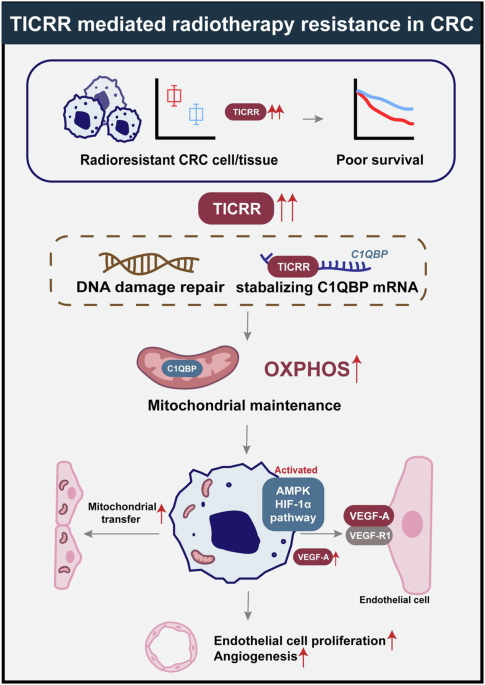
Radiotherapy resistance remains a major challenge in the clinical management of colorectal cancer (CRC), highlighting the urgent need to identify novel regulators of radiosensitivity. Here, we reveal a multi-layered mechanism whereby TICRR drives CRC radioresistance. TICRR is significantly upregulated in radioresistant CRC tissues and cell lines and is associated with poor patient survival. TICRR knockdown suppresses tumor cell proliferation, impairs DNA damage repair, and enhances radiosensitivity both in vitro and in vivo. Mechanistically, TICRR functions as an RNA-binding protein (RBP) to stabilize the mitochondrial protein C1QBP mRNA, thereby maintaining mitochondrial function and regulating AMP levels, which in turn modulate the AMPK/HIF pathway and VEGFA transcription. TICRR-high tumor cells interact with endothelial cells via the VEGFA-VEGFR1 signaling axis and transfer mitochondria to endothelial cells to enhance angiogenesis, a process disrupted by TICRR downregulation. Collectively, these findings demonstrate that TICRR promotes CRC radioresistance through a multi-layered mechanism involving mitochondrial function and tumor-endothelial cell communication, highlighting TICRR inhibition as a potential strategy for radiosensitization.
Trending
- Woman changes her life after sister’s incurable cancer diagnosis
- TICRR orchestrates mitochondrial dynamics and tumor-endothelial crosstalk to drive radioresistance in colorectal cancer
- Biallelic loss of RB1 in hepatocellular carcinoma as synthetic lethal target for artificial intelligence-guided therapy
- Risk of urologic cancers in patients with hospital-diagnosed recurrent cystitis: a nationwide population-based study
- What Should Supportive Care Entail in Relapsed/Refractory Multiple Myeloma?
- Who Are The Key Candidates to Receive Subcutaneous Amivantamab for HNSCC?
- Vaccine breakthrough stops cancer returning in trial
- How we found a new transmissible cancer in bullhead catfish


Thursday, August 20
TICRR orchestrates mitochondrial dynamics and tumor-endothelial crosstalk to drive radioresistance in colorectal cancer
 By NewsCancer