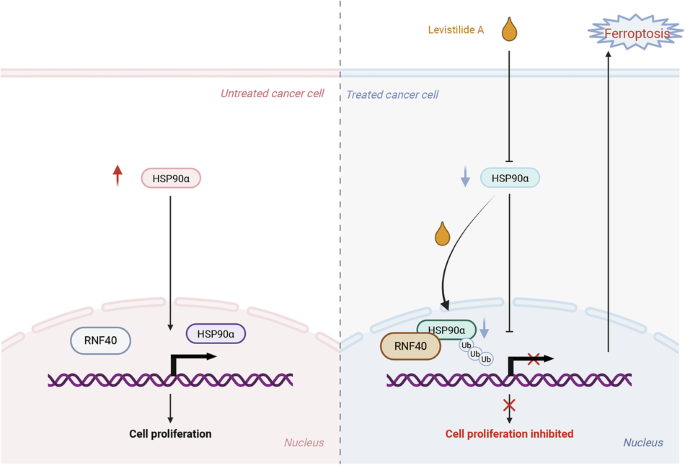
The molecular mechanisms underlying lung metastasis of colorectal cancer (CRC) remain largely elusive, and effective therapeutic agents are still lacking. In this study, we identify levistilide A (LeA) as a potential anti-metastatic agent against CRC lung metastasis. We demonstrate that heat shock protein 90α (HSP90α) is markedly upregulated in CRC and promotes lung metastasis by suppressing ferroptosis. Notably, combined treatment with LeA and the ferroptosis inducer RSL3 further alleviates lung metastatic burden in vivo. Mechanistically, we reveal that the E3 ubiquitin ligase ring finger protein 40 (RNF40) suppresses CRC cell proliferation by directly interacting with HSP90α, inducing ubiquitination at lysine 407 and promoting its proteasomal degradation. RNF40-mediated HSP90α downregulation leads to the accumulation of malondialdehyde (MDA) and reactive oxygen species (ROS), thereby inhibiting CRC cell growth. Collectively, our findings provide mechanistic insights into how LeA directly targets HSP90α or facilitates RNF40-HSP90α-mediated degradation of HSP90α to regulate ferroptosis in CRC.
Trending
- What Are The Biggest Misconceptions About CAR T Cells in Multiple Myeloma?
- Sheffield skin cancer sufferer launches free sun cream scheme
- The Rationale for JAK Inhibition/PD-1 Blockade in Immune-Resistant RCC
- Levistilide A promotes ferroptosis through the RNF40-HSP90α axis and inhibit colorectal cancer lung metastasis
- Scientists solve the mystery of a brain “switch” that can trigger weight loss in opposite ways
- Induced proximity-based therapeutics for advanced prostate cancer
- An EZH2–SREBP2 axis promotes cholesterol biosynthesis and represents a noncanonical vulnerability in tumorigenesis
- THBS1+ macrophages drive an immunosuppressive tumor microenvironment and promote progression in early-onset gastric cancer


Saturday, August 15
Levistilide A promotes ferroptosis through the RNF40-HSP90α axis and inhibit colorectal cancer lung metastasis
 By NewsCancer