


Germline predisposition plays a major role in hematologic neoplasms (HNs), with pathogenic or likely-pathogenic (P/LP) germline variants identified in up to ~14% of adults with myeloid neoplasms [1, 2]. We recently reported that early detection of these variants immediately influences clinical management in up to 21.5% of patients [3], particularly by guiding donor selection for allogeneic stem cell transplantation, where prompt identification of familial variant carriers has become critical given the increasing recognition of donor-derived HN [4, 5].
Skin-derived fibroblasts remain the gold-standard non-hematopoietic DNA source for germline testing [6]. However, the prolonged culture time required for DNA extraction limits their applicability in clinically urgent scenarios [7]. Peripheral T lymphocytes are still frequently used, although their reliability has been challenged by the increasing recognition of somatic reversion events involving genes associated with HN predisposition [8,9,10]. In this context, hair bulbs and oral mucosa have emerged as rapid, non-invasive alternatives for germline testing, enabling same-day analysis while overcoming the limitations imposed by somatic reversion phenomena. Nevertheless, concerns regarding derived DNA quality continue to limit their widespread clinical adoption [11].
Here, we report, to our knowledge, one of the largest studies to date evaluating hair bulb- and oral mucosa-derived DNA samples (hbDNA and omDNA, respectively) in the HN setting, comprehensively assessing our extraction protocols in terms of yield, purity, molecular integrity, hematopoietic contamination, and the impact of key clinical factors on extraction performance.
All subjects undergoing hair bulb and/or oral mucosa sampling for germline genetic testing at the Hematologic Genetic Counseling and Diagnostic Unit (HGCDU), Hospital Universitari Vall d’Hebron (HUVH, Barcelona, Spain) were included. An independent cohort of early-onset myelodysplastic neoplasm (MDS) cases recruited through the Spanish Group of MDS (GESMD) was additionally incorporated for the hematopoietic contamination sub-analysis.
The study was approved by the institutional review boards of HUVH (PR(AG)553/2020), Hospital Morales Meseguer (Murcia) (EST-32/12), and all participating centers, and was conducted in accordance with the Declaration of Helsinki. Specimens were collected at diagnosis or upon suspicion of hereditary HN according to the Spanish guidelines for germline genetic testing [3]. Detailed eligibility criteria are provided in the Supplementary Methods. Within the Catalan public healthcare system, hair follicles and oral mucosa constitute part of the current standard of care for germline testing in hereditary HNs [12].
Genomic DNA was extracted using standardized in-house protocols (Supplementary Methods). DNA concentration was quantified by fluorometry. Purity was assessed by spectrophotometry using the A260/A280 and A260/A230 ratios according to recommended reference ranges of 1.6–2.2 and 1.8–2.4, respectively [13]. DNA integrity was evaluated by high-resolution microfluidic electrophoresis using 3 metrics: DNA Integrity Number (DIN), percentage of integrated area above 10 kilobases (AUC10kb), and maximum peak size (MPS). AUC10kb is equivalent to the elsewhere used Genomic Quality Number (GQN) score using a 10 kilobase threshold.
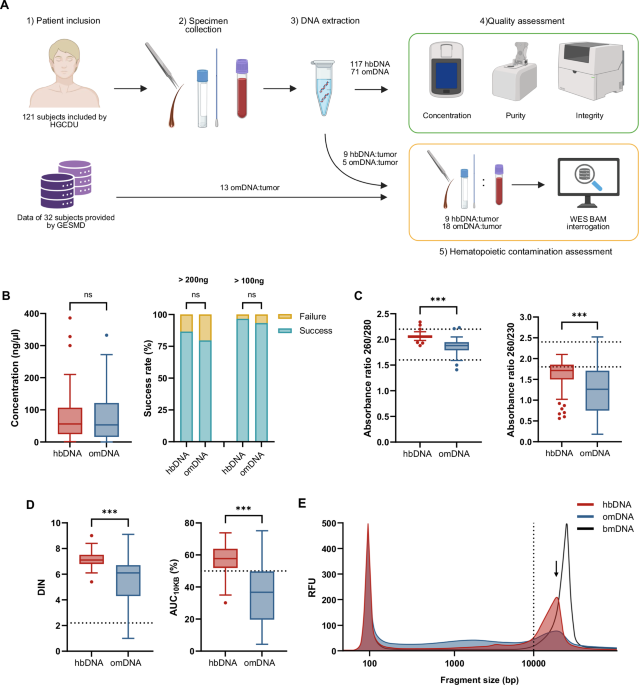
Hematopoietic contamination in hbDNA and omDNA samples was assessed using a matched tumor-normal approach. Patients with paired whole-exome sequencing (WES) data from normal sample (hbDNA or omDNA) and targeted somatic sequencing from tumor sample (bone marrow or peripheral blood) identifying HN driver variants were included. The somatic variant with the highest variant allele frequency (VAF) was selected for each case to maximize detection sensitivity, and germline WES BAM files were then interrogated for its presence. The overall study workflow is summarized in Fig. 1A.
Fig. 1: Overview of the study workflow and comparison of DNA quality metrics in hbDNA and omDNA.
A (1) A total of 121 subjects evaluated at the Hematologic Genetic Counseling and Diagnostic Unit (HGCDU) at Hospital Universitari Vall d’Hebron (HUVH) were included, with sequencing strategy and germline DNA source selected according to individual and familial clinical history. (2) Hair specimen and/or buccal swabs, together with paired peripheral blood samples, were collected and submitted for DNA extraction. (3) DNA extraction was performed using validated in-house protocols. (4) DNA quality assessment included fluorometric quantification, spectrophotometric purity evaluation, and integrity analysis by high-resolution microfluidic electrophoresis. (5) Hematopoietic contamination in germline samples was assessed using a matched tumor-normal approach, including an independent cohort from the Spanish Group of Myelodysplastic Syndromes (GESMD). Figure created with BioRender.com. B DNA concentration showed comparable median yields between sample types (hbDNA n = 89; omDNA n = 58). One hbDNA datapoint (y = 469 ng/µl) and one omDNA datapoint (y = 540 ng/µl) have been left outside the axis limits for visualization purposes. Extraction success rates, defined according to sequencing input requirements of 200 ng or 100 ng, were comparable between groups (hbDNA n = 89; omDNA n = 59). C DNA purity assessed by spectrophotometry showed higher A260/280 ratio median values in hbDNA (n = 96) compared to omDNA samples (n = 69). Nevertheless, high proportion of samples remained between the optimum range of 1.6–2.2, indicated with dotted lines. A260/230 ratios showed medians below the recommended ranges of 1.8–2.2 in both groups, but were lower in omDNA. D DNA integrity was superior in hbDNA (n = 89) compared to omDNA samples (n = 55), measured by both DIN and AUC10kb. Dotted lines indicate the DIN and AUC10kb threshold values of 2.2 and 50%, respectively, proposed in previous studies as suitable for high-quality sequencing results. E Electropherograms of representative DNA fragment size distributions for hair bulb (red), oral mucosa (blue), and bone marrow (black) samples. The peak at 100 bp corresponds to the kit lower marker. The dotted line indicates the 10 kb threshold used for AUC10kb calculation, and the black arrow denotes the approximate MPS in the hbDNA and omDNA samples. DIN, AUC10kb, and MPS values for the representative samples are, respectively, 7.1, 58.07%, and 26,419 pb (hbDNA); 5.6, 33.30%, and 35,463 pb (omDNA); and 9.6, 83.89%, and >60,000 pb (bmDNA). Bone marrow profile is shown for reference. Group median comparisons were performed using the Mann–Whitney U test (***p < 0.001). hbDNA, hair bulb-derived DNA; omDNA, oral mucosa-derived DNA; bmDNA, bone marrow-derived DNA; AUC10kb, percentage of integrated area above 10 kilobases; DIN, DNA Integrity Number; RFU, relative fluorescence units.
The HGCDU cohort comprised 121 subjects (median age, 48 years; 53.7% female), from whom 117 hbDNA and 71 omDNA samples were obtained for DNA quality assessment. Detailed cohort characteristics are provided in Supplementary Table S1. Most samples were analyzed after storage at −20 °C. Although longer storage time was associated with a modest decline in hbDNA integrity metrics, no significant differences were observed between long-term stored and non-stored samples; therefore, all samples were retained for subsequent analyses (Supplementary Results).
DNA yield was comparable between both sample types, with median concentrations of 56.0 ng/µl for hbDNA and 53.0 ng/µl for omDNA samples (p = 0.940). Consistently, extraction success rates according to sequencing input requirements were similar between groups. Overall, 86.5% of hbDNA and 79.7% of omDNA samples achieved the ≥200 ng input required for the most demanding WES protocol (p = 0.363), increasing to 95.5% and 93.2%, respectively, when applying the ≥100 ng threshold compatible with less stringent WES protocols and targeted Sanger sequencing (p = 0.437) (Fig. 1B). DNA purity assessed by A260/A280 ratios was also comparable between sample types, with 97.9% of hbDNA and 92.8% of omDNA samples within the recommended range of 1.6 to 2.2 (p = 0.131). Although omDNA showed lower A260/A230 ratios than hbDNA, the reliability of this metric at low DNA concentrations remains controversial [13] (Fig. 1C). Importantly, variability in purity metrics was not associated with reduced sequencing performance in our cohort (Supplementary Results). The most pronounced differences were observed in DNA integrity analyses, with hbDNA showing significantly higher integrity than omDNA, as reflected by higher median DIN (7.1 vs 6.2; p < 0.001) and AUC10kb values (57.7% vs 36.8%; p = 0.001) (Fig. 1D). Meanwhile, MPS was similar between groups, with medians of ~ 23,000 bp (p = 0.290). Representative electropherograms illustrating AUC10kb and MPS parameters are shown in Fig. 1E. Detailed quality metrics are provided in Supplementary Table S2. Together, these findings support both tissues as suitable germline DNA sources while positioning hair bulbs as a more robust source of high-quality DNA. Further workflow optimization may unlock the potential of hbDNA for emerging long-fragment sequencing applications, opening new opportunities for germline structural variant research in HNs [14].
Hematopoietic DNA contamination analysis included 27 cases with available germline WES (hbDNA, n = 9; omDNA, n = 18) and paired somatic profiling data (Supplementary Table S3). No detectable contamination was observed in hbDNA samples, whereas somatic variants were identified in 5 omDNA samples (26.3%), consistent with previous reports supporting hair bulbs as a low-contamination germline DNA source compared with oral mucosa [15, 16]. Detected somatic alterations involved SRSF2 (n = 3), JAK2 (n = 1) and RUNX1 (n = 1), with lower mean VAF in germline WES than in matched tumor sequencing (17.5% vs 34.4%). These findings suggest that reduced VAFs in germline WES may help distinguish somatic from germline origin in paired normal-tumor analyses. Nevertheless, caution remains warranted, as the JAK2-mutated case showed a higher VAF in germline WES than in the somatic panel (23% vs 17%). Notably, this patient had MDS with myelofibrosis, in line with previous reports linking extramedullary hematopoiesis to increased contamination risk in non-hematopoietic tissues [17]. Whether similar disease-specific patterns of contamination occur in hbDNA warrants further investigation.
We next explored the impact of clinical variables on DNA yield, including sex, recent cytotoxic treatment (1 week to 3 months before specimen collection), and a telomere biology disorder (TBD) diagnosis (Supplementary Fig. S1). Recent cytotoxic treatment was associated with a marked reduction in hbDNA yield, with approximately fourfold lower concentrations observed in patients with recent chemotherapy than in untreated individuals (median,14.7 ng/µl vs 59.2 ng/µl; p < 0.001). In contrast, omDNA yield was not significantly affected (62.6 ng/µl vs 45.2 ng/µl; p = 0.464). Given the reported limitations of skin-derived fibroblasts in the study of patients diagnosed with a TBD [7], we additionally explored hbDNA performance in this setting. However, no significant differences in yield were observed between patients with and without TBD (median, 73.6 ng/µl vs 54.5 ng/µl; p = 0.355). These findings highlight the importance of clinical context when selecting germline DNA sources. Hair bulb collection should be prioritized before treatment initiation, with oral mucosa offering a suitable alternative when adequate hair specimens cannot be obtained.
We acknowledge certain limitations in our study. First, a substantial proportion of samples were stored at −20 °C prior to quality assessment, which was associated with a modest decline in hbDNA integrity and may limit the generalizability of the results. Second, hbDNA and omDNA were processed using different extraction protocols, introducing potential methodological bias and limiting direct comparability between tissue types. Third, contamination analyses may be affected by selection bias, as not all patients underwent bone marrow sequencing or lacked detectable somatic variants, potentially underestimating disease-specific variability. Lastly, our cohort was predominantly composed of individuals of European ancestry, which may limit the generalizability of future germline variant studies across populations with different ancestral backgrounds.
In summary, leveraging what is, to our knowledge, one of the largest reported series of hbDNA and omDNA samples in the setting of HNs to date, we provide robust evidence supporting the performance of hair bulbs and oral mucosa as sources of DNA for germline testing. Although both tissues yielded DNA suitable for current NGS applications, hair bulbs consistently provided higher-quality DNA and showed no evidence of hematopoietic contamination, in contrast to oral mucosa. Concerns regarding DNA yield have remained a major barrier to their broader clinical implementation [16]; however, this limitation can largely be overcome by increasing the number of collected hair bulbs. Consistent with recent findings by St Martin E. et al., who reported a median yield of 21.5 ng/µl using 20–30 bulbs [15], our data demonstrates that collection of at least 25 hair bulbs consistently provides DNA yields comparable to oral mucosa. The robustness of hair follicles in the context of somatic reversion phenomena has also been recently highlighted by the Peter MacCallum Cancer Center group [8], pioneers in the use of hair bulbs for germline testing in HNs. From a practical perspective, hair bulb and oral mucosa sampling may offer logistical advantages over skin fibroblasts, allowing outpatient collection and direct DNA extraction, thereby reducing turnaround time, laboratory workload, and overall resource utilization. Collectively, these findings support our position advocating the inclusion of hair bulbs as a practical alternative to skin-derived fibroblasts in emerging germline testing guidelines [6].
In conclusion, hair bulbs represent a rapid, non-invasive source of non-hematopoietic germline DNA, while oral mucosa may constitute a feasible complementary alternative. The evidence presented herein provides a strong framework for the broader implementation of hair bulbs as a first-line DNA source for germline genetic testing in hematologic neoplasms.
