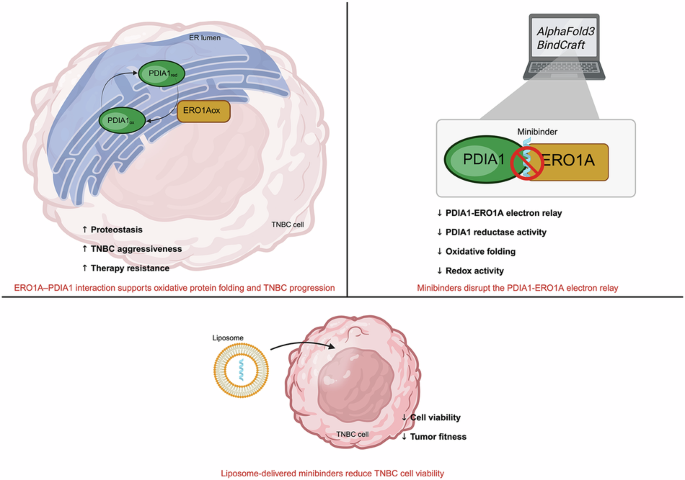
Endoplasmic reticulum oxidoreductin 1 alpha (ERO1A), together with its partner protein disulfide isomerase A1 (PDIA1), promotes oxidative protein folding within the endoplasmic reticulum (ER), thereby supporting ER redox homeostasis, proteostasis, and cancer progression. Importantly, ERO1A enhances the aggressiveness and therapy resistance of triple-negative breast cancer (TNBC), while PDIA1 is also upregulated and positively correlates with ERO1A expression in TNBC. These observations suggest that targeting the ERO1A–PDIA1 interaction may simultaneously impair the activity of both proteins, thereby providing a dual-hit anti-cancer strategy. Guided by AI-based structural modeling of the ERO1A–PDIA1 interface, we used the BindCraft pipeline to design and rank one hundred de novo protein minibinders targeting the b′ domain of PDIA1, from which eight top-scoring, non-redundant candidates were selected for experimental characterization. In vitro biochemical assays using recombinant proteins demonstrated direct binding of three minibinders (mb) to PDIA1 and inhibition of both the ERO1A–PDIA1 electron transfer relay and the intrinsic reductase activity of PDIA1. Furthermore, liposome-mediated intracellular delivery of mb7 impaired TNBC cell viability, providing proof-of-concept evidence that the minibinder can restrain tumor cell survival. Overall, our work provides a rationale for the development of highly specific and stable protein-based modulators of the ERO1A–PDIA1 interaction, which, by simultaneously inhibiting the activities of both ERO1A and PDIA1, may represent an effective strategy to restrain TNBC progression and counteract therapy resistance.
Trending
- Mefatinib versus gefitinib as a first-line treatment for EGFR-mutated non-small cell lung cancer: a randomized, double-blind, multicenter phase III study
- Functional deficiency of circadian regulator PER2 enhances breast cancer susceptibility and progression with immunosuppression
- ARNT Expression Patterns Hold Promise for HIF-1β Inhibition in RCC Subtypes
- Precision oncology needs precision trial design: lessons from FGFR2-rearranged cholangiocarcinoma
- Bolstering The Referral Process for CAR T-Cell Therapy in Multiple Myeloma
- Iza-Bren Yields Encouraging Activity in Extensive-Stage SCLC
- Sirexatamab Regimen May Improve PFS, OS in DKK1-High Colorectal Cancer
- A simple blood test could detect multiple cancers and reveal where they started


Thursday, August 13
Targeting the ERO1A–PDIA1 redox axis in triple-negative breast cancer with AI-designed minibinders
 By NewsCancer