


Building on the study’s objective to assess functional fitness using the Senior Fitness Test (SFT) and to compare its results with ECOG performance status, our findings demonstrate that the SFT is a feasible, safe, and sensitive tool for objectively evaluating functional status in cancer patients and survivors. No adverse events occurred during testing, indicating that the SFT can be safely applied both during and after anti-cancer treatment. Test completion required approximately 20–30 min, depending on the need for individual explanation of the six test components, which supports its practicality in clinical or research settings. These findings are consistent with previous studies in oncological populations reporting high feasibility and responsiveness of the SFT19.
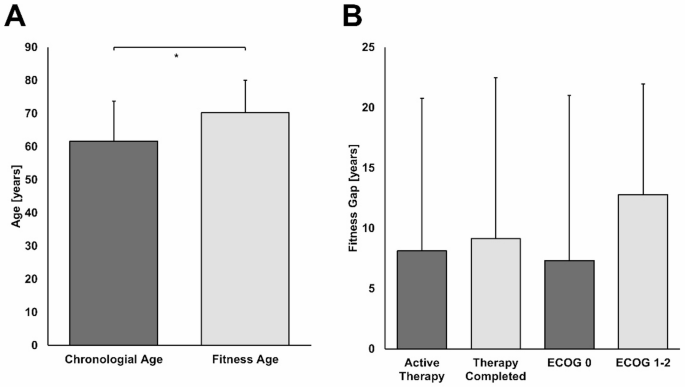
Beyond feasibility, the SFT identified substantial multi-domain functional impairments when compared with established age- and sex-specific normative values. On average, participants demonstrated a Fitness Gap (FG) of 8.59 years, indicating that their functional performance corresponded to normative values typical of individuals nearly nine years older. This finding provides an integrated quantification of cancer- and treatment-related declines across strength, endurance, flexibility, balance, and mobility. Similar impairments have been reported in previous studies showing that cancer survivors exhibit lower gait speed, reduced grip strength, and poorer overall physical performance than age-matched individuals without cancer8,27. These deficits may reflect a combination of treatment-related toxicities, chronic inflammation, deconditioning, and accelerated aging processes, which could compound normal age-related declines in physical function28.
Notably, the magnitude of the FG did not differ between patients undergoing active therapy and those in the post-therapy phase, suggesting that cancer-related impairments in functional fitness may persist well beyond treatment completion. This finding aligns with longitudinal evidence demonstrating sustained or progressive declines in functional capacity among cancer survivors compared with cancer-free populations. It underscores the need for long-term, individualized exercise and rehabilitation strategies targeting persistent deficits in physical function and fitness22. However, given the single time-point assessment in the present study, interpretations regarding differences between therapy stages are based on normative comparisons and existing literature rather than within-subject temporal data.
Interestingly, SFT-derived FG did not differ significantly between patients classified as fully active (ECOG 0) and those with mild functional limitations (ECOG > 0). Although mean FG values were lower in patients without ECOG-defined limitations, high interindividual variability resulted in non-significant group differences. This finding underscores the possibility that ECOG performance status, as a subjective single-item clinician-rated scale, may not fully capture physiologic reserve or functional domains relevant to daily activities. Prior research has shown only moderate correlations between ECOG scores and objective performance measures, with a substantial proportion of patients rated as ECOG 0–1 still exhibiting impairments in strength, mobility, balance, or ADL/IADL function12,29. Our results add to this body of evidence by demonstrating that structured, performance-based assessments such as the SFT can reveal clinically meaningful impairments that are not captured by ECOG alone.
From a clinical perspective, these findings support the integration of brief, validated objective assessments – such as the SFT, gait speed30, timed up-and-go31, or the 6-minute walk test32– into routine oncological care. Such tools may facilitate earlier identification of subclinical functional impairments and enable timely referral to targeted exercise or rehabilitation programs2. Furthermore, domain-specific results from the SFT can support the development of tailored exercise programs targeting strength, endurance, balance, or flexibility, in line with international exercise recommendations for people living with and beyond cancer22. In addition to these domain-specific outcomes, the composite Fitness Age derived from the SFT subtests may provide a broader summary measure of functional status and serve as an indicative screening index for functional limitations. As a screening approach, it captures multiple physiological systems simultaneously, including strength, endurance, balance, and flexibility. Deficits in any single domain reduce the overall performance profile, allowing early functional limitations to be detected across different areas of physical functioning. This makes it suitable for identifying potential indicators of fall risk, general frailty, and training needs. However, it should be emphasized that this does not represent a validated measure of biological age, but rather an aggregated deviation from age-related normative values across multiple domains of motor performance.
Future research should investigate whether SFT-derived measures, including the proposed Fitness Gap construct, predict clinically relevant outcomes such as treatment tolerance, hospitalization, functional decline, or survival. Longitudinal and randomized controlled trials are also needed to determine whether targeted exercise interventions that reduce these objective impairments translate into improved clinical endpoints and long-term survivorship outcomes.
Several limitations should be acknowledged, including the small sample size, heterogeneous patient population, and lack of a control group, which limit statistical power and generalizability. The cross-sectional study design precludes causal or longitudinal interpretations. Also, feasibility and safety can only be concluded for participants meeting our inclusion criteria, further limiting generalizability. In addition, ECOG performance status was not consistently assessed by the attending physician but by a senior researcher (in cases where no ECOG was available in the medical records), so the possibility of classification inaccuracy cannot be fully excluded. Factors that may affect physical performance and functional outcomes, including certain comorbidities and lifestyle-related factors such as physical activity, nutrition, and smoking status, were not systematically assessed in this study and may have influenced the observed results. It should also be noted that the study population was clinically heterogeneous with respect to tumor entities, disease stages, and treatment modalities. Although this variability may limit the generalizability of the findings, it reflects real-world oncological care settings. In addition, comparisons between participants during and after therapy were performed without adjustment for these factors, as adjustment was not methodologically appropriate given the clinical heterogeneity of the study population. Consequently, potential diagnosis- or treatment-specific effects on functional fitness cannot be excluded and may have been masked by cohort variability. With regard to the overall study cohort, participant enrollment may partly reflect the impact of institutional COVID-19 infection control measures in place during parts of the recruitment period.
Despite these limitations, the assessment proved feasible in routine clinical practice. Following appropriate training and familiarization with the measurement protocol, it could be integrated into the clinical workflow with minimal disruption and without placing a substantial burden on patients or clinical staff. Future studies with larger samples are needed to confirm these findings and further evaluate their generalizability.
Overall, the present findings highlight the added value of objective, multi-domain functional assessment in oncology and support the SFT as a meaningful complement to traditional performance status scales.
