


Study design and patient population
This was an open-label, nonrandomized, multicenter, first-in-human, phase I study. The main study (NCT04857138) and the imaging substudy (at a single site in Spain) complied with all relevant regulations regarding human study participants, were conducted in accordance with the Declaration of Helsinki and were approved by local institutional review boards (IRBs) and/or ethics committees (ECs) (CEIC de Navarra, EC_2021/2; HRA & HCRW, 21/FT/0031; De VK Region Hovedstaden, H-21017757; SNUH IRB, H-2104-078-1211; ASM IRB S2021-0747-0001; and CPP Ile de France I, CPPIDF1-2022-DI21-cat.1), with the substudy approved as an amendment (CEIC de Navarra, EC_2021/2). Participants provided written informed consent and were not compensated. Specimen collection and evaluation were in accordance with informed consent. A redacted protocol is included in Supplementary Information.
Intravenous RO7300490 was administered on day 1 of every 2-week cycle for 24 months or until PrD, unacceptable toxicity, or consent withdrawal. Dose escalation was guided by the modified continual reassessment method (CRM) with escalation with overdose control design59. The MTD was defined as the dose with the highest probability of the DLT rate being within a target interval of 20–35%, with a low probability (<25%) of the DLT rate exceeding 35%. A two-parameter logistic model was used to fit the dose–toxicity relationship, and a minimally informative bivariate normal prior was used for the parameters of the DLT dose–response curve. Six ascending dose cohorts involving ≥3 patients were assessed (16 mg, n = 6; 48 mg, n = 4; 140 mg, n = 4; 280 mg, n = 7; 550 mg, n = 4; and 1,100 mg, n = 4). DLTs were monitored from the first dose until 7 days after the second dose. The decision to dose escalate was made by the sponsor and investigators following review of all available data, including safety and PK, and was guided by the CRM. No statistical methods were used to predetermine sample sizes, with enrollment into the dose-escalation cohorts determined by the operating characteristics of the CRM model, as in similar phase I dose-escalation trials.
Additional patients were enrolled into two backfill cohorts (140 mg, n = 19 and 550 mg, n = 24) to collect paired baseline and on-treatment (day 3 of cycle 3) biopsies for PD analysis. Sample sizes were determined empirically, with the aim being to collect approximately ten evaluable paired biopsies, sufficient to detect a difference of one s.d. This target was selected based on previous CD8 PD analyses in immunotherapy trials,60 accounting for anticipated biopsy failure rates.
In the one-cycle, nonrandomized, open-labeled, imaging substudy, PET/computed tomography (CT) was used with [89Zr]Zr-RO7300490 to determine RO7300490 tissue biodistribution. [89Zr]Zr-RO7300490 was manufactured at VU University Medical Center Amsterdam. Patients were enrolled into two imaging cohorts, at labeled doses of 140 or 550 mg, after the safety and tolerability of each dose was confirmed. Patients received a single intravenous dose of 135 or 545 mg unlabeled RO7300490, followed by 5 mg [89Zr]Zr-RO7300490. Clinical grade RO7300490 was coupled with the bifunctional chelator DFO-Bz-NCS (Macrocyclics) and labeled with 89Zr (BV Cyclotron VU) according to good manufacturing practice standards with validated production processes and release criteria61. [89Zr]Zr-RO7300490 was administered ~40 h after its release. RO7300490 was continued from cycle 2 onwards in the main study. Patients in the substudy did not undergo biopsy.
Patients aged ≥18 years with advanced and/or metastatic solid tumors that had progressed on previous cancer therapy or were not amenable to standard therapy, including NSCLC, small cell lung cancer, triple negative breast cancer, cutaneous melanoma, urothelial cancer, mesothelioma, hepatocellular carcinoma, head and neck squamous cell carcinoma, esophageal squamous cell carcinoma and cervical squamous cell carcinoma, were enrolled. A wash-out period of 28 days or five half-lives of previous drug(s), whichever was shorter, was required before the first RO7300490 administration. Patients had an Eastern Cooperative Oncology Group performance status of 0 or 1, adequate bone marrow, renal, hepatic, coagulation and cardiovascular functions (Supplementary Table 2), and measurable disease per RECIST v.1.1 criteria. Patients enrolled into the backfill cohorts had lesions that could be safely biopsied. Patients with untreated brain metastases, autoimmune disorders, coagulopathies or notable comorbidities were excluded.
Safety
The primary end points (incidence, nature and severity of AEs), were summarized per dose level. AEs were mapped using MedDRA v.26.1 and graded according to National Cancer Institute Common Terminology Criteria for Adverse Events v.5.0, except for CRS, which was graded using American Society for Transplantation and Cellular Therapy criteria62. AEs considered DLTs are presented in Supplementary Table 3. Patients who received ≥1 RO7300490 dose were safety evaluable.
Efficacy
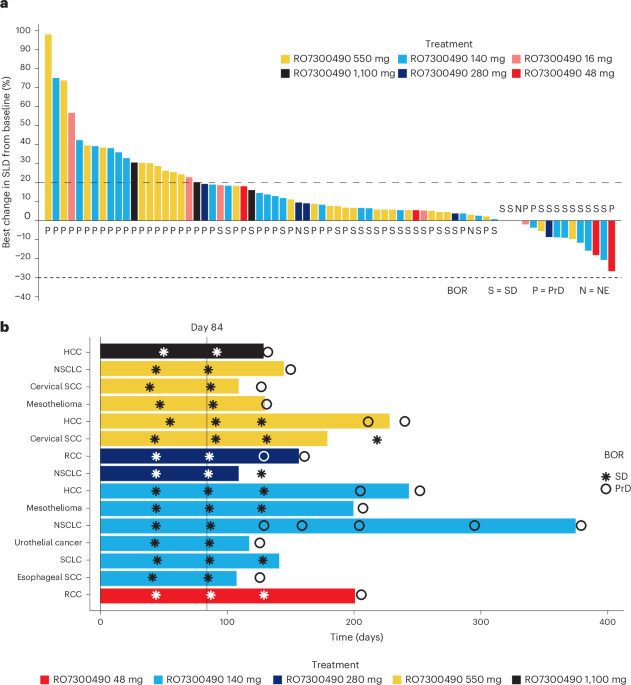
The secondary end points relating to efficacy (objective response rate, DCR, duration of response and PFS), were summarized per dose level. Tumor assessments were performed at screening, weeks 6, 12, 18 and every 12 weeks thereafter, using a CT scan with contrast (or magnetic resonance imaging). Responses were categorized according to RECIST v.1.1 by the investigator. Patients who received ≥1 RO7300490 dose and had ≥1 post-baseline tumor assessment after 6 weeks or discontinued the study due to symptomatic deterioration before the first on-study tumor assessment were efficacy evaluable. Patients with missing or no response assessments were classified as not evaluable unless there was documented clinical deterioration, in which case the patient was classified as a nonresponder. Time-to-event end points were censored at the day of the last tumor assessment for patients without documented PrD or death. Exploratory subgroup analyses were performed based on CPI status or number of previous lines of anticancer therapy. Prolonged SD was defined as disease remaining stable per RECIST v.1.1 for ≥12 weeks (84 days) since the start of study treatment.
[89Zr]Zr-RO7300490 tumor uptake
The primary end points of the imaging substudy utilized standardized uptake value (SUV) metrics to quantify [89Zr]Zr-RO7300490 uptake in tumor lesions and healthy organs. Imaging assessments included a baseline [18F]-FDG-PET/CT (FDG-PET) scan and up to four [89Zr]Zr-RO7300490 PET/CT (89Zr-PET) scans on treatment (2 (day 1), 24 (day 2), 96 (day 5) and 168 h (day 8) post-infusion). Analysis was performed by a nuclear medicine physician experienced in PET/CT imaging. To quantify specific tumor uptake under different mass doses, TBR based on maximum SUV was used, which also considers the uptake signal in blood (descending aorta as reference region). Tumor lesions with positive signal on FDG-PET were segmented using semi-automated and manual methods. Relative threshold cutoffs of maximum uptake values within any given lesion region were used as starting point. Manual edits were made to adjust volume of interest (VOI) boundaries to account for missed regions of elevated uptake or to remove regions of high signal from adjacent organs. Lesion VOIs delineated on FDG-PET scans were transferred to 89Zr-PET scans. If a lesion was identified on FDG-PET but no uptake was detected on 89Zr-PET, the VOI were transferred onto the 89Zr-PET using anatomical landmarks only. Up to ten lesions per patient were delineated. All patients consented to the publication of medical images using their individual participant ID.
Pharmacokinetics
Characterizing the PK parameters (clearance (CL) and volume of distribution (V) at steady state) of RO7300490 was a secondary study end point. Serum RO7300490 was quantified using a one-step electrochemiluminescence immunoassay on the Cobas e411 immunoanalyzer platform. Biotinylated rH-Cd40 receptor (rH-CD40-Bi, mono) was used as capture molecule, with Ru(bpy) human FAP (huFAP-SRu (NHS)) as a detection molecule, and streptavidin-coated complexes were visualized with the chemiluminescent co-reactant tripropylamine. Calibrators (RO7300490) and quality control samples were analyzed in parallel to the test samples using a bioanalytical validated assay. The PK-evaluable population included 80 patients who received ≥1 dose of RO7300490 and had ≥1 PK post-dose sample. Overall, 1,742 of 1,931 analyzed PK samples were evaluable and 189 (9.79%) were below the lower limit of quantification (1.16 ng ml−1). RO7300490 PK showed a TMDD, which could be well described by a TMDD population PK model using the quasi-steady-state approximation as described by Gibiansky and Gibiansky63; evaluation and simulation were carried out with NONMEM software v.7.5.1. Graphical analyses were performed with R v.4.3.1 using R studio (2023).
Immunogenicity
ADA incidence to RO7300490 was a secondary end point. ADA measurements were conducted on the Cobas e411 immunoanalyzer platform. Before analysis, test samples, negative controls and ADA-positive controls were incubated with a suppressor-reagent that binds to soluble (s) FAP in the sample matrix (serum) and blocks sFAP from binding to the labeled capture (RO7300490-Bi) and detection (RO7300490-Ru) molecules. The chemiluminescent agent was tripropylamine. The ADA-evaluable population included 75 of a total of 80 patients who received at least one RO7300490 dose and had at least one post-baseline ADA sample.
Flow cytometry
The RO of CD40 by RO7300490 was determined using a flow cytometry-based assay (see list of antibodies in Supplementary Table 4). Whole blood collected in sodium heparin was prepared following standard protocols. RO was determined using the bound receptor approach with the use of an ADA specific for the PG_LALA mutation on RO7300490. The following three conditions were measured: mean fluorescent intensity (MFI) of effectively bound RO7300490 (MFI effective binding); MFI of negative control binding corresponding to background fluorescence (MFI neg control binding); and MFI of saturated RO7300490 binding (MFI saturation binding). The percentage of RO was calculated by RO (% = 100 × ((MFI effective binding − MFI neg control binding)/(MFI saturation binding − MFI neg control binding)).
Blood samples for immunophenotyping were collected in Cyto-Chex Blood Collection Tubes (Streck) and sent at ambient temperature for sample preparation and flow cytometry analysis according to validated assay protocols. Cell preparation was carried out according to manufacturer’s instructions (https://www.bdbiosciences.com/en-ch/products/reagents/flow-cytometry-reagents/clinical-diagnostics/multitest-6-color-tbnk-kit). A list of antibodies is in Supplementary Table 5.
Immune cell subsets (T, B, natural killer (NK) cells and monocytes) and RO were analyzed using a standard hierarchical gating strategy on CD45+ singlets and lineage markers, comparable to fit-for-purpose validated methods previously described64. Data acquisition for the CD40 RO assay was conducted using FACS Canto II (ten-color, three-laser) instruments (BD Biosciences). Data acquisition for the phenotyping assay was conducted using FACS Canto II (eight-color, three-laser) instruments (BD Biosciences). Analysis of CD40 RO and T, B, and NK cell assays was conducted using FACSDiva acquisition templates tailored to each specific assay (BD Biosciences). Data analysis was performed with FACSDiva software (BD Biosciences).
Cytokines
Peripheral cytokine levels were measured by ELISA utilizing the Protein Simple ELLA Cartridge SPCKC-PS-001845 (CD25/sIL-2R, IL-6, IL-8, IP-10/CXCL10).
PD effects in tumor tissue
The PD effects of RO7300490 were investigated in two backfill cohorts at 140 and 550 mg. These doses were selected based on the expected exposure of RO7300490 in the tumor tissue, considering CD40 RO results, population PK dose modeling, and tumor imaging data, and allowed testing at exposures that achieved either transient or persistent saturation of CD40. Tumor biopsies were collected pretreatment and 48 h after the third cycle, preferentially from the same location. All samples were processed and paraffin-embedded according to standardized histopathology protocols. Formalin-fixed paraffin-embedded (FFPE) blocks were sectioned consecutively at 3 µm (IF assay) or 4 µm (hematoxylin and eosin stain and IHC assays). Only samples passing quality control for sufficient tumor content without necrotic areas and excluding major lymph node tissue contamination were included. Due to the scarcity and high variability of the cells of interest, particularly DCs, data were analyzed by individual dose cohorts and by pooling both cohorts. Details on the analyzed biopsy samples can be found in Supplementary Table 6.
FAP and CD8/FoxP3/GZMB-triplex IHC
The Ventana FAP (SP325) assay (Ventana Medical Systems) was used according to manufacturer’s instructions. A FAP staining protocol (list of antibodies in Supplementary Table 7) developed and validated with the OptiView detection kit was used to stain FFPE sections on a Benchmark ULTRA staining platform. Slides were visually scored by a board-certified pathologist. FAP was reported as the percentage of FAP-positive cells in the tumor area (epithelium and stroma).
A chromogenic CD8/FoxP3/GZMB-triplex assay protocol was applied on FFPE sections using a Ventana Discovery ULTRA platform (see list of antibodies in Supplementary Table 7). Whole slide images were digitized with a ×20 objective deploying Panoramic scan devices (3DHistech). Upon annotation of the tumor area, CD8/FOxP3/GZMB cells were quantified by a validated automatic image analysis scoring algorithm using Visiopharm software and quality checked by a pathologist.
LAMP3/CLEC9a/CLEC10a/CD20/CD70/CD68+163/CD86/CD279-multiplex-IF
A validated custom developed eight-plex IF panel (in situplex) was performed applying Ultivue technology. The markers used were optimized for specific identification of DC-LAMP+ mature DCs, CLEC9A+ cDC1 and CLEC10A+ classical type2 DCs (cDC2), macrophages (CD68/CD163) and B cells (CD20; see list of antibodies in Supplementary Table 8). This selection was informed by the analysis of CD40 expression in single-cell RNA sequencing datasets on tumor-infiltrating lymphocytes65.
FFPE sections were stained on the BOND RX staining platform. Whole slide images were digitized at ×20 magnification. Round 1 and 2 images were co-registered and stacked with Ultivue’s UltiStacker software. Upon annotation, defined cell types were quantified by a validated automatic image analysis scoring algorithm using Visiopharm software and quality checked by a pathologist. CD70 results were noninformative and are not presented.
Immunofluorescence data analysis
For each cell type and feature, samples were excluded if only one time point (either baseline or on treatment) was available. As the data do not follow a normal distribution and show some extreme values that could not be classified as outliers due to lack of abnormalities in the IF images, the Wilcoxon signed-rank test (two-sided) was used to determine the statistical significance of baseline versus on-treatment comparisons. Due to the high variability inherent to IHC data and the different potential biological considerations for multiple testing corrections, raw P values are reported. Corrected P values were also computed using the FDR method, after checking for potential high correlations (correlation coefficient ≥0.8) between the five different cell types. For example, for the density of CD86+ cells, a correlation of 0.94 between cDC2 and macrophage cells resulted in 5 − 1 = 4 tests for FDR correction.
Gene expression profiling and data analysis
Total RNA was isolated from macro-dissected FFPE tumor tissue sections using the QIAGEN AllPrep DNA/RNA FFPE kit according to manufacturer’s instructions. RNA was subjected to library preparation with the Illumina TruSeq RNA Exome kit, which is a hybridization-based assay to enrich coding RNAs from total RNA sequencing libraries. RNA libraries were sequenced on a NovaSeq 6000 instrument (Illumina) at a targeted read depth of 25 M per sample. Base calling (BCL) was performed with BCL to FASTQ file converter bcl2fastq2 v.2.20.0 (Illumina). FASTQ files were quality checked with FastQC v.0.11.9 (ref. 66). Reads were mapped to the human genome using STAR v.2.7.3a and default parameters67. Aligned reads were quality checked with MultiQC 1.9 (ref. 68). Numbers of mapped reads were combined into a single value (count) per gene using featureCounts v.2.0.1 (ref. 69) assuming a reverse-stranded library and normalized as transcripts per million. All samples passed quality control and were retained, except three samples that did not pass histology criteria (due to cytology-like morphology on baseline or residual lymph node tissue). Genes expressed at >1 counts per million (cpm) in ≥8 samples were further processed in R v.4.2.0 (ref. 70) and the packages limma v.3.54.2 (ref. 71) and edgeR v.3.40.2 (ref. 72). Differential gene expression analysis was performed using all paired samples and genes expressed at cpm >1 in ≥4 samples, by applying voom-limma and the model ~ 0 + patient + Visit73. Estimated log2 fold changes (log2FC) on-treatment versus baseline across patients and FDR-corrected P values were reported. Signature enrichment analysis was performed using CAMERA74. FDR-corrected P values and median log2FC across all genes of a signature were reported. Employed signatures were based on previous publications75,76,77,78 (Supplementary Table 9). To identify distinct groups of patients, we performed hierarchical clustering of on-treatment versus baseline signature log2FC values per individual as implemented in ComplexHeatmap in R, using default parameters (distance = ‘euclidean’, method = ‘complete’) and displaying all values as a heatmap. The resulting dendrogram was cut at the first level, dividing patients into two distinct groups based on their similarity of treatment-induced changes. To assess the association between the two patient clusters (Hclust) and patient metadata (variables IndicationSimple (simplified indication), Long SD (RECIST 1.1 BOR of SD with a minimum duration of ≥12 weeks), FAP_IHC (FAP levels assessed by IHC), ACTARM (backfill cohort arm) and CPI (CPI treatment history)), we performed logistic regression analysis using the glm function (stats package, R), family = ‘binomial’, and reported results as odds ratios and P values.
Statistical analyses
The primary objective was to evaluate the safety and tolerability of RO7300490 and identify the MTD. Secondary objectives included evaluation of efficacy, PK and immunogenicity. Exploratory objectives focused on the drug’s MOA. The imaging substudy objective was to evaluate drug tumor uptake.
For safety, efficacy and PK analyses, data were pooled based on the patient’s assigned dose level (the effective dose level received on cycle 1 day 1 for safety and efficacy and the actual dose level received for PK analysis), irrespective of the cohort in which the patient was enrolled or intra-patient dose escalation. For the analyses of peripheral PD, data from the dose-escalation and backfill cohorts were pooled based on the patient’s assigned dose level. Descriptive statistics were used to summarize baseline characteristics, exposure and disposition, clinical efficacy and safety. Kaplan–Meier methodology was used to estimate median time-to-event endpoints with associated 95% CI. Descriptive statistics were used to summarize PK data and derived RO from the TMDD population PK model. Two-tailed t-test and Mann–Whitney tests were used to analyze the differences in tumor uptake between the imaging dose groups. For detailed description of the methods performed to analyze PD data (RNA sequencing and IF data), see the respective sections on IF data analysis and gene expression profiling. A value of P < 0.05 was considered statistically significant.
Data collection and analysis were performed without blinding. Data distributions were assumed to be normal, but this was not formally tested. log2 transformation was applied where needed to approximate normality, and nonparametric methods were used otherwise.
Reporting summary
Further information on research design is available in the Nature Portfolio Reporting Summary linked to this article.
