


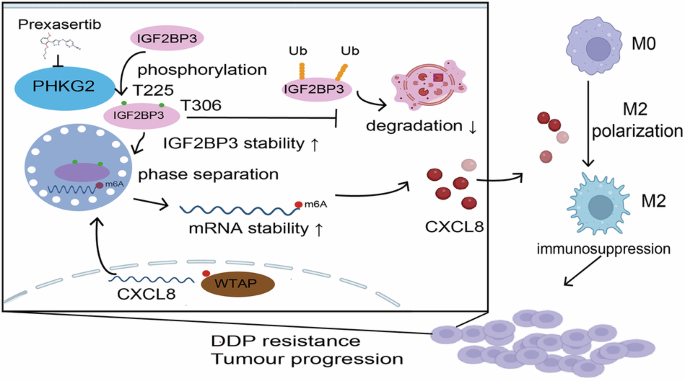
Cisplatin (DDP)-based chemotherapy serves as a foundational cornerstone in the clinical management of esophageal squamous cell carcinoma (ESCC). However, intrinsic or acquired resistance to DDP persists as a significant clinical challenge, severely undermining therapeutic efficacy and contributing to unfavorable patient prognoses. Through functional screening with a CRISPR/Cas9 knockout library, transcriptomic profiling of cisplatin-resistant cell lines and clinical specimens, and in vitro/in vivo validation assays, we identified PHKG2 as a key mediator of cisplatin resistance in ESCC. Mechanistically, PHKG2-mediated cisplatin resistance is driven by the phosphorylation of IGF2BP3 at residues T225 and T306. This post-translational modification enhances IGF2BP3 phase separation, thereby stabilizing CXCL8 mRNA in an m6A-dependent manner. Furthermore, increased CXCL8 secretion by ESCC cells induces the polarization of M0 macrophages toward an M2 phenotype within the tumor immune microenvironment, which subsequently suppresses the cytotoxicity of CD8⁺ T cells and fosters an immunosuppressive microenvironment in ESCC. Significantly, pharmacological inhibition of PHKG2 using prexasertib notably curtails ESCC cell proliferation and enhances cisplatin sensitivity. This study underscores the promising potential of targeting PHKG2 as a therapeutic approach to overcome cisplatin resistance in ESCC.
The alternative text for this image may have been generated using AI.
